


Visitor drought at Tk 120 million museum

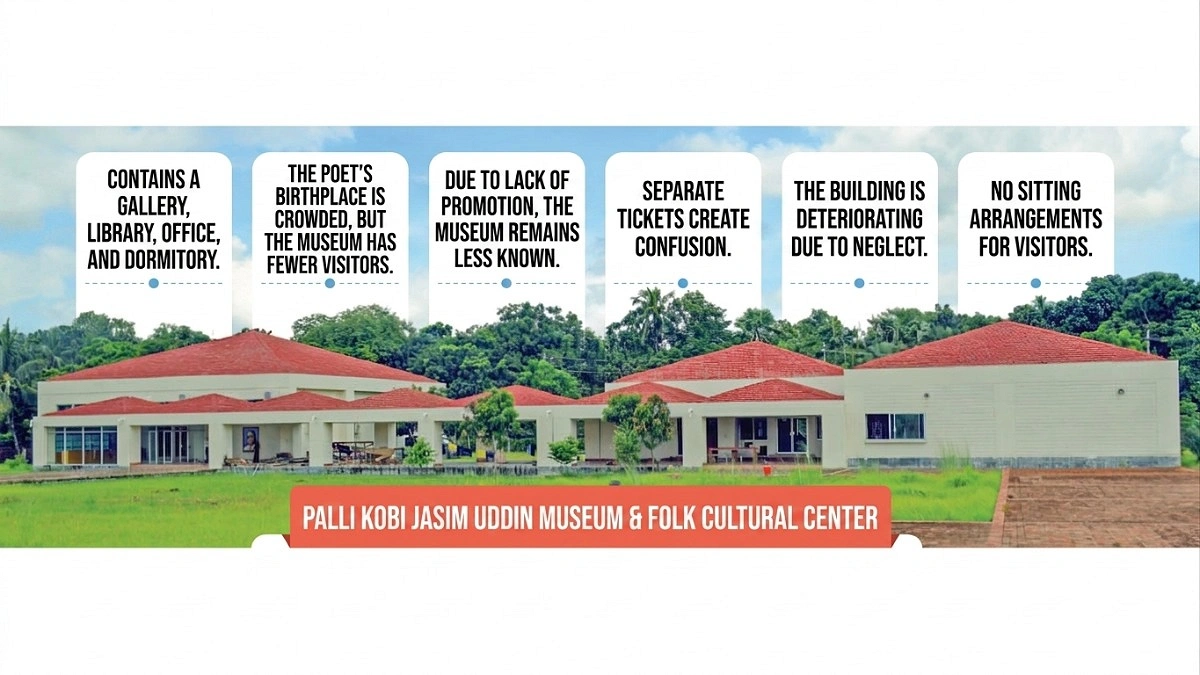
Graphics: Agamir Somoy
Just two kilometers north of Faridpur city lies Gobindapur village in Ambikapur. On the bank of the Kumar River is the ancestral home of rural poet Jasim Uddin. People from different parts of the country visit the poet’s home every day. However, many of them do not know about the Palli Kabi Jasim Uddin Museum and Folk Cultural Center built next to the house at a cost of nearly Tk 120 million.
The situation becomes most evident on the weekly holidays. Visitors crowd Jasim Uddin’s ancestral home every Friday and Saturday. Visitors are coming but a large portion of them do not make it to the museum. Those concerned mainly blame the lack of publicity and complications in the ticketing system.
The Palli Kabi Jasim Uddin Museum and Folk Cultural Center is a branch of the National Museum under the Ministry of Cultural Affairs. The museum project was taken up in 2006. Construction was completed in 2014. Although it was inaugurated on March 29, 2017, it was opened to visitors on December 9 of that year. Built on four acres of land, the museum has gallery, office, library and dormitory buildings. There is also an open stage on the southeast side.
Locals say the museum and folk cultural center is architecturally attractive. Its interior is also well maintained. The museum was established to preserve various memorabilia related to the poet’s life and literary works. It has the potential to easily attract visitors. However, there is a significant gap between that potential and the current reality. Due to inadequate supervision and publicity, the facility is gradually losing its appeal.
The problem is not limited to the shortage of visitors. There are also maintenance issues at the facility. There are not enough seating arrangements for visitors. There is also no adequate drinking water facility. As there is no gardener, weeds have accumulated in different parts of the garden. Dampness and salt deposits have appeared in various places on the building walls. In some places, the paint is also peeling off.
Visitors complain that they are not informed about the museum next to Jasim Uddin’s ancestral home when they come to visit it. A visitor named Rakib Hasan said they first went to see the poet’s house. They did not know that the museum was located next to the house. Although they bought tickets to enter the house, no one concerned informed them about the museum.
Rakib’s experience highlights another aspect of the problem. The two institutions located next to each other have separate ticketing systems. Many visitors first pay Tk 20 for a ticket to enter the poet’s original ancestral home. When they are then required to buy another ticket for the museum next door, many lose interest.
Rupok who came from Darshana also believes that publicity for the museum needs to be increased. In his words, it is unfortunate that people do not have the opportunity to know about a museum built at a cost of so many crores of taka.
The regret is not limited to visitors from other districts. Local people also share the concern. Setu Akter is from Faridpur but lives in Dhaka. She said, “As people of Faridpur, rural poet Jasim Uddin is our pride. Although I live in Dhaka because of work, I visit the poet’s house whenever I get the opportunity. However, the difference in the management of the house and the museum disappoints me.”
In her view, the poet’s family has arranged for visitors to see the inside of the house on its own initiative. The government built the museum. However, due to a lack of publicity, the government museum seems to have remained hidden from public attention.
The museum authorities largely agree with these complaints from visitors. Mukesh Chandra Roy, in charge of the Jasim Uddin Museum, said, “As there are two facilities next to each other, visitors become confused. After buying a ticket to enter the poet’s house, many do not want to buy a separate ticket for the museum. As a result, the number of visitors to the museum decreases.”
He also acknowledged the lack of publicity.
However, the authorities said initiatives are being taken to resolve the problem. Mukesh Chandra Roy said the National Museum is working to increase publicity. He said that increased publicity would help highlight the importance of the museum to visitors.


