


A Story of Transformation
How Fruit Bags Are Changing Mango Farming

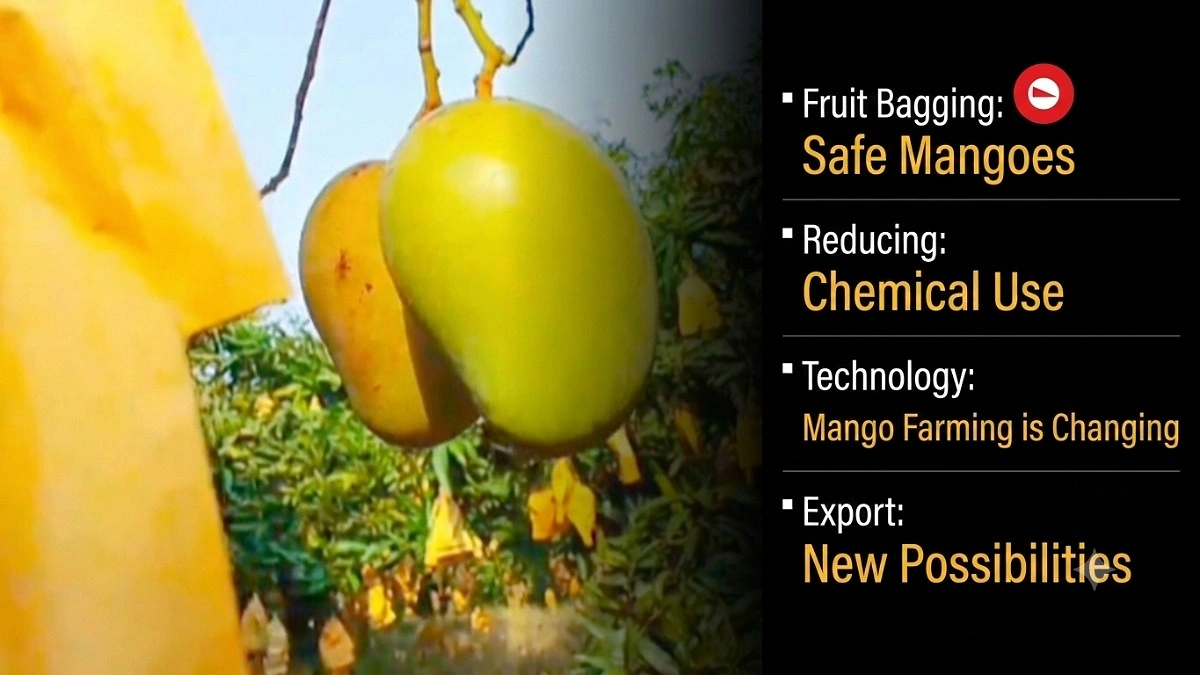
Graphics: Agamir Somoy
Every mango tells a story of care. From the first blossoms to the harvest of ripe fruit, growers nurture the crop at every stage. Today, technology has joined that care, helping farmers in Chapainawabganj produce safe mangoes. Alongside taste, equal importance is now being placed on consumer trust and food safety.
Concerns over the excessive use of chemical fertilizers and pesticides are gradually easing. With farmers taking the initiative and institutions providing support, positive changes are becoming visible in the fields. Confidence is growing, and new market opportunities are emerging.
A visit to Sobhannagar in Rohanpur reveals a clear picture of that transformation. Farmers here now cultivate mangoes with far greater awareness and planning than before.
Mango grower Md. Moin Uddin, who has been involved in safe mango production for the past seven to eight years, stands as a living example of this change. From flowering to maturity, he pays close attention to every stage of cultivation. Once the fruit reaches maturity, he applies the fruit-bagging method. The technique is used particularly for the Rupali variety of mangoes.
Speaking at his orchard in Sobhannagar on Wednesday, Moyen Uddin said, “We used to spray each mango six to seven times. Now, because of fruit bags, we no longer need to do that. The mangoes remain free from toxic contamination. They are also protected from various pests and diseases, including attacks by fruit flies.”
According to him, fruit bagging also reduces the risk of anthracnose disease. The bags shield the fruit from storms, rain, and other adverse weather conditions. By the time the mangoes are harvested, they stand out from conventionally grown fruit in terms of color, taste, and overall quality.
The method is also economically beneficial. A fruit bag costs between Tk 4 and Tk 4.50, while labor costs add about Tk 1, bringing the total expense to around Tk 5 per bag. However, each bag can be reused two to three times. Demand for these safe mangoes is high, and they command better prices. In local markets, they sell for Tk 100 to Tk 120 per kilogram, compared with Tk 70 to Tk 80 for conventionally produced mangoes.
Moyen Uddin said it costs around Tk 150,000 to cultivate mangoes on one bigha of land. After covering all expenses, he earns an average profit of about Tk 50,000.
Meanwhile, managing eight bighas of land requires around 15 workers, creating employment opportunities within the local community.
Moyen Uddin is not alone. This reporter spoke with several other mango growers in Sobhannagar, Rohanpur, all of whom said fruit bagging had transformed their fortunes. A major driver behind this change is the Sustainable Microenterprise and Resilient Transformation (SMART) Project. With support from the Palli Karma-Sahayak Foundation (PKSF), farmers and entrepreneurs receive training in good agricultural practices. The program also promotes resource-efficient and cleaner production methods. As a result, it emphasizes proper pesticide use, balanced fertilizer application, and hygienic processing techniques.
After returning to the capital from the mango-growing region, this reporter spoke with Md. Fazlul Kader, Managing Director of PKSF. He said, “People are increasingly demanding food that is free from harmful chemicals. Consumers want safe food, but credibility is the most important factor.”
He said safe production alone is not enough; reliable certification is also necessary to prove it. “Consumers should be able to easily access information about where and how the mangoes were produced. Safe food production is now a necessity. We are training farmers so they can meet international standards. This is creating new opportunities not only in the domestic market but also for exports.”
The SMART Project is also exploring new approaches to reduce dependence on chemicals. It is promoting environmentally friendly pest repellents as an alternative to pesticides. Their scent drives harmful insects away. The project is also using pheromone traps to attract and capture male insects, reducing breeding and helping protect orchards. These practices are creating examples of sustainable cultivation.
As demand for safe mangoes grows, so does the risk of misinformation. Many producers claim they, too, are growing safe mangoes. To address this challenge, the SMART Project is working on solutions. It plans to introduce blockchain technology in the future, providing consumers with a tool to verify whether a mango is genuinely safe.
PKSF officials believe that if these initiatives are fully implemented, market transparency will improve, consumer confidence will strengthen, and a solid foundation for a safe food system will emerge. Such practices could help Chapainawabganj’s mangoes secure a stronger position in international markets, boost exports, and ensure fair prices for farmers.
According to PKSF officials, the positive impact is already becoming visible. Consumer confidence in safe mangoes is increasing, and many buyers are willing to pay a premium once they are assured of the fruit’s safety.


