
Prices Rise, Incomes Stagnate
- It is a struggle for low-income people like us to cover monthly expenses

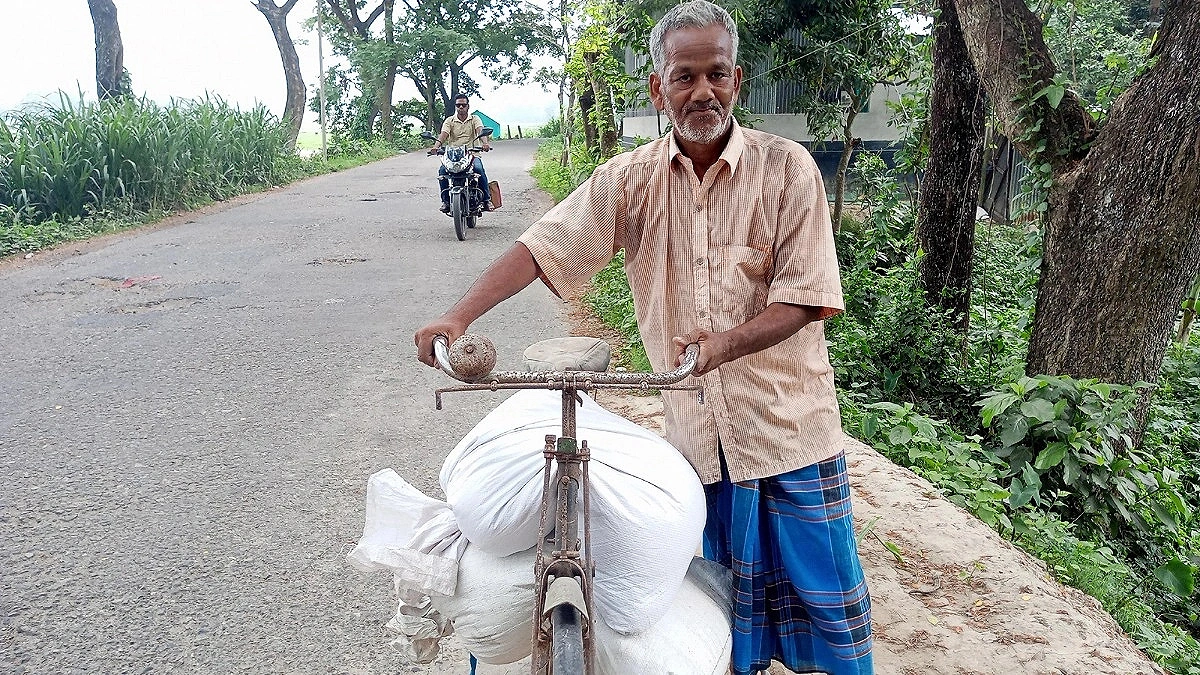
Farmer Ganesh Chandra Sarkar returns home with husked rice on his bicycle from a rice mill to meet his family's needs. Agamir Somoy.
The recent surge in fuel prices has triggered a domino effect, driving up bus fares, transportation costs, and the prices of all essential commodities. However, income of general public has not increased at the same pace. A significant gap is widening between earnings and expenditures, particularly for the lower and middle-class residents of rural areas. An analysis of local market rates, agricultural production costs, and daily wages reveals a grim picture of their incumbent reality.
Sanchoy Rajbongshi (24), who has worked as a blacksmith in Manikganj’s Ghior market for eight years, told Agamir Somoy about his struggle: "I earn 500 to 700 taka a day—sometimes a bit more. That brings in about 15,000 to 20,000 taka a month. But every bit of it goes into household expenses.

I charge 200 to 250 taka to make a new sickle and 50 taka to sharpen an old one. It is very difficult for low-income people like us to make ends meet. On top of that, the price of everything keeps rising. I live with my parents; I haven't married yet. If I do, the expenses will only go up. We have dreams, but not the means."
In the local markets of rural Manikganj, the prices of rice, pulses, vegetables, and furniture have risen by 30% to 40% over the past year. Seasonally, vegetable prices have more than doubled. This has significantly increased the monthly expenditure for families, while incomes remain stagnant. Rural low-income earners are now struggling more than urban dwellers to stay afloat.
Simultaneously, the cost of agricultural production for the Rabi and Kharif-1 seasons is climbing. The prices of fertilizer, seeds, pesticides, irrigation, and labor have all increased. Since the market price for crops has not risen accordingly, farmers are being deprived of fair profits. This growing frustration is causing many to lose interest in farming.
Sumon Hossain, a farmer from Zhitka Poddar Bari village in Harirampur, said: "Last year, onion prices were good, and we made a profit. But this time, there is no (good) price for onions, even though it cost me 40,000 to 50,000 taka to cultivate one bigha of land. Despite a bumper harvest due to favorable weather, I am living in fear of losses. I sold one maund (approx. 37.32kg) of early-harvest onions for only 700 to 800 taka in the wholesale market. Currently, I am selling seasonal onions for 1,200 to 1,400 taka per maund. If prices stay this low, many will quit the farming. I urge the administration to ensure fair prices for farmers because when the farmer thrives, the country's economy thrives."
Ganesh Chandra Sarkar, a resident of Bariakhora Union in Ghior, shared a similar sentiment: "I work as a laborer alongside farming. I earn 400 to 600 taka a day. There won't be much profit in agriculture this year because production costs are too high. My eldest son is studying for his Honors at Government Debendra College. I manage the household expenses with my meager income with great difficulty, but I cannot express my pain to anyone."
Ganesh has a horse. He said: "A horse's daily food costs between 400 and 500 taka. On top of that, there are my own expenses, my children’s education costs, and medical bills if a family member falls ill. At the end of the month, the expenses far outweigh the income."
According to local farmers, they sell their produces such as vegetables in the wholesale markets by the palla (5kg) or maund at very low prices. Yet, when we go to the local retail markets, we have to buy those same vegetables at much higher prices. The question is: who is making these massive profits by fooling the farmers?"
Touhid Mia, a rickshaw puller of Panch Baroil village in Manikganj Sadar Upazila, said, "By pulling a rickshaw in the village all day, I earn 400 to 500 taka. Meanwhile, many in the city earn 600 to 800 taka, or even a thousand. Whatever I earn in the village is almost entirely spent the moment I step into the market."

There is also a significant disparity in daily wages between rural and urban areas. While a rural day laborer earns 500 to 700 taka daily, an urban laborer earns 800 to 1,000 taka or more. Although the cost of living in the city is higher than in the village, laborers claim that even these wages are becoming insufficient to cover basic life necessities.
Shah Alam (52), a farmer from Kusta village in Ghior Upazila, said, "This year, I have a Boro rice project spanning 250 bighas of land. However, I am not getting enough diesel due to the fuel crisis. My project requires 30 to 40 liters of diesel daily for irrigation. Diesel, which should cost 115 taka, is being sold for 140 taka in the local market. This will drive up the production cost of rice. On the other hand, despite having a BADC (Bangladesh Agricultural Development Corporation) irrigation project, electricity is only available for 3 to 4 hours a day. Due to frequent load shedding, I cannot water the fields properly. The rice is currently at the heading stage; if I can't provide enough water now, the grains will turn out empty. I have already spent 250,000 taka so far."
In his view, "If this continues, the future dreams of farmers will be destroyed. Each bigha yields about 20 to 25 maunds of rice. It will cost 1,100 taka to produce a single maund of rice. If we don't get a good market price at the time of sale, farmers will have no choice but to perish. Therefore, the fair price of agricultural products must be ensured first."
Jahangir Alam Biswas, General Secretary of Shujan (Citizens for Good Governance) Manikganj branch and President of the Manikganj Press Club, stated that income opportunities for rural people are far more limited than those living in the urban areas. While cities offer more earning potential, the cost of living there is significantly higher. In contrast, while rural living costs are somewhat lower, the agriculture-dependent economy lacks alternative employment opportunities, leading to a decline in rural living standards. He emphasized that to truly understand the disparity between rural and urban life, one must go to the grassroots. Policymaking should not happen in isolation; leaders must listen to the common people and gain practical experience. He stressed the need for a clear message on eliminating discrimination, ensuring fair wages for labor, and the equitable distribution of facilities.
Md. Abdus Salam Badal, President of the Manikganj Chamber of Commerce and Industry and General Secretary of the District Krishak Dal, told Agamir Somoy that the global economic situation is becoming increasingly unstable. Recent conflicts in the Middle East have impacted Bangladesh, as rising fuel prices in the international market have driven up domestic costs. According to him, there is no control over soaring commodity prices, which change within very short intervals. This affects not only the lower and middle classes but also small and medium-sized entrepreneurs. From day laborers to the wealthy, everyone is feeling the pressure.
"After the departure of the autocracy, the BNP formed the government through a popular mandate. In line with the election manifesto, the current Prime Minister, Tarique Rahman, is adopting various plans to revitalize the economy. Prioritizing agriculture, the government has already begun distributing 'Krishi Cards' (Agriculture Cards) for farmers and 'Family Cards' for low-income households. If agricultural production is sufficiently increased, dependence on imports will decrease. To boost production and reduce irrigation costs, a nationwide canal-excavation program is underway to build a modern, agriculture-based economy. Increased production will naturally stabilize market supply and prices. Reducing import dependency will bring positive changes to the national economy."
Shahjahan Siraj, Deputy Director of the Manikganj Department of Agricultural Extension, said Manikganj is renowned as the "kitchen" of the capital. As one of the country's major agricultural districts, farmers across its seven upazilas produce various crops, including vegetables, rice, jute, maize, onions, potatoes, peanuts, mustard, and chilies. The demand for vegetables grown here is exceptionally high in Dhaka and surrounding districts.

He explained that the total cultivable land in the district is 99,576 hectares. However, over the past few years, cultivable land has decreased by 70 to 80 hectares due to several factors. These include labor shortages, rising wages, the sale of topsoil to brick kilns, the conversion of farmland for fish farming, industrialization, housing construction, and a lack of interest among the new generation in labor-intensive farming. As cultivable land shrinks and the population grows, maintaining food security remains a challenge, though the Ministry of Agriculture and the Department of Agricultural Extension are working tirelessly to address these issues.
