Paddy market struggles without basic infrastructure

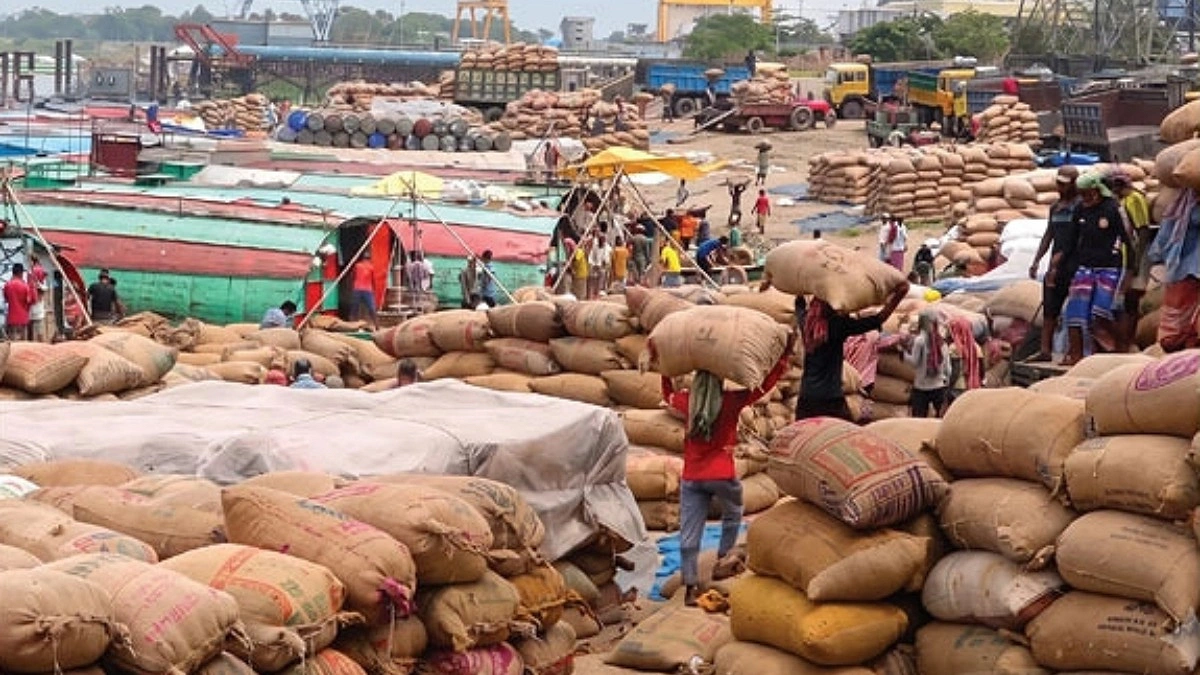
Photo: Agamir Somoy
VOC Ghat paddy market in Ashuganj, Brahmanbaria, one of the largest paddy markets in the eastern region and a vital lifeline for the region’s agricultural economy, still lacks the necessary infrastructure.
Around 1,00,000 maunds of paddy are traded daily at this market on the banks of the Meghna River. The commercial scale of the market highlights its importance, as paddy from at least seven districts in the Haor region, including Brahmanbaria.
Traders transport paddy via waterways from various Haor areas in Kishoreganj (Nikli, Mithamoin, Itna), Sunamganj, and Netrokona. A major market for BR28, BR29, and coarse varieties of paddy has developed here.
This steady flow of grain has created a massive economic sphere, supporting around 250 rice mills in the Brahmanbaria district alone. These mills supply at least Tk 10 crore worth of rice to various parts of the country every day.
Suffering amidst lack of facilities
Locals said the market has generated employment for thousands of people across sectors such as loading and unloading, transportation, rice mills, warehousing, and retail trade.
However, traders and laborers complained that despite its size, the market lacks a modern jetty. This leads to daily hardships during the loading and unloading of paddy from boats.
Without the ability to safely moor boats during the monsoon or stormy weather, there is a constant risk of paddy being damaged, and traders are often forced to wait for hours on the river during adverse weather conditions.
The lack of a jetty is not the only issue; a humanitarian crisis also persists. Workers who bring paddy from the Haor regions often have to stay in Ashuganj for several days to complete their sales.
With no accommodation available, they are forced to spend their nights on boats. The lack of food facilities and proper sanitation remains a source of regular suffering.
Ramzan Mia, a paddy trader from Nikli, said, “We bring thousands of maunds of paddy here to sell. But there are not even minimal facilities.”
He emphasized the urgent need for the government to construct a jetty and provide accommodation for traders. Laborers face similar struggles; despite hundreds working daily, there are no rest areas or hygienic environments for them.
After a day of grueling physical labor, many must rest in open spaces or on boats.
Locals, including Golam Hossain Epti, believed that ensuring a modern rest area, pure water supply, and improved sanitation would significantly reduce the suffering of workers. He noted that building a sufficient jetty and necessary infrastructure would allow the market to expand further, easing transportation and boosting the local economy.
According to him, developing Ashuganj into a planned agricultural trade center would enable it to play a major role in the national economy.
Ashuganj Upazila Nirbahi Officer (UNO) Raffey Mohammad Chhrha said, “Initiatives will be taken to build necessary infrastructure for market expansion and to resolve the suffering of workers and traders.”
He added that effective measures would be taken to solve the problems after discussions with the business community.