

Mosquitoes: Budget rises for larviciding, but so multiply dengue patients

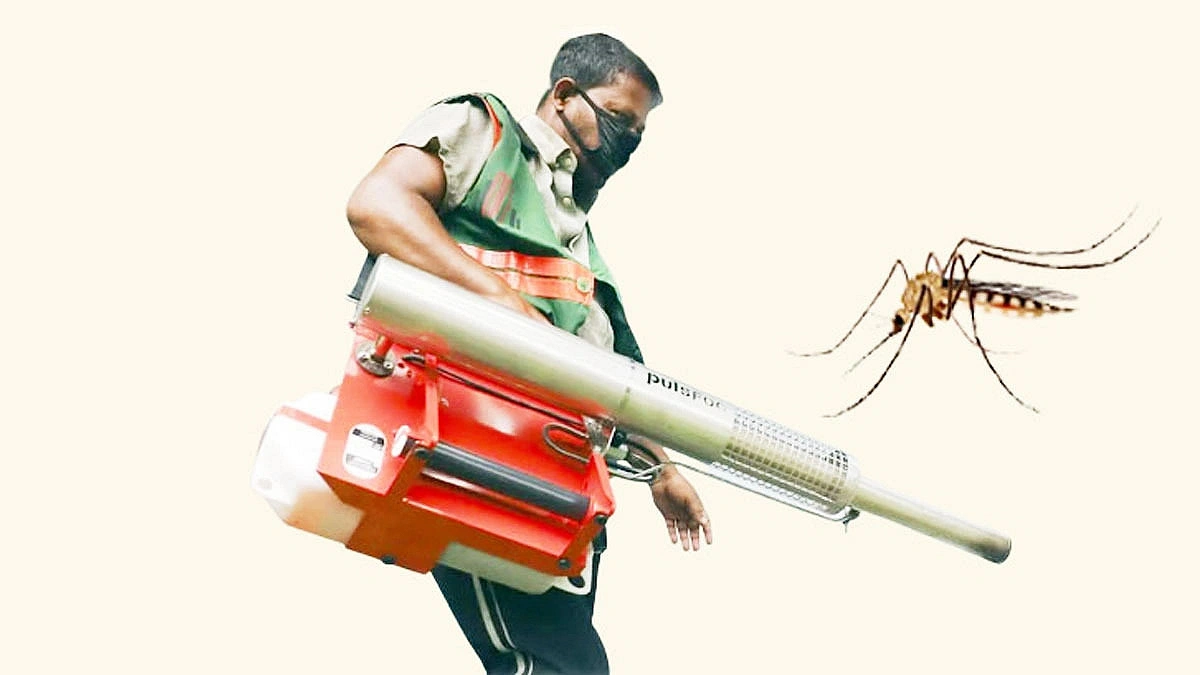
Graphics: Agamir Somoy
While the new government is busy with multifaceted burdens over national reconstruction, the old terror of dengue is settling back on the shoulders of city dwellers. Deep concerns have arisen over whether this familiar 'enemy,' which has persisted for years, will take an even more terrifying form this time. Over the last 10 years, Dhaka's two city corporations have increased their budgets for dengue control nearly tenfold. Yet, during these same years, dengue deaths have also risen.
An analysis of Dhaka's statistics over the past few years reveals an abnormal and alarming picture. The budgets of the two city corporations for mosquito control are being raised by tens of millions of taka every year. Huge sums have been spent on buying fogging machines, importing modern insecticides, and using drones. But the reality is, as the budget has increased, so has the death toll from dengue.
In fiscal year 2020-21, the allocation for mosquito control activities was Tk 69.87 crore. Of this, Dhaka North City Corporation (DNCC) had Tk 50.50 crore and Dhaka South City Corporation (DSCC) had Tk 19.37 crore. In contrast, in fiscal year 2015-16, the budget for DNCC was Tk 12 crore and for DSCC was Tk 12.50 crore. By that calculation, within five years after 2015, the budget for mosquito control had more than tripled. On the other hand, for fiscal year 2025-26, DNCC's budget for mosquito control is Tk 182.50 crore, while DSCC's is Tk 46.50 crore. The total budget for both cities stands at Tk 229 crore—roughly 10 times that of fiscal year 2015-16. Despite this massive expenditure, city dwellers remain anxious as mosquitoes have not decreased.
Until 2018, despite lower budgets, effective field-level work kept deaths nominal or at zero. Yet, in 2023-2024, when the combined budget of the two city corporations for mosquito control crossed hundreds of crores of taka, the opposite happened: a record 1,705 people died in 2023 due to dengue, and a huge number of lives were also lost in 2024.
According to public health experts, merely increasing the budget or using eye-catching imported technology fails to control dengue.
Public health expert Dr. Be-Nazir Ahmed spoke about the future, stating that the Aedes mosquito species is different. As a result, it is not possible to reduce Aedes solely through mosquito control programs. The expert advised paying more attention to destroying larvae and breeding grounds rather than just targeting adult mosquitoes.
Three Surveys on Dengue This Year: This year, two surveys related to dengue have been conducted by Dhaka's two city corporations. In addition, another survey was conducted led by entomologist Dr. Kabirul Bashar, a professor in the Department of Zoology at Jahangirnagar University. These surveys found a higher presence of Aedes mosquito larvae in Dhaka compared to other years. In other years, the Breteau Index stood at 10; this year, it is above 30. The Breteau Index is used to calculate the presence of Aedes larvae. Accordingly, the presence of larvae has increased threefold this year.
Survey Findings and the Way Forward
The survey found that in 27 out of 75 wards of Dhaka South City, the average Breteau Index for mosquito larvae exceeded 20—which is identified as extremely high-risk for dengue transmission. On the other hand, in Dhaka North City Corporation areas, larvae concentration in drains, flower pots, plastic containers, coconut shells, and building basements was found to be above the permissible limit.
The 'Magic' That Controlled Dengue in Dhaka 25 Years Ago: The first major dengue outbreak in the country began around 2000. That year, 5,551 people were infected and 93 died, delivering a major shock to the country's public health system. In response, the first elected mayor of the then-undivided Dhaka City Corporation, Mohammad Hanif, took action. He involved the city corporation in a Japanese dengue control project. Under this agreement, a team of over 100 members was formed led by researcher Wagatsuma Yukiko. One of its members was Kabirul Bashar, now a professor in the Department of Zoology at Jahangirnagar University and an entomologist. He told Agamir Samay that the core "magic" behind keeping dengue under control during that time was regular and proper destruction of breeding grounds along with larvae, virus identification, and surveillance. This agreement with Japan lasted for two years. After that, dengue remained under control for nearly two decades until the situation suddenly turned dire in 2019. Since then, the dengue situation has become progressively more lethal each year.
To keep pace with urban expansion, Dhaka City Corporation was split in 2011 into two corporations—Dhaka North and Dhaka South. The undivided Dhaka City Corporation spent a total of Tk 321 crore on mosquito control. In contrast, the two separate city corporations have spent over Tk 1,000 crore combined on mosquito control up to fiscal year 2025-26. However, over this long period, Dhaka has seen little success in mosquito control. But why?
DNCC's Chief Health Officer, Brigadier General Imrul Qayes Chowdhury, referring to the Aedes mosquito as an "elite" mosquito, shared a summary of a recent program. He told Agamir Somoy that under the presence of Local Government Minister Mir Shah Alam, a three-day mosquito control drive was conducted in the Gulshan, Banani, and Mirpur areas. There, 60% of households were found to have mosquito larvae—a dangerous situation. Stating that there is no point in talking about the "good old days" of dengue control, he outlined details of a special three-month program from mid-June to mid-September.
Meanwhile, DSCC's Chief Health Officer, Dr. Jahane Ferdous Binte Rahman, stated that 10 committees have been formed across 10 zones in South City for dengue eradication. These will work on public awareness. Additionally, crash programs have been conducted throughout the week in high-risk wards. She also mentioned programs involving students in various schools.
However, despite all these efforts, experts say that relying solely on city corporation insecticide spraying makes it impossible to become dengue-free. As long as social participation is not ensured, the Aedes mosquito cannot be destroyed. They also believe that citizens must take personal responsibility to keep rooftop gardens and courtyards clean, while the city corporations need to adopt scientific planning.