

Bangladesh records highest Dengue mortality rate globally

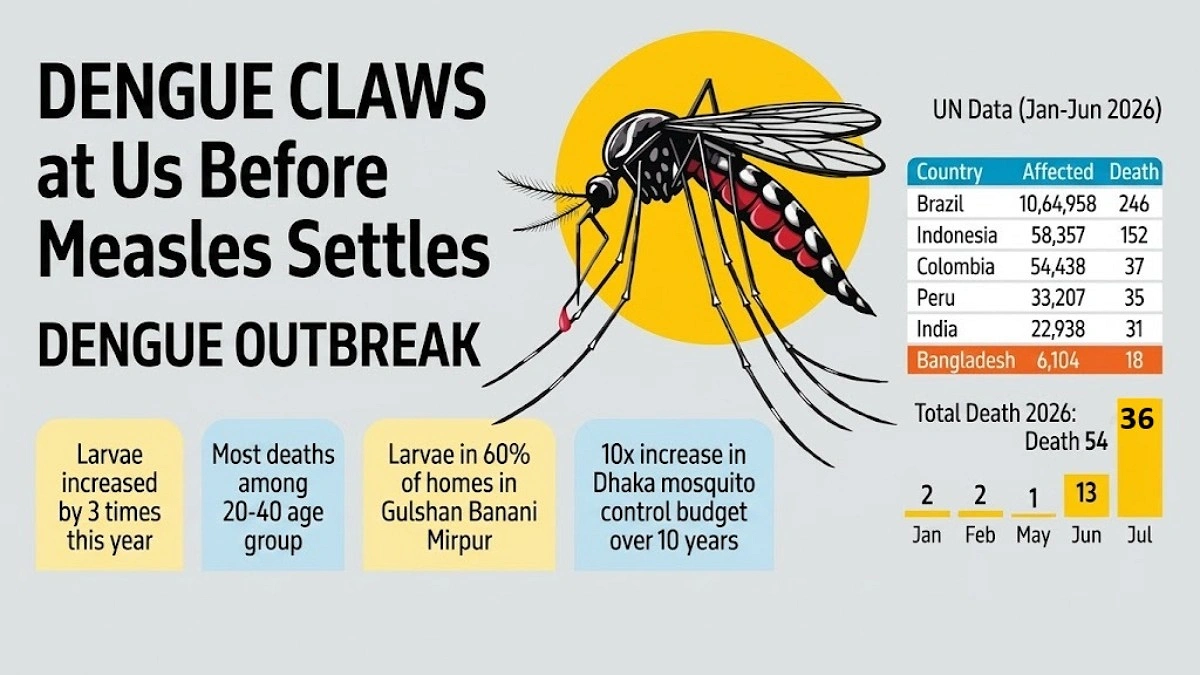
Graphics: Agamir Somoy
Dengue is spreading faster in this rainy weather, posing a massive threat to populations already battered by measles outbreak.
Though many have recovered from measles, the lingering “immunity amnesia” it leaves behind - destroying existing defenses for two to three years - makes survivors dangerously vulnerable to the virus.
This dual threat, combined with the emergence of new dengue “serotypes,” is leading to an increasing number of deaths. Deficiencies in the national healthcare system are further driving the upward trend in mortality.
Highest mortality rate in Bangladesh
According to World Health Organization (WHO), while the number of infected individuals is much higher in the United States or Brazil, Bangladesh has surpassed them all in the mortality rate, ranking highest in South Asia.
In 2026. out of 15,153 infected individuals, 53 have died, with 13 deaths in June and 35 in July.
Sri Lanka recorded 76,000 cases during the same period but only 57 deaths. According to the WHO South-East Asia health bulletin, the mortality rate in Bangladesh is 0.49 percent, while it is 0.08 percent in India, 0.06 percent in Sri Lanka, and 0.05 percent in Pakistan.
Several health reports have highlighted that Bangladesh’s dengue mortality rate is the highest in the world. A WHO report published on 29 July noted that 81 percent of total global dengue cases occurred in the US, yet their mortality rate is one-tenth of Bangladesh’s.
Brazil’s mortality rate is one-twelfth of Bangladesh’s, despite a much higher number of infections.
Public health expert Mushtuq Husain, former chief scientific officer of the Institute of Epidemiology, Disease Control and Research (IEDCR), said, “Dengue control is not possible through seasonal programs without destroying mosquito sources year-round. On the contrary, the entire country is now at severe risk of dengue. The number of infections and deaths is rising.”
He added that mortality rates for all diseases are relatively higher in Bangladesh due to the nature of the healthcare system, and specifically for dengue, Bangladesh leads the world. The change in dengue serotypes and a lack of secondary-level healthcare facilities are also contributing to the rising death toll.
Public Health Expert and Special Assistant (Health) to the Prime Minister Ziauddin Hyder attributed the high mortality rate to high population density, coastal weather conducive to mosquito breeding, rooftop gardens, malnutrition, and the healthcare-seeking behavior of citizens.
Rising cases outside Dhaka
Mosquito larvae presence is many times higher outside Dhaka, yet eradication campaigns are comparatively fewer.
Government data showed that since 2022, the number of patients outside Dhaka has been increasing. In 2021, 89 percent of patients were identified in Dhaka, but that figure dropped to 63 percent the following year.
In 2026, the infection rate in the Dhaka Division is 38 percent, though deaths remain high in the capital. In Barisal Division, the number of patients is rising significantly, reaching 3,308, followed by Chattogram and Khulna. Mymensingh reports high mortality despite fewer cases.
Kabirul Bashar, an entomologist and professor in the Zoology Department at Jahangirnagar University, said mosquito larvae presence is calculated via the Breteau Index (BI). Current levels of larvae and pupae found both inside and outside Dhaka indicate the entire country is at high risk.
He added that high concentrations of larvae are being found outside Dhaka, where control measures are even less frequent.
Expert advice not implemented
Experts expressed frustration that their recommendations for dengue control are requested but not executed.
Kabirul said, “Dengue is not being controlled according to the advice of entomologists. And because of this, no results are being achieved. Dengue control activities must be carried out with the same level of importance year-round.”
Mushtuq echoed these concerns, saying the government is not taking their advice into account. He added, “Positive change will not come unless the community is 100 percent engaged in dengue control. Wherever a patient is found, the breeding grounds of Aedes mosquitoes must be searched out and destroyed.”
Addressing these complaints, Ziauddin said, “From a theoretical standpoint, there is a gap between what should be done in any situation and what is being done in reality. They may raise this complaint from that perspective. The release from such problems can only come through public awareness and their active participation alongside the government.”