
Floodwater Remains Trapped Despite Canals, Sluice Gates

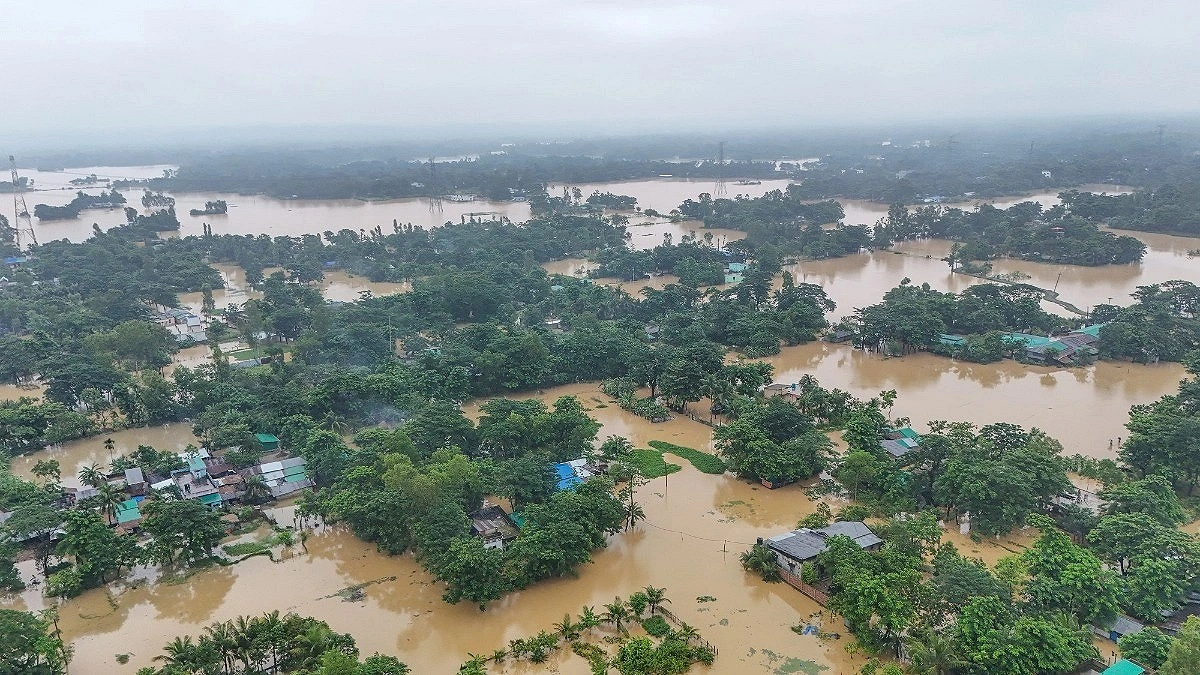
Photo: Agamir Somoy
Banshkhali upazila in Chattogram comprises 212 villages. The only drainage route for these villages is the 32-kilometer Jalkadar Canal, which runs through the middle of the upazila. A total of 246 sluice gates have been built along the canal and its connected waterways. Of them, only 89 are authorized. Local influential individuals constructed the remaining gates illegally without regard for the law. The Bangladesh Water Development Board (BWDB) has no control over these 157 unauthorized gates, which have now become a major obstacle to floodwater drainage in Banshkhali.
At the same time, many of the BWDB's authorized sluice gates have become inoperative. Influential individuals have also kept their own gates closed. With nearly all drainage routes blocked, about 400,000 residents of Banshkhali are now battling floodwaters.
Floods have destroyed homes, washed away fish farms, livestock, and poultry, and left hundreds of thousands of people homeless. Four people, including a child, have died.
The BWDB maintains 140 kilometers of embankments in Banshkhali. About 64 percent of the sluice gates along these embankments are unauthorized. Of the authorized gates, 33, or 37 percent, are inoperative. Even the gates that remain functional do not receive regular maintenance. As a result, heavy rainfall routinely causes waterlogging around the sluice gates.
An analysis of satellite imagery and field-level data shows that nearly 35.7 percent of Banshkhali's total land area is now completely submerged. At least 15,212 hectares of land, much of it cropland and residential areas, remain underwater.
Under the law, the BWDB is required to establish local water management organizations to oversee sluice gate maintenance. However, it has failed to do so. The agency also did not carry out the required repairs before the monsoon season.
BWDB Executive Engineer Dr. Tanjir Saif Ahmed said record rainfall had exceeded the capacity of the sluice gates, delaying water drainage. He said the agency plans to install additional sluice gates to improve drainage in the future.
New Gate Buried Under Soil, Old One Left Without Maintenance
The Kodala Canal flows through Gunagari in Banshkhali before joining the Jalkadar Canal. It drains water from four villages; Kokdandi, Gunagari, Chapachhari, and Ilsha. However, during a visit on Saturday afternoon, this correspondent found that only a small amount of water was flowing through the two sluice gates at the junction of the canals.
Five local residents, including Md. Bahadur, said soil had accumulated above the newly constructed sluice gate, preventing adequate water flow. Although the gate had been built, it had not been effectively connected to the main watercourse. The older adjacent gate has also remained neglected for years.
Local resident and lawyer Jahedul Islam said regulations require a management committee to maintain the gates, but no such committee exists. He added that the BWDB has also failed to repair the gate for years.
The Achhia Canal, which divides Baharchhara and Khankhanabad, begins at the coastal embankment along the Bay of Bengal before joining the Jalkadar Canal. A sluice gate stands at the canal's outlet as well. However, local businessman Mohammad Shahjahan said he had never seen the gate undergo repairs.
Kamrul Alam, a former member of Baharchhara Union Parishad, said the people of Banshkhali had remained submerged in floodwaters for nearly six days because the sluice gates were not functioning. He blamed the administration for failing to make them operational.
