
Fiscal Year 2026-27
Tk 9.38 Trillion Budget Proposed

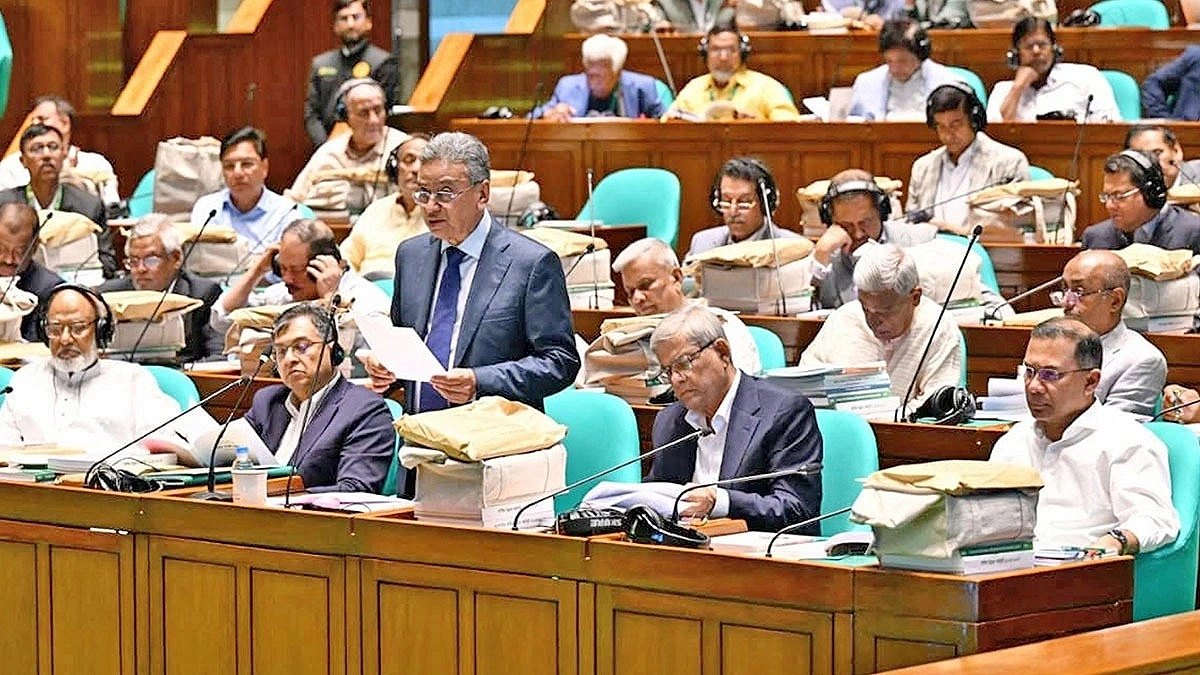
আমির খসরু- পিএমও Finance Minister Amir Khasru Mahmud Chowdhury today placed the 2026-27 budget proposal in Parliament. Photo: PMO
Following a major political shift after 15 years and the 2024 mass uprising led by students and the public, the BNP government has presented its first national budget. After coming to power through the general election on February 12, 2026, the government has placed a massive budget proposal of Tk 9.38 trillion for the 2026-27 fiscal year under the slogan ‘Journey Toward a Democratic, Humane and Inclusive Economy.’
Finance Minister Amir Khasru Mahmud Chowdhury placed the budget proposal in Parliament on Thursday.
The budget primarily aims to recover the macroeconomy from the debris of economic crisis, corruption, and widespread mismanagement under the previous government, rein in inflation, and restore order in the market system. Considering global geopolitical instability and risks arising from ongoing conflicts in the Middle East, the finance minister announced a target to reduce inflation to 7.5 percent and raise economic growth to 6.5 percent in the next fiscal year. He also outlined a concrete roadmap to transform Bangladesh into a $1 trillion economy by 2034.
Overall Expenditure Structure and Sectoral Allocation
The proposed budget prioritizes social and human development in its expenditure framework. Among the three major spending categories:
The social infrastructure sector receives the highest allocation of Tk 2,79,001 crore, accounting for 29.74 percent of the total budget.
The general services sector is allocated Tk 2,45,117 crore, representing 26.13 percent of total spending.
The physical infrastructure sector is allocated Tk 1,74,988 crore, or 18.66 percent of the total budget.
External and Domestic Financing Sources
The proposed Tk 9.38 trillion budget carries an overall deficit of Tk 2.43 trillion. To finance this gap, the government has opted to rely more on external sources rather than placing additional pressure on the banking sector, as in previous administrations.
Of the total deficit, Tk 1.16 trillion will be met from external sources, while Tk 1.27 trillion will come from domestic sources. Within domestic financing, Tk 1.12 trillion will be borrowed from the banking sector, Tk 6,000 crore less than in the outgoing fiscal year. The government has reduced borrowing from banks to keep private sector credit flows stable.
Education Sector Reforms
The government has proposed a significant restructuring of the education sector, increasing allocation by nearly Tk 50,000 crore to Tk 1.36 trillion in the next fiscal year, equivalent to 2 percent of GDP. Among the key highlights of the sector is the introduction of a mandatory third language in the curriculum alongside Bangla and English, such as Japanese, Korean, Chinese, or Arabic.
Students with proficiency in these languages will receive government-backed loans of up to Tk 1 million if they seek higher education in the respective countries. To expand female education, the government has made undergraduate (honors) education completely free for girls. Schools will also introduce a technology-based ‘one teacher, one tablet’ program, along with mid-day meals to improve nutrition.
Allocation Doubled in Health Sector
To improve healthcare services and reduce treatment costs, the government has proposed nearly doubling the health sector allocation to Tk 694.09 billion. To expand grassroots healthcare coverage, modern primary healthcare units will be established in every union and every urban ward across the country.
Under a universal health protection scheme, every citizen will receive a modern ‘e-health card.’ The government has also announced the immediate recruitment of 5,000 MBBS doctors and 100,000 new healthcare workers nationwide, 80 percent of whom will be women, to address longstanding vacancies in the sector.
Tax Hike on Tobacco Products, Stricter VAT Measures
The budget has proposed a significant increase in supplementary duties and minimum retail prices on tobacco products to boost revenue collection and reduce health risks.
The government has proposed setting the minimum price of a 10-stick cigarette pack at Tk 62 for the lowest tier and Tk 210 for the highest tier. It has also imposed a 40 percent supplementary duty on nicotine pouches and a 67 percent supplementary duty on heated tobacco products.
To expand the VAT base, the budget has proposed making VAT registration mandatory for opening any type of business bank account, with necessary legal amendments to the law. It has also proposed a 15 percent VAT on imported high-value frozen fish and aromatic plant extracts.
However, the government has extended VAT exemption on metro rail services until June 30, 2028.
In the concluding part of the budget speech, the finance minister expressed optimism, stating that the budget is not merely a statement of government income and expenditure but a foundation for building a welfare-oriented, accountable, and inequality-free Bangladesh by ensuring the proper use of taxpayers’ hard-earned money.
Sector-wise Allocation
Social
infrastructure sector: Tk 2.7901 trillion (29.74 percent of total allocation)
General services sector: Tk 2.45117 trillion (26.13 percent)
Physical infrastructure sector: Tk 1.74988 trillion (18.66 percent)
Education sector: Tk 1.36606 trillion
Health and family welfare sector: Tk 694.09 billion
Transport infrastructure sector: Tk 607.3 billion
Water resources management sector: Tk 105.33 billion
Disaster management and relief sector: Tk 103.5 billion
Women and child development sector: Tk 51.96 billion
