
Six Lakh Sacrificial Animals Ready, Uncertainty Looms Over Prices in Pabna

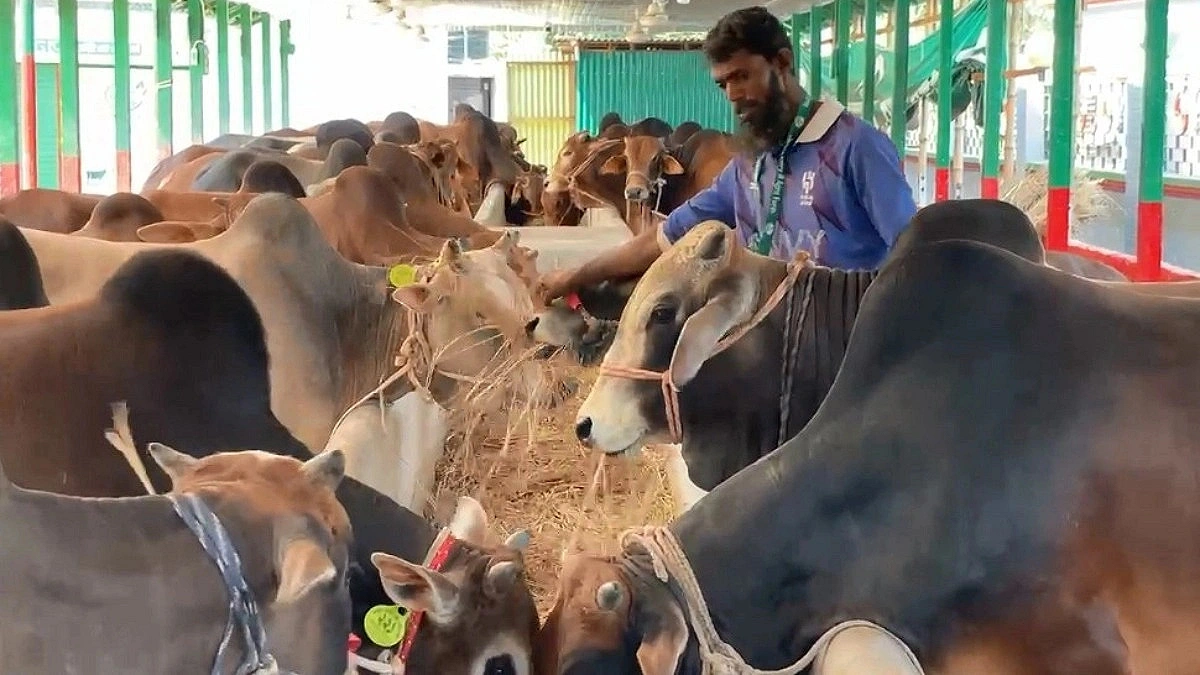
Photo: Agamir Somoy
Pabna’s cattle markets have long been famous across the country. Especially ahead of Eid-ul-Azha, farmers in the district become exceptionally busy—and this year is no different. In Bera, Santhia, Sujanagar, Sadar, Ishwardi and Chatmohar upazilas, last-minute preparations are underway in almost every household.
However, behind this abundance of livestock and intense activity, anxiety is clearly visible on farmers’ faces. On one hand, production costs have risen uncontrollably; on the other, there is uncertainty about receiving fair prices in the market. Caught between these two pressures, both marginal farmers and large farm owners are feeling helpless.
According to statistics from the District Livestock Department, the demand for sacrificial animals in Pabna this year stands at 336,572. In contrast, 653,588 animals are ready for sacrifice across 33,040 farms in the district. This includes 264,005 cattle and 379,177 goats and sheep—resulting in a surplus of nearly 316,000 animals. Livestock officials hope that after meeting local demand, this large number of animals will be supplied to major markets in Dhaka, Chattogram and other parts of the country.
The main source of farmers’ concern is the abnormal rise in the prices of cattle feed. Field visits to farms in Chatmohar and Bhangura upazilas reveal that over the past two years, the price of concentrated feed has increased by Tk 400 to Tk 1,000 per sack.
Raju Molla, a farmer and livestock trader from Choubariya village in Bhangura upazila, said that compared to last year, the prices of 40-kg sacks of wheat bran, lentil bran and anchor dal bran have risen by Tk 200 to Tk 300. Even rice husk and dry straw have gone up by as much as Tk 300 per maund.
He said, “At present, the cost per maund for raising a cow is around Tk 28,000. For those who run farms with hired labor, the cost is even higher. But in the past week, cattle prices in the market have dropped by Tk 10,000 to Tk 12,000 per maund.”
Belal Haji, a farmer from Goyeshpur area of Sadar upazila, is particularly worried about large cattle. He said he bought a 13-maund cow last year for Tk 330,000 and spent another Tk 200,000 on rearing it over the year. The cow now weighs around 20 maunds.
“So far, no buyers are quoting prices. There are fewer buyers for large cattle, even though these animals cost the most to raise. If we are forced to sell at a loss, we will be completely ruined,” Belal said.
The same concern was echoed by Abu Taleb, a farmer from the Nazirpur area. He said that while traders usually crowd farms at this time in other years, the situation is different this year. Due to reduced purchasing power, buyers are showing more interest in medium-sized cattle rather than large ones.
Another major concern for farmers is the illegal entry of cattle from India. Raju Molla said, “If Indian cattle enter the local markets illegally, local farmers will face severe losses. A whole year’s hard work will be wasted. The government must strictly monitor the borders so that Indian cattle cannot enter the markets under any circumstances.”
However, Azmat Ali, a cattle feed trader at Pabna town’s main market, offered a note of optimism. He said, “Prices of bran had increased earlier due to import problems, but supply has now normalized and prices have started to come down slightly. Hopefully, farmers will benefit from this.”
Reassuring farmers, District Livestock Officer Dr. Md. Zahurul Islam said, “We are maintaining round-the-clock communication with farmers at the field level. To protect their interests, surveillance has been increased in border areas and strict instructions have been issued to control the movement of livestock, so that no outside cattle can disrupt our markets.”
He added, “If farmers receive Tk 32,000 to Tk 34,000 per maund, they will make a profit. We are hopeful that fair prices will be ensured in the markets this year.”
