


New era in refrigerator condensers as modern technologies replace conventional copper
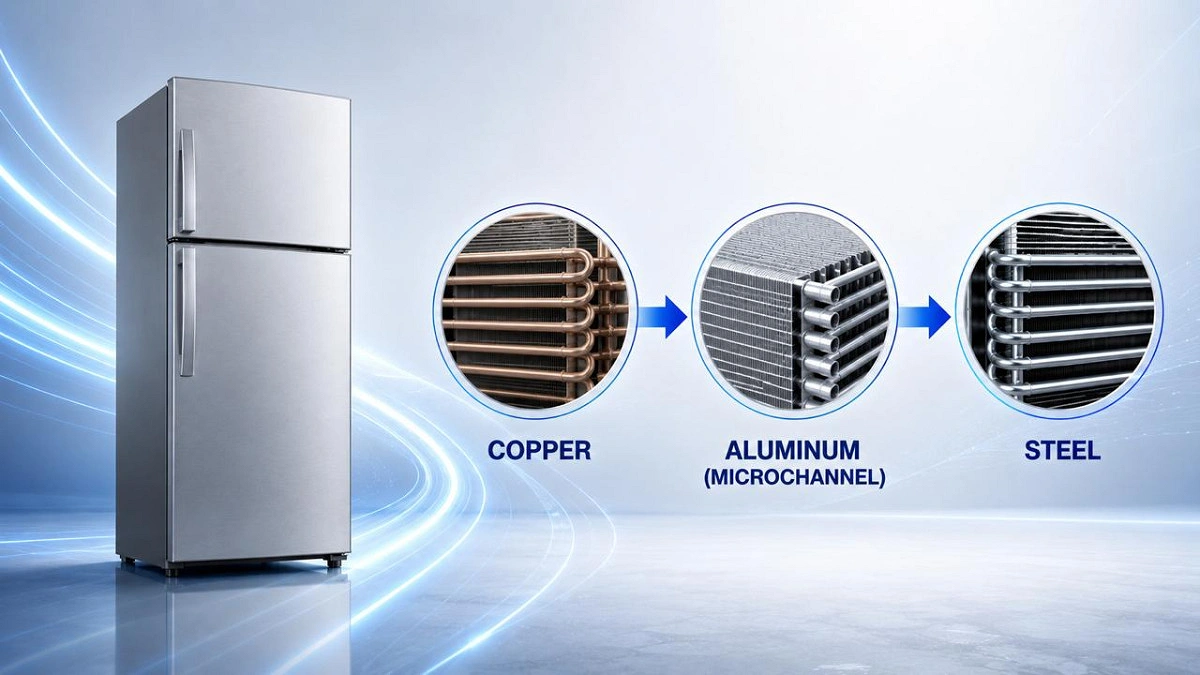
- Micro-channel heat exchanges, aluminum, ZAM-coated steel and multi-layer protection are reshaping conventional condenser design

Collected Photo
For decades, copper was one of the most widely used materials in refrigerator condensers, valued for its high thermal conductivity, corrosion resistance and ease of repair. But as refrigerator technology has evolved, so have the priorities of manufacturers.
Modern refrigerators are no longer designed around heat conductivity alone. Energy efficiency, lower refrigerant charge, reduced weight, corrosion protection, long-term reliability and lower environmental impact have all become important considerations.
Against this backdrop, aluminium, coated steel, zinc-aluminium-magnesium or ZAM-coated materials, and all-aluminium microchannel heat exchangers are increasingly being used in place of conventional copper-based designs.
Engineers say this is not merely a shift from one metal to another. It is part of a broader evolution in refrigeration technology.
Why condenser technology is changing
Copper remains an excellent conductor of heat. However, the performance of a modern refrigerator depends on much more than the base material of its condenser.
Tube geometry and thickness, surface area, fin design, airflow, refrigerant flow path and the overall configuration of the cooling system all influence how effectively heat is removed.
The introduction of next-generation compressors, improved insulation, electronic controls and environmentally friendlier refrigerants has also allowed manufacturers to optimise the complete refrigeration system rather than depend primarily on the thermal properties of a single material.
Microchannel technology brings a major shift
One of the most significant developments is the use of microchannel heat exchangers.
Instead of conventional round tubes, these systems use flat aluminium tubes containing multiple tiny internal channels through which refrigerant flows.
The design allows a relatively large heat-transfer surface to be created within a compact space, making the heat exchanger lighter and smaller while maintaining effective heat transfer. In many applications, the reduced internal volume also makes it possible to use less refrigerant.
A study published in the International Journal of Refrigeration on domestic R600a refrigerator systems found that optimisation of microchannel condenser geometry could reduce total refrigerant charge by around 14 percent.
The finding underlines an important shift in refrigeration engineering: performance increasingly depends not only on the metal being used, but also on how the heat exchanger is designed.
ZAM coating offers a new approach to corrosion protection
As manufacturers adopt steel and other alternative materials, corrosion protection becomes a key issue.
One important development is zinc-aluminium-magnesium, or ZAM, coating.
The technology applies a protective layer containing zinc, aluminium and magnesium over steel, helping shield the base material from moisture and other corrosive elements.
According to salt-spray test data published by Nippon Steel, its ZAM coating demonstrated corrosion resistance 10 to 20 times greater than conventional hot-dip zinc-coated steel.
Copper is generally more corrosion-resistant than unprotected steel, but that comparison is no longer sufficient for all modern condenser designs. Steel used in newer systems may be protected by advanced coatings such as ZAM as well as additional polymer barriers.
Copper, meanwhile, is not completely immune to corrosion. Its performance can be affected by humidity, salinity, pollution and certain chemical environments.
As a result, long-term condenser durability increasingly depends not only on the base metal, but also on the quality of its coating and protection system.
Research published in Corrosion Science has also reported improved corrosion resistance of Zn-Al-Mg coatings in sodium chloride environments.
Multi-layer protection adds another barrier
Some modern condenser designs go a step further by applying a heat-shrink polymer sleeve or additional protective layer over the metallic coating.
This multi-layer approach helps reduce direct exposure of the underlying metal to moisture, dust and salt-laden air.
As a result, durability is increasingly being assessed through a combination of base material, coating technology, protective layers and manufacturing quality rather than by material alone.
Refrigerants are reshaping system design
The shift in condenser technology is also linked to changes in refrigerants.
Many modern household refrigerators now use R600a, or isobutane, which has a relatively low global warming impact compared with older refrigerants.
Research by Oak Ridge National Laboratory and projects supported by the US Department of Energy have focused on optimising complete refrigeration cycles using R600a while reducing refrigerant charge and improving efficiency.
This means the condenser is increasingly being designed as part of an integrated, high-efficiency refrigeration system rather than as an isolated component.
From easier repair to fewer failures
Copper condensers have long been appreciated for their repairability. In certain cases, leaks can be repaired by skilled technicians.
Newer technologies, however, place greater emphasis on reducing the likelihood of failure in the first place.
Advanced manufacturing, automated production, corrosion-resistant coatings, multi-layer protection and stricter quality control are being used to extend service life and minimise maintenance requirements.
As a result, the industry is placing increasing value not only on whether a condenser can be repaired easily, but also on how rarely it needs repair.
Manufacturing and environmental advantages
Aluminium is lightweight and well suited to compact microchannel heat exchangers, while steel can be efficiently integrated into modern automated production processes.
These materials can help reduce product weight, simplify manufacturing and, in certain designs, lower the amount of refrigerant required.
As environmental considerations become more important worldwide, manufacturers are also focusing on producing durable appliances with less material, lower refrigerant charge and reduced electricity consumption.
Why it matters for Bangladesh
Bangladesh presents particularly demanding operating conditions for refrigerators because of high temperatures, year-round humidity, dust and salt-laden air in coastal regions.
These conditions can accelerate corrosion of metal components, making protection technology especially important.
ZAM coatings and additional polymer protection can help shield condenser materials from moisture and saline environments. At the same time, effective cooling in high ambient temperatures depends on the coordinated design of the condenser, compressor, refrigerant and evaporator.
For consumers in Bangladesh, therefore, condenser material alone is no longer enough to judge the quality of a refrigerator. Cooling performance in local conditions, energy use, corrosion protection and long-term reliability are also critical.
Consumer perceptions are also changing
For many consumers, a copper condenser has traditionally been seen as a sign of a good refrigerator, and that perception is rooted in copper’s established strengths.
But as technology evolves, the criteria for judging refrigerator quality are becoming broader.
Energy efficiency, cooling performance at high temperatures, corrosion protection, refrigerant type, compressor technology, warranty coverage and after-sales service are now all relevant.
The question is therefore no longer simply, “What is the condenser made of?” It is increasingly, “How efficient, durable and reliable is the entire cooling system?”
Industry moves towards next-generation refrigeration
The refrigerator industry is increasingly moving towards technologies designed to deliver lower electricity consumption, lower refrigerant charge, reduced weight, improved corrosion protection and greater long-term reliability.
Microchannel heat exchangers, aluminium, ZAM-coated steel, multi-layer corrosion protection and environmentally friendlier refrigerants such as R600a are all part of that transition.
Copper has played an important role in refrigeration for decades. But newer materials, improved heat-exchanger designs and advanced protection technologies are increasingly being adopted alongside, and in many cases in place of, conventional copper systems.
The shift, therefore, is better understood not simply as replacing copper with another metal, but as a broader move towards lighter, more efficient, corrosion-resistant and environmentally responsible refrigeration technology.

