Economy at Risk of Falling into Energy Trap

Collected Photo
Bangladesh’s economy is increasingly coming under dual pressure from volatility in the global energy market and domestic structural constraints. Rising fuel prices, a prolonged dollar shortage, and heavy import dependence are significantly affecting production, agriculture, and transport sectors. In this context, policy analysts have raised the question of whether the economy is merely absorbing temporary shocks or gradually falling into an ‘energy trap’.
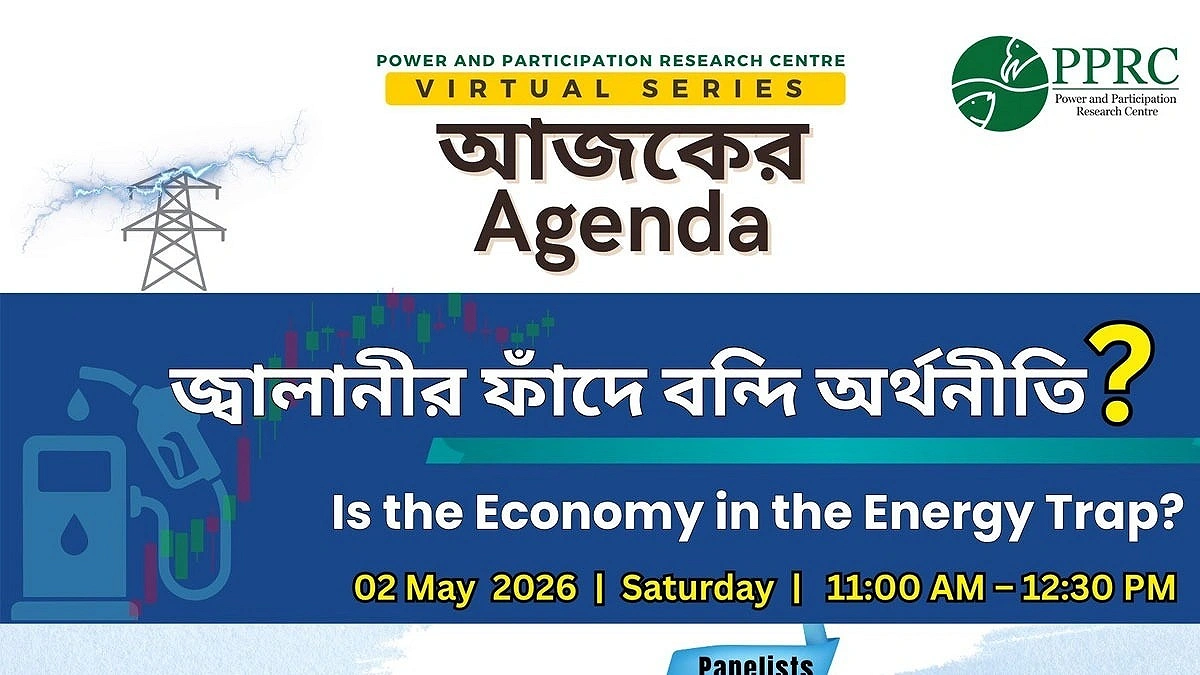
The issue was discussed in detail at a flagship webinar titled ‘Today’s Agenda: Is the Economy Trapped in Energy Dependency?’ organized by the Power and Participation Research Centre (PPRC) on Saturday. Energy, agriculture, and industry experts, business representatives, and policymakers participated in the discussion. PPRC Executive Chairman Hossain Zillur Rahman moderated the event.
Speakers said the recent energy crisis is not solely the result of supply shortages. Instead, they pointed to a combined impact of weak demand management, gaps in information and communication, and market uncertainty. An initial disruption in supply quickly turned into panic buying, sharply increasing demand in a short period. Despite measures such as rationing, hoarding behavior among consumers and small traders further complicated the situation.
A K M Zafar Ullah Khan, Chairman of Padma Oil and former Energy Secretary, said the country’s fuel storage capacity remains limited. He noted that price adjustments in line with the international market are inevitable, but ensuring uninterrupted supply remains the bigger challenge.
“Our storage capacity is not sufficient to hold additional reserves,” he said.
Agricultural economist M A Sattar Mandal said diesel demand is rising rapidly due to increased mechanization in agriculture. Around 4.2 million diesel-powered engines are currently in use in the sector, and the number is expected to grow further. He stressed that ensuring fuel supply is essential to sustain agricultural production.
Syed Mahmudul Haque, Chairman of Trade Services International, said rising global oil prices directly increase pressure on the national economy. He emphasized the need to diversify energy sources and explore new supply options.
Anwar-ul Alam Parvez, President of the Bangladesh Chamber of Industries, stressed the importance of an integrated short-, medium-, and long-term policy to ensure energy security. He recommended utilizing coal-based power plant capacity and improving gas distribution to keep industries and fertilizer production stable.
Mohammad Nazmul Haque, President of the Bangladesh Petrol Pump Owners Association, called for expanding renewable energy and drilling new gas wells. He also noted that panic-driven stockpiling during crises has further worsened the situation.
In his closing remarks, Hossain Zillur Rahman said the energy crisis should not be seen as a temporary issue. He described it as a medium-term structural challenge and warned that failure to adopt timely and effective policies could lead to repeated crises. He stressed the need to enhance energy storage capacity, improve demand forecasting, and strengthen coordinated communication strategies.
Overall, the discussion highlighted that without immediate measures alongside long-term planning and institutional coordination, the economy risks becoming truly trapped in an 'energy dependency cycle'.