
Junk 'Super Service' Buses Dominate Dhaka Roads

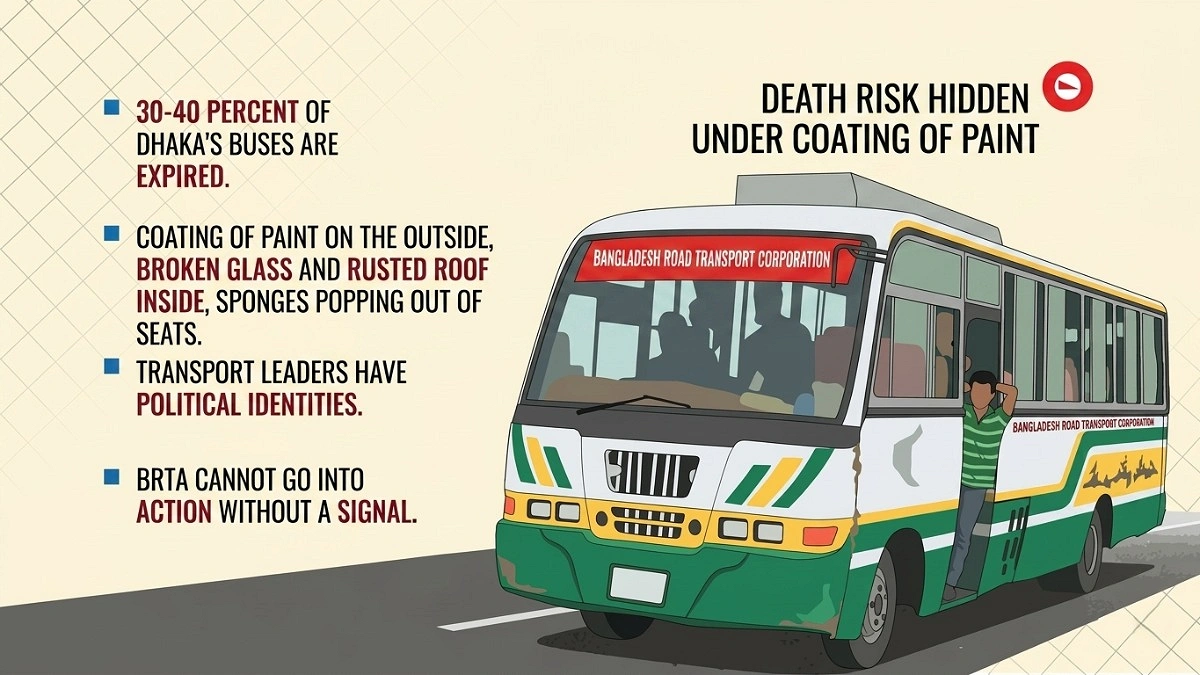
Graphics: Agamir Somoy generated by AI
A busy morning in Dhaka. Office-goers rush through Mirpur-10 intersection as a bus heading toward Motijheel suddenly brakes, shaking the entire vehicle. Its windows are missing glass, the roof sheets are rusted, and dirty foam protrudes from torn seats. Yet the bus is painted brightly, with large letters on the front reading “Super Service.” For passengers, however, it is just another outdated vehicle that should have been scrapped long ago.
Such scenes are no longer unusual in Dhaka—they have become the norm. Across Dhaka’s roads, expired, unsafe, and unfit buses continue to operate openly. Despite regulations requiring their gradual removal, these vehicles still run freely on major routes. Transport and road safety experts say this situation has emerged due to an informal understanding between the government and transport owners.
They argue that rising fuel prices over recent years once triggered frequent transport strikes demanding fare hikes. That pattern has now largely disappeared, with operators quietly accepting government-set fare adjustments. Behind this silence lies a mutual benefit: the government avoids political pressure over fare increases, while owners continue operating old buses without investing in new ones.
Under the Road Transport Act, vehicles beyond their economic lifespan are supposed to be phased out, especially in metropolitan areas. Various recommendations have also called for defining a fixed operational lifespan for public transport.
According to data from the Bangladesh Road Transport Authority (BRTA), there are more than 60,000 registered buses and minibuses in the country, with around 10,000-12,000 operating in and around Dhaka. Transport experts estimate that 30-40% of these vehicles have exceeded their lifespan or are in dangerously poor mechanical condition. Yet enforcement actions against them have become rare.
Joint drives once conducted by BRTA, police, and mobile courts to seize unfit vehicles have largely disappeared. Instead, old buses now operate freely after being repainted and rebranded with new names and stickers. At terminals such as Gabtoli, Sayedabad, Abdullahpur, Mirpur, Mohakhali, and Jatrabari, many buses are visibly dilapidated—emitting excessive smoke, with broken doors, worn tyres, and missing safety equipment such as fire extinguishers or functional emergency exits.
Transport owners defend the situation. Kazi M. Zobayer Masud, joint general secretary of the Bangladesh Road Transport Owners’ Association, said operating costs have become unsustainable. “If buses run below Tk 4.5 per kilometre, they incur losses. No one wants to invest in new buses anymore. The system is being sustained with old investments,” he said.
Studies from BUET’s Accident Research Institute show that mechanical failure is a major cause of road accidents, including brake failure, steering defects, tyre bursts, and excessive emissions that not only pollute the environment but also increase the risk of fatalities.
Every day, millions of Dhaka residents are forced to travel in such buses due to a lack of viable alternatives. Despite long-standing discussions on route rationalisation, company-based operations, and modern fleet introduction, implementation has remained slow.
When asked why the system remains unchanged, Saiful Alam, Secretary General of the Dhaka Road Transport Owners’ Association, said they had requested tax exemptions for importing electric buses and reduced charges for charging stations. “We want to import better buses and operate them ourselves,” he said.
Questions are increasingly being raised about whether BRTA is fulfilling its regulatory role or yielding to political and economic realities. As rusted, shaking, smoke-emitting buses continue to run across the capital, a pressing question remains for commuters: are these vehicles truly escaping enforcement, or is everyone simply choosing not to see them? If the latter is true, it is no longer just a transport failure but a silent compromise where the government preserves its image, owners sustain their business, and passengers bear the daily risk.
Attempts were made to contact BRTA Chairman Mohammad Habibur Rahman for comment, but he did not respond to phone calls.
However, a senior BRTA official, speaking on condition of anonymity, said most transport leaders have political affiliations. Whoever is in power, allied figures usually hold key positions in transport associations, making enforcement difficult without high-level political will.
