

Uber and Pathao operating ‘illegally’

Graphics: Agamir Somoy
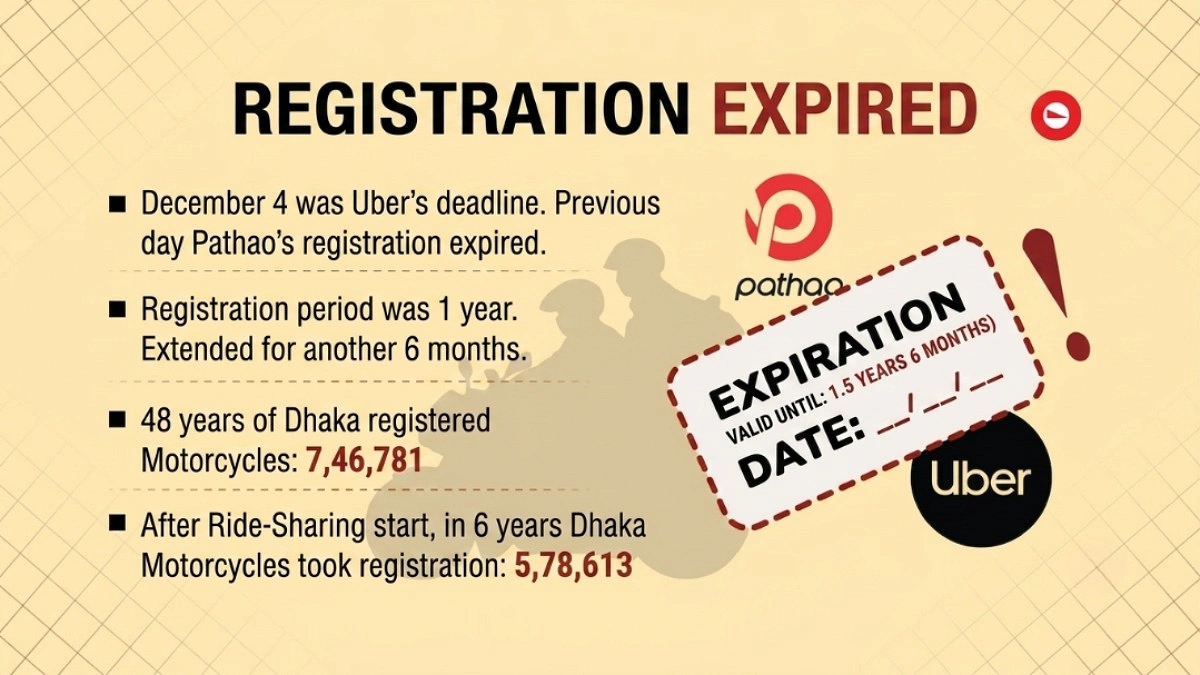
Uber and Pathao have been operating ‘illegally’ even after the expiration of their registration terms. The enlistment certificates obtained by Uber and Pathao from the Bangladesh Road Transport Authority (BRTA) as ride-sharing companies expired last year. Pathao’s certificate expired on Dec. 3, 2025, while Uber’s expired the following day, Dec. 4. For the past six months, vehicles operating under the two companies have continued to run in violation of government regulations. However, the BRTA said applications for renewal of the certificates are under process.
Under the policy, the authority issues enlistment certificates for one year. They must be renewed every year, and applications for renewal must be submitted three months before the expiration date. Questions have also arisen over the likelihood of obtaining renewed registration, as the matter has remained pending for so long after the certificates expired. Although Uber and Pathao continue to operate without registration, no government agency has raised objections. Their app-based services have not been suspended.
According to BRTA sources, Uber and Pathao obtained registration in 2019 to begin transport operations in Bangladesh. Since then, they have regularly renewed their registrations and continued ride-sharing services.
The registration process is handled by the Engineering Wing of the BRTA. Nurul Hossain, assistant director of the wing, told Agamir Somoy, “The renewal applications are with us. Work on them is underway. Some documents were missing, so we had to ask for those again. That caused the delay. The registration process is in its final stage. The registrations will be issued soon.”
However, when asked when the applications had been submitted, he did not respond. Asked whether the companies can continue ride-sharing operations under the current circumstances, he said that since applications have been submitted, there is no problem with continuing operations.
But the law says otherwise. According to the Ride Sharing Service Policy, 2017, there is no provision allowing any company to operate ride-sharing services without an enlistment certificate.
Under the policy, a service provider must obtain an enlistment certificate from the BRTA before operating ride-sharing services. No company can conduct ride-sharing operations without this certificate. A separate enlistment certificate is also mandatory for each motor vehicle used in ride-sharing services. In other words, it is not enough for only the company to be registered; every car or motorcycle connected to the platform must also be brought under BRTA enlistment.
The policy states that enlistment certificates will be issued only after applications are submitted in the prescribed manner, required documents are verified, and approval is granted by the BRTA. Once the validity period of an enlistment certificate expires, it must be renewed. To renew the certificate, an application must be submitted through the BRTA’s online portal after depositing the prescribed fee, and a renewed certificate is issued following verification.
No comments from Uber or Pathao could be obtained on the matter. Benchmark PR, a firm that handles Uber’s public relations, also could not be reached despite several attempts over several days.
Meanwhile, the number of motorcycles in Dhaka has surged since the introduction of ride-sharing services. Data from BRTA’s registered motor vehicle records show that over the first 48 years, up to 2019, there were 746,781 registered motorcycles. In just the following six and a half years, from 2020 to May 2026, another 578,613 motorcycles were registered.
That means the number of motorcycles added in just six and a half years is equivalent to nearly 78 percent of all registrations in the previous period. Currently, nearly 44 percent of registered motorcycles in the capital have been registered since 2020.
Mohammad Hadiuzzaman, a transportation expert and professor at Bangladesh University of Engineering and Technology, believes the BRTA should determine the maximum number of vehicles that a ride-sharing company can enlist. “The number of vehicles is increasing beyond the capacity of the roads. This will create even more problems in the future,” he said.

