

Land mutation now takes 100 clicks, not 13 promised

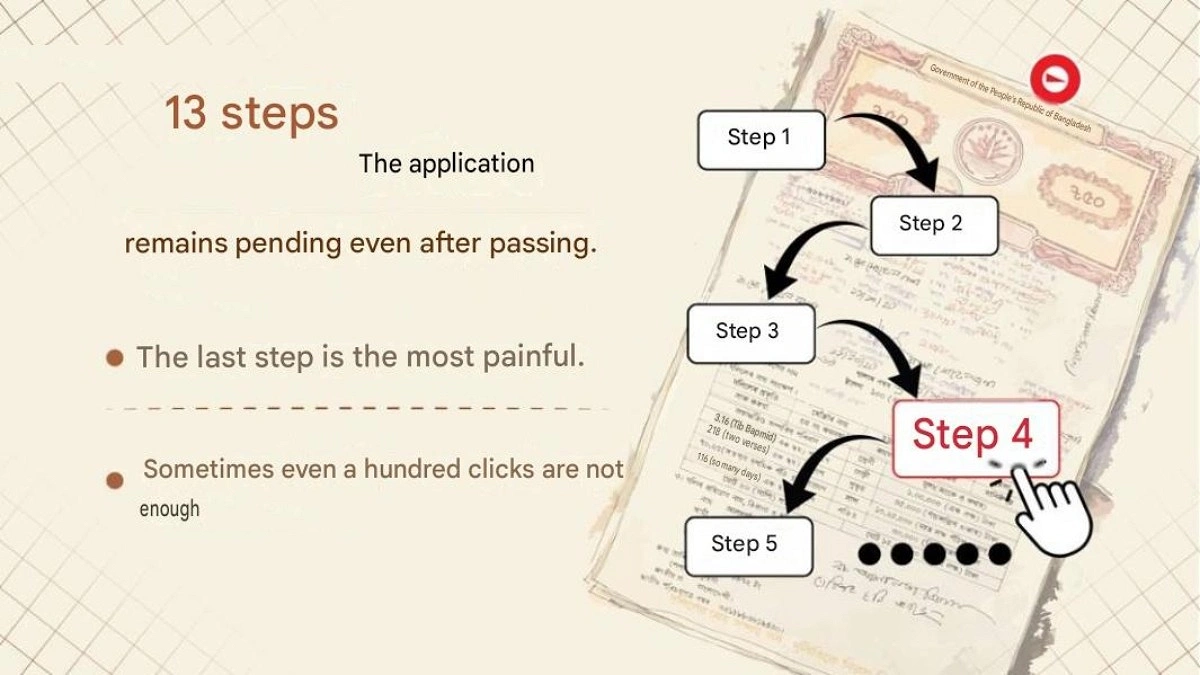
Graphics: Agamir Somoy
Seven years after launching automated land management, the promise of mutation (Namjari) in 13 clicks and 28 days remains unfulfilled. Far from streamlining the process, the system now requires over 100 clicks - with no settlement in sight.
An investigation by Agamir Somoy has revealed that as Assistant Commissioners (Land), or AC Lands, fail to settle applications, both officials and service seekers are facing significant hardships.
An AC Land must complete 13 specific steps to settle a single mutation application. The steps are as follows:
- Opening the application.
- Verifying the deed.
- Verifying the Khatian and Land Development Tax (Khajna).
- Accepting the notice or hearing.
- Ensuring the presence of the plaintiff.
- Mentioning whether the hearing date has changed.
- Taking any objections into account.
- Mentioning the presence of the defendant or interested parties.
- Selecting whether the recommendations of relevant officials are identical or different.
- Providing comments or explanations.
- Granting, rejecting, or scheduling the application for a re-hearing.
- Recording transfer details, holding adjustment, and the Kanungo report.
- Approving the proposed Khatian and issuing the final order.
Before an AC Land reaches these 13 clicks, a citizen first applies online, and the application arrives at the AC Land’s ID. After a preliminary check, it is sent to the relevant Union Land Office.
Following an investigation and verification process there, the application returns to the AC Land with a proposal. It is then sent to the Kanungo, and after receiving the Kanungo’s report, it returns to the AC Land again. The application is finally settled through a hearing notice, the hearing itself, and a final order.
Officials alleged that the most significant problems occur at the final stage. Often, there is no balance for the specific plot land, or there are entry errors in the plot column of the Khatian. Had these issues been visible to the Union Land Assistant, a rejection decision could have been made at the very beginning.
Moreover, officials claimed that even after completing all steps, server errors during the final approval stage force the application to reload, sending it back to the very first step. At times, no options are displayed at all, or the system fails to respond to commands, forcing the same application to be processed repeatedly.
When Wi-Fi connections fail, officials must resort to using mobile data. This not only wastes working hours but also creates long delays in service delivery. Generally, even simple one-minute tasks take several minutes due to the slow server speed.
An AC Land, speaking on condition of anonymity, said, “Server complexity is now a daily occurrence. After finishing the first step and moving to the second, the application returns to the first step again. The same work has to be done repeatedly. This makes it difficult to settle applications within the stipulated time.”
Another AC Land noted, “The system gets stuck right at the step before the final order. Many times, no options appear. I have to start over from the beginning. It takes several times longer than usual to complete one application. It just keeps loading. It is not even possible to keep track of how many times I have to click.”
Narail Sadar AC Land KH Tasfiqur Rahman told Agamir Somoy, “Even after searching for an application, the information is often not found. In some cases, the application cannot be located even after the review is completed.”
He added that mutation activities are hampered by these issues and that they face such problems frequently. Although reporting these matters to the support group leads to temporary fixes, the same complexities resurface later.
On Thursday, server issues persisted for most of the day. Many officials completed 12 consecutive steps, but upon clicking the final approval option at the 13th step, all application-related information turned blank, making approval impossible.
Subsequent attempts resulted in an internal error message titled “Sorry” appearing at the seventh step, accompanied by a parachute-shaped animation. Despite multiple attempts over several hours, the final approval for those applications could not be granted. Similar incidents occurred in the majority of land offices across the country.
Currently, 4,28,980 mutation applications are pending nationwide, with an overall average approval rate of around 66 percent. About 85,000 applications have been hanging for more than 28 days.
In the Kalapara Upazila of Patuakhali, 1,611 applications are pending, 70 percent of which have been delayed for more than 28 days.

