


Bangladesh's 19 presidents – who served for how long?

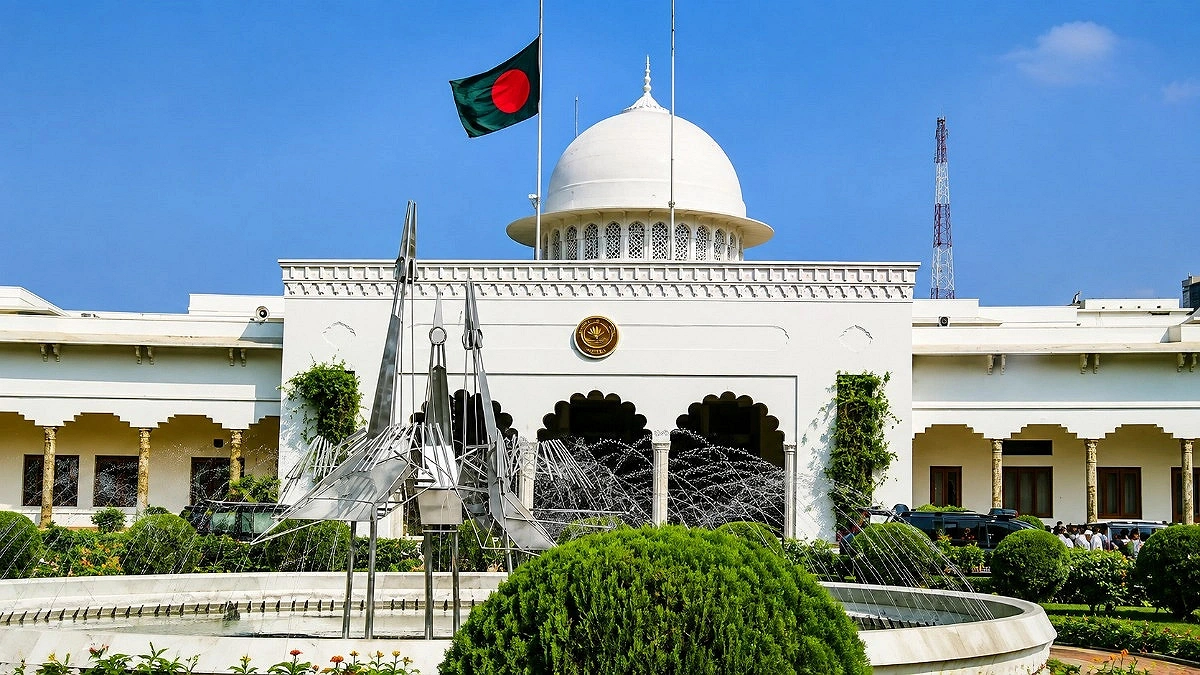
Bangabhaban, the official residence and office of Bangladesh's President. Collected photo.
BNP candidate Mirza Fakhrul Islam Alamgir has been elected as the President of Bangladesh. He was declared winner at 5 PM on Thursday at the National Parliament Building. He received 255 votes. His rival, the candidate of the 11-party alliance and LDP Chairman Colonel (retd.) Oli Ahmad, bagged 88 votes.
With this, Mirza Fakhrul Islam Alamgir becomes the country's 23rd President and the 20th individual to reside at Bangabhaban.
Prior to him, in the history of independent Bangladesh, 19 individuals have held the office of the President at various times. Among them, besides full-term presidents, there were interim, acting, and caretaker presidents as well. Some served for a few months, while others served consecutive terms.
The tenures of those who have held the presidency since independence are highlighted below—
Sheikh Mujibur Rahman
During the Liberation War, Bangabandhu Sheikh Mujibur Rahman was made the President of the Mujibnagar Government. He served as President from March 26, 1971, to January 10, 1972. After being released from prison in Pakistan and returning home, he took on the role of Prime Minister.
On January 25, 1975, some as some Constitutional amendments were made, a Presidential form of government followed and he became President again. He remained in office until he was assassinated along with his family on August 15 of that year.
In the history of independent Bangladesh, Sheikh Mujibur Rahman served as both the first and fifth President.
Syed Nazrul Islam
As Sheikh Mujibur Rahman was imprisoned in Pakistan, Syed Nazrul Islam served as the Acting President during the Liberation War, in his absence.
He held this responsibility from March 26, 1971, to January 10, 1972. As one of the key leaders of the provisional government during the war, he played some crucial roles.
Justice Abu Sayeed Chowdhury
Justice Abu Sayeed Chowdhury assumed the presidency on January 12, 1972, upon returning to the country from London.
After serving as President for nearly two years, he resigned on December 24, 1973.
Muhammad Ullah
Following the resignation of Abu Sayeed Chowdhury, the Speaker of the Parliament, Muhammad Ullah, took over as the Acting President.
He served as Acting President from December 24, 1973, to January 27, 1974. Later, on January 27, 1974, he was sworn in as the regular President and served until January 25, 1975.
Sheikh Mujibur Rahman
After the Presidential system of government was introduced on January 25, 1975, Sheikh Mujibur Rahman assumed the presidency for the second time. His second term ended with his assassination on August 15 of that year.
Khondaker Mostaq Ahmad
Following the assassination of Bangabandhu Sheikh Mujibur Rahman on August 15, 1975, Khondaker Mostaq Ahmad took over as President.
However, his tenure was very short. He served a total of 81 days as President until he was ousted on November 6, 1975.
Justice Abu Sadat Mohammad Sayem
After Khondaker Mostaq Ahmad, Bangladesh's first Chief Justice, Abu Sadat Mohammad Sayem, assumed the presidency on November 6, 1975.
After serving as President for about a year and a half, he resigned on April 21, 1977, citing health grounds.
Ziaur Rahman
On April 21, 1977, the then Chief of Army Staff and Chief Martial Law Administrator, Major General Ziaur Rahman, took over as President.
In 1978, he founded the Bangladesh Nationalist Party (BNP) and won the presidential election. He remained President until he was assassinated by a group of army officers in Chittagong on May 30, 1981.
Justice Abdus Sattar
Following the assassination of Ziaur Rahman, Vice President Justice Abdus Sattar took over as Acting President on May 30, 1981.
Later, on November 20 of the same year, he won the presidential election and became the regular President. However, just a few months later, on March 24, 1982, he was ousted in a military coup led by the Chief of Army Staff, Hussain Muhammad Ershad.
He was the first elected civilian president of independent Bangladesh to be overthrown in a military coup.
Justice A. F. M. Ahsanuddin Chowdhury
Three days after Abdus Sattar was ousted, on March 27, 1982, Justice Abul Fazal Mohammad Ahsanuddin Chowdhury assumed the presidency.
However, with effective state power remaining in the hands of Army Chief Ershad, his presidency did not last long. He stepped down from the post on December 11, 1983.
Hussain Muhammad Ershad
On December 11, 1983, the then Chief of Army Staff, Hussain Muhammad Ershad, assumed the presidency. In 1986, he became president again through a presidential election. However, faced with a prolonged mass movement, he was forced to step down on December 6, 1990.
Justice Shahabuddin Ahmed
Following Ershad's fall, the then Chief Justice, Shahabuddin Ahmed, took over as Acting President on December 6, 1990.
He formed a neutral caretaker government and oversaw the 1991 national elections. After completing his duties, he relinquished the presidency on October 9, 1991.
Later, in 1996, after the Awami League government came to power, he was again elected President. He completed his five-year term and stepped down on November 14, 2001.
Having served in two separate terms, Shahabuddin Ahmed is counted as both the 12th and 14th President on the list of presidents.
Abdur Rahman Biswas
Following Shahabuddin Ahmed, Abdur Rahman Biswas became President on October 9, 1991. He completed his full term and retired from the presidency on October 9, 1996.
A. Q. M. Badruddoza Chowdhury
On November 14, 2001, the founding secretary-general of the BNP, A. Q. M. Badruddoza Chowdhury, was sworn in as President.
However, due to disagreements with the BNP, he resigned just seven months later, on June 21, 2002.
Muhammad Jamiruddin Sircar
Following Badruddoza Chowdhury's resignation, the Speaker of the National Assembly, Muhammad Jamiruddin Sircar, took over as Acting President.
He served as President from June 21 to September 6, 2002.
Iajuddin Ahmed
On September 6, 2002, Professor Iajuddin Ahmed was sworn in as President.
In 2006, amid a political crisis, he took on the role of Chief Advisor of the caretaker government in addition to the presidency. He later stepped down from the Chief Advisor's position but remained President. He served as President until February 12, 2009.
Md. Zillur Rahman
After the Awami League government was formed in 2009, senior Awami League leader Md. Zillur Rahman assumed the presidency. He served as President until his death on March 20, 2013.
Md. Abdul Hamid
Md. Abdul Hamid holds the record for the longest tenure as President in Bangladesh's history.
He took over as Acting President on March 13, 2013, while Zillur Rahman was ill. Later, he served as Interim President from March 20 to April 23, and then as President for two consecutive terms from April 24, 2013, to April 23, 2023.
Md. Shahabuddin
Following the end of Abdul Hamid's two terms, Md. Shahabuddin became President on April 24, 2023.
He remained in office during the interim government formed after the July Mass Uprising and the subsequent formation of the elected government. Later, citing health reasons, he resigned on July 24, 2026.
With this, his presidential tenure came to an end. On the same day, the Speaker of the National Assembly, Hafiz Uddin Ahmed, took over as the country's Acting President. According to Article 54 of the Constitution, he assumed the responsibilities of the head of state.
Mirza Fakhrul to be the latest resident of Bangabhaban
In the presidential election held after Md. Shahabuddin's resignation, BNP candidate Mirza Fakhrul Islam Alamgir won with 255 votes. His rival, Oli Ahmad, received 88 votes.
When Mirza Fakhrul assumes office, he will become the 23rd President of independent Bangladesh and the 20th individual to hold the presidency.
That is to say, over more than half a century since independence, 19 individuals have served as President. Among them, some were interim or acting presidents, some completed full terms, and others lost office before the end of their terms due to political changes.

