


Dengue deaths mount as Dhaka’s mosquito war fails

Graphics: Agamir Somoy
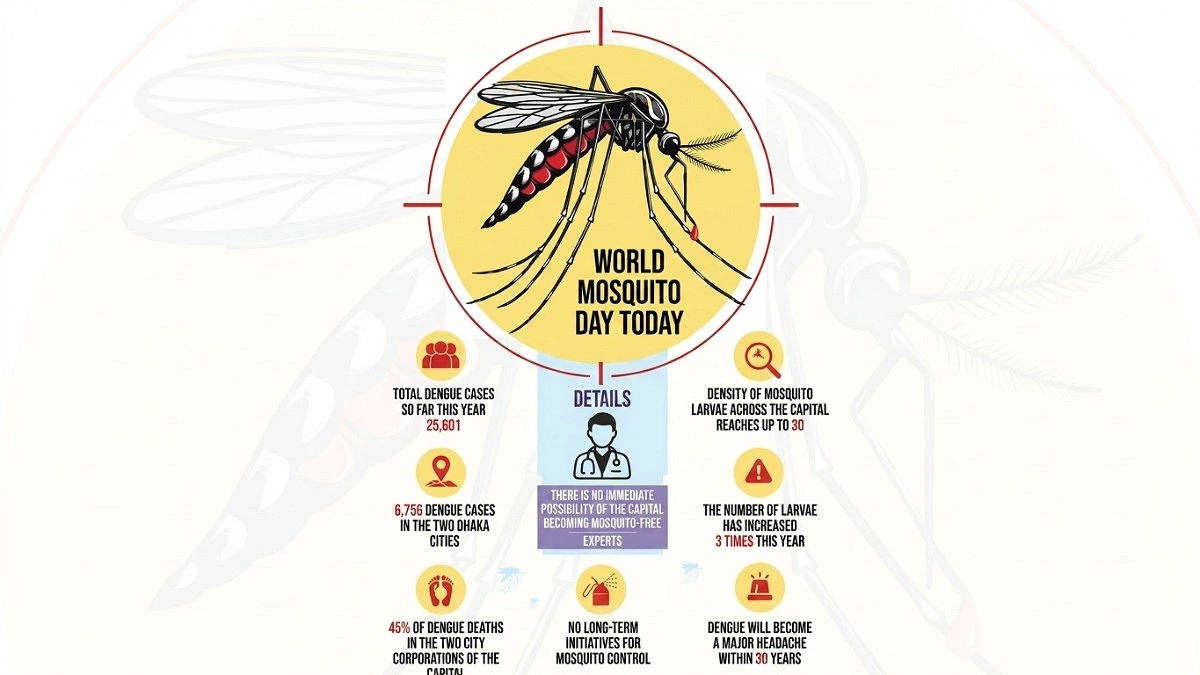
Alongside the mosquito nuisance, the dread of dengue is escalating as Directorate General of Health Services (DGHS) said 25,601 people have been admitted to hospitals with dengue up to 18 August, resulting in 74 deaths.
Out of these casualties, 6,756 infections and 33 deaths occurred within the Dhaka North and South City Corporation areas. Nearly 45 percent of all dengue deaths in the country have taken place within the jurisdictions of these two city corporations.
Beyond these two cities, 3,479 infections and one death were recorded in the Dhaka Division. An inspection of various areas in Dhaka revealed that the infestation of mosquitoes has surged everywhere, from drainage canals and narrow lanes to the insides of residential homes.
According to entomologists, the density of Aedes and Culex mosquito larvae is hovering in the 30s range. Experts warn that the presence of larvae has surged nearly threefold compared to 2025, which is alarming.
Although both city corporations claim to conduct regular larviciding and fogging, the reality on the ground paints a different picture. Much of the mosquito eradication efforts seem confined, such as flying drones under the guise of inspection and finding larvae, or releasing photographs of comb campaigns.
However, the administrators of both city corporations said the situation is under control. Dhaka North City Corporation (DNCC) Administrator Safiqul Islam Khan told Agamir Somoy that most of those who died from dengue were residents from outside Dhaka. He claimed that the health department is working on mosquito control and mentioned that they are importing two new pesticides, though he did not clarify when these would actually be deployed in the field.
Dhaka South City Corporation (DSCC) Administrator Md Abdus Salam claimed that the mosquito situation within his city corporation area remains under control. When he was informed about the severe mosquito infestation right outside his office, he laughed and told Agamir Somoy, “I have not seen anything like that. Of course, I think mosquitoes are afraid of me!”
He later assured that he would look into the matter and take appropriate measures.
Public health experts disagree with these claims made by the administrators. Public health expert Be-Nazir Ahmed warned that dengue will remain a major headache for Dhaka and the entire country for the next 20 to 30 years.
He identified unplanned urbanization, inadequate drainage infrastructure, and a critical shortage of skilled entomologists and modern laboratories as the primary obstacles to effective mosquito control. While a major metropolis like Dhaka requires at least 20-30 entomologists, it has only two or three.
Be-Nazir highlighted another fundamental reason why the mosquito eradication campaigns of Dhaka’s two city corporations have failed: the reliance on uneducated mosquito workers. He explained that these workers do not hold any degree in entomology, do not know the correct pesticide mixing ratios or the specific properties of the chemicals, and are entirely unaware of the scientific methods required for spraying.
The eradication efforts are being run by such uneducated staff, and it is impossible to make Dhaka mosquito-free through such nominal, superficial actions without a long-term plan.
The high presence of mosquitoes in Dhaka is increasingly accepted as a normal occurrence. Mocking the trend, Be-Nazir said, “At some point on World Mosquito Day, the theme might be ‘Let mosquitoes increase further’ or ‘Long live mosquitoes’.”

