


Dialysis profits go to Indian company, costs borne by Bangladesh
- Private dialysis in government hospitals
- After losing their jobs, technicians get transferred
- NICDU's capacity exhausted

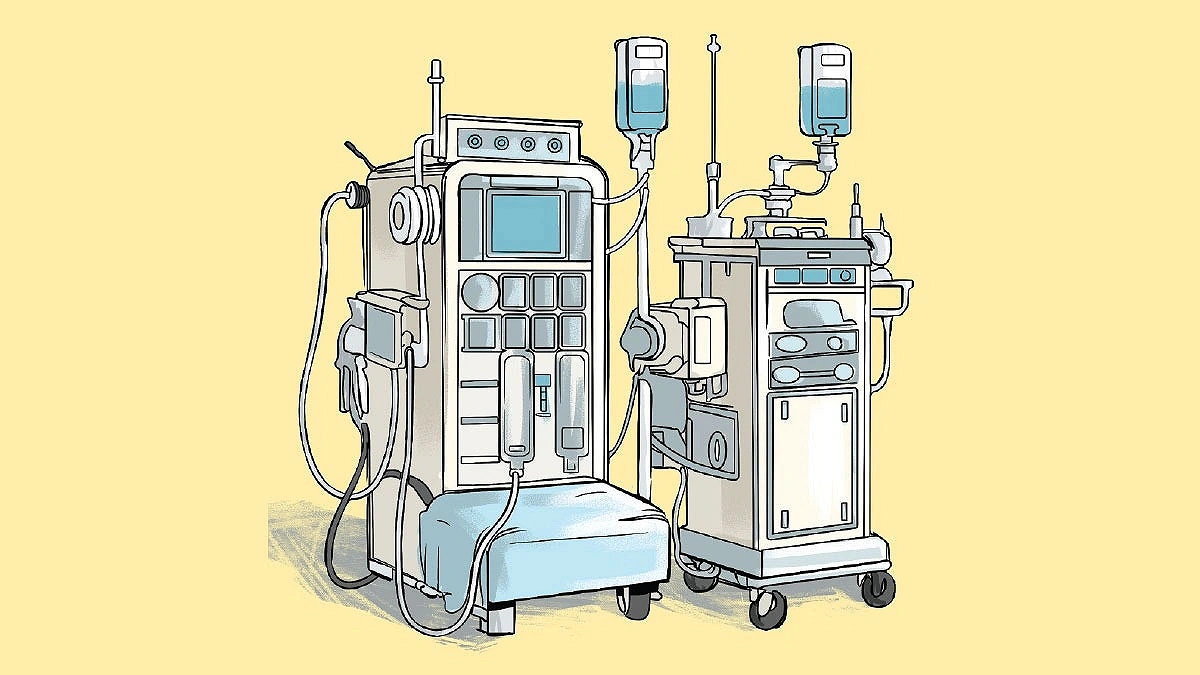
Graphics: Agamir Somoy
For the past 10 years, the Indian company Sandor Medicaids Private Limited has been receiving space, electricity, water, and subsidies from the government to provide dialysis services in public hospitals. While patients are receiving care with Sandor claiming their service quality is good, the public hospitals' own capabilities have collapsed.
At the National Institute of Kidney Diseases and Urology (NIKDU) hospital, out of 40 dialysis machines, only 8 to 10 are currently functional; the rest lie unused and have become inoperative. Technicians who lost their jobs have either been transferred or assigned to administrative duties. As the project nears its end, the question arises: how much benefit did the government gain by handing over dialysis to a private entity, and how much of its own capacity did it lose?
Another way to loot at it: Under Sandor's dialysis service, the government currently has to subsidize Tk 2,777 per session. After including the patient's share, the cost per session stands at Tk 3,398. Additionally, NIKDU and Chittagong Medical College (CMC) hospitals have to bear the electricity and water bills used by Sandor. As the 10-year Public-Private Partnership (PPP) project approaches its end, questions are being raised about whether this model is sustainable for the government, even if the service quality is good.
The matter was discussed with Dr. Be-Nazir Ahmed, former director of the Disease Control Division of the Directorate General of Health Services and a public health expert. Referring to the PPP as the "lesser of two evils," he said that any contract must prioritize national interest and public welfare. He pointed out that in many agreements, the national interest and institutional interests are not protected. This happens due to the incompetence of those executing the contracts and a lack of accountability to the country. As a result, an institution can be destroyed and national interests harmed—which is undesirable.
On January 27, 2015, the Directorate General of Health Services signed an agreement with Sandor to establish dialysis centers at NIKDU and CMC hospitals. According to the PPP authority, this was the first PPP project in the health sector. Under the agreement, the private partner's responsibility was to install, operate, and maintain the dialysis center equipment; the government was to provide space and utilities. The plan also included rendering the old centers inoperable and reassigning their staff to other hospital departments.
Since 2016, Sandor has been providing services at NIKDU and CMC. The project term is scheduled to end on November 30 of the upcoming year. Uncertainty has been looming regarding the renewal of the contract. When asked, Dr. Md. Nurul Islam, Director (Hospital) of the Directorate General of Health Services, said it is unlikely that the contract will be extended. He said the hospitals want to run the dialysis centers under their own management. However, the final decision will be made by the ministry.
According to the contract, Sandor's operations run using the space, water, and electricity of NIKDU and CMC hospitals, with the hospital authorities paying the utility bills. Sandor bears the costs of dialysis equipment, consumables, and other operational expenses. At the start of the project, the cost of dialysis per patient was Tk 2,190. The patient paid Tk 400, and the government subsidized Tk 1,790. With a 5% annual increase in charges, the patient's share is now stands Tk 621, and the government subsidy is Tk 2,777. In total, the cost per session is Tk 3,398, which is higher compared to other government and many private hospitals.
Mohammad Nazmul Hasan, General Manager of Sandor's Bangladesh branch, said that from January 2016 to July 2026, a total of 638,121 dialysis sessions were conducted at NIKDU and CMC. Of these, 23,031 sessions were provided free of charge. Due to patient absenteeism, 13,576 sessions could not be performed despite preparations being made. During this period, 108,521 sessions were conducted for external or private patients.
Nazmul Hasan said that over the past 10 years, the government subsidy for dialysis has not exceeded Tk 120 crore. He claims that patients are satisfied due to the good quality of services. A proposal has been submitted to renew the contract with lower costs. However, he stated that it is not possible to bring the cost of dialysis per patient below Tk 2,800, and to achieve that, the number of dialysis sessions would need to be increased.
Before Sandor began its operations, NIKDU's own dialysis center had 40 functional machines, with services running with the help of six technicians and nurses. Now, apart from 8 to 10 machines, almost all are inoperative. Each dialysis machine costs between Tk 15 and 20 lakh.
Among the six technicians, one has been transferred to Gopalganj Hospital and another to Khulna Hospital Due to less work. One is now assigned to the reception desk, while another works at the counter. The remaining two assist in dialysis during emergencies; otherwise, they remain idle when not needed.
Professor Mohammad Rashed Anwar, Director of NIKDU, said that due to the contract terms, the hospital authorities cannot operate the dialysis center under their own management. However, an application has been submitted to the Ministry of Health asking for doctors, nurses, technicians, and equipment to run the center independently.
In addition to providing space for Sandor, NIKDU has to bear monthly electricity bills of approximately Tk 5.5 to 6 lakh and water bills of Tk 20,000 to 30,000 for Sandor's usage.
During the contract period, NIKDU is unable to initiate the process of setting up a new dialysis center. As a result, there is uncertainty over whether services can be launched under its own management immediately after the project ends.
The NIKDU Director informed that setting up a new center may take one month. Currently, 115–120 patients receive dialysis there daily. If the contract is not renewed, temporary arrangements must be made for them to receive dialysis at other hospitals.
A senior official of the Directorate General of Health Services stated that, in reality, launching new services might take at least six months. While recruiting staff quickly is possible, purchasing dialysis machines through the government procurement process is time-consuming. Therefore, considering the patients' vulnerability, extending Sandor's operations for another three to six months may be considered.
However, Dr. Md. Nurul Islam, Director (Hospital) of the Directorate General of Health Services, said that steps have already been taken to procure equipment to resolve the crisis. He assured that even after the contract ends, dialysis services will not be disrupted.
Public health expert Mushtaq Husain said that it would not be right to completely shut down private dialysis until sufficient capacity is developed under government management. A long interruption in dialysis can cause serious physical harm to the patients. His suggestion is to amend the contract terms, simultaneously increase government capacity, and add conditions to reduce costs.
Referring to kidney dialysis as expensive, public health expert Be-Nazir Ahmed said that if the government withdraws from the contract without establishing alternative arrangements, it could lead to financial hardship or even death for patients. The Directorate General of Health Services should form a committee to quickly arrange alternatives.
Shirin Ahmed (50), who has been receiving dialysis at NIKDU's Sandor center for three years, said, "Whether Sandor or the government runs the dialysis center, we patients must receive continuous service."
According to the Kidney Awareness, Monitoring and Prevention Society, approximately 3.8 crore (38 million) people in the country are affected by some form of kidney disease. Among them, around 30,000 to 40,000 people suffer from permanent kidney failure each year, requiring regular dialysis or a kidney transplant. According to the National Institute of Kidney Diseases and Urology, there are roughly 130 establishments across the country (both public and private) offering dialysis facilities, with approximately 650 dialysis machines in total.

