


US, Canada strike last-minute deal to halt 50% tariffs

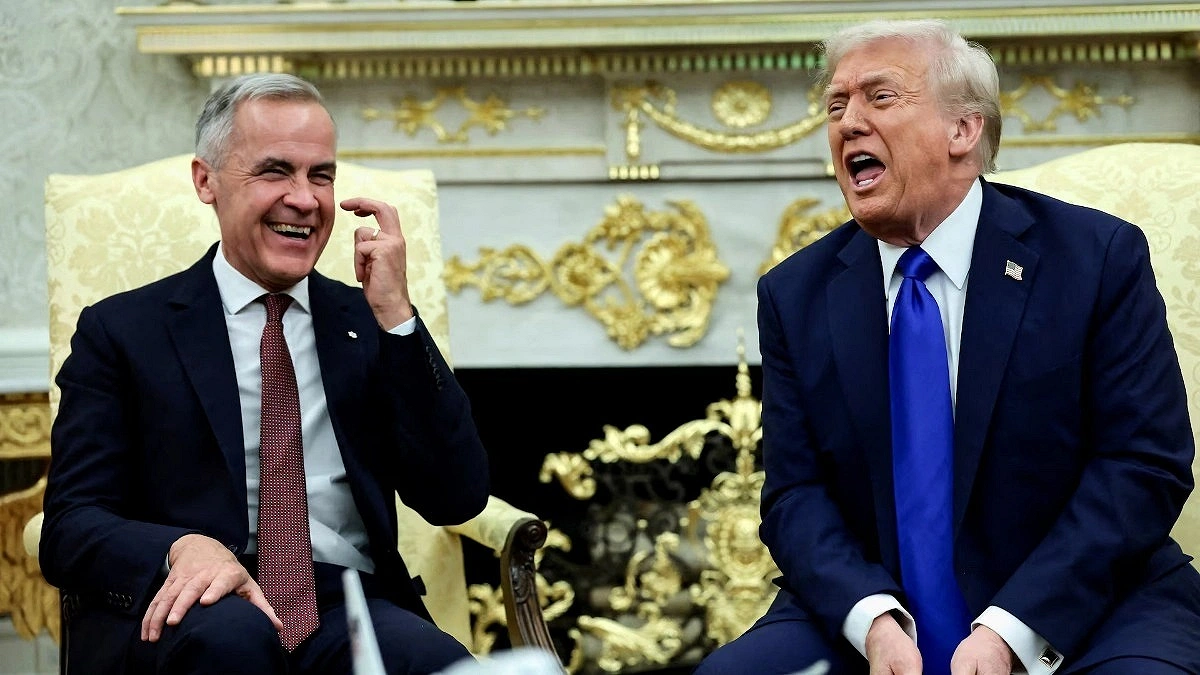
File photo: REUTERS
US President Donald Trump and Canadian Prime Minister Mark Carney finalized a last-minute agreement to postpone aggressive 50-percent tariffs on billions of dollars of Canadian exports.
This decision, announced just before the midnight deadline, provides a short-term reprieve for businesses fearing an escalated trade war between the two partners. Carney confirmed shortly after the announcement that the US agreed to suspend the duties until 22 August.
The 11th-hour breakthrough occurred following Tuesday negotiations between the two leaders, aiming to resolve weeks of tense trade negotiations. These tariffs would have impacted around $20.2 billion in goods, including electronics, industrial machinery, furniture, dairy products, and wine.
In a post on Truth Social, Trump noted that the three-day pause remains “subject to finalization of documents.”
Trump appeared to connect this progress to his goal of reviving the Keystone XL Pipeline, a project designed to move 830,000 barrels of crude oil daily between the Canadian province of Alberta and the US state of Nebraska.
Former President Joe Biden had previously halted the pipeline in 2021 on economic and environmental grounds. Regarding the project, Trump posted, “The great Keystone XL Pipeline, long ago killed by Sleepy Joe Biden, may be awoken from the grave!”
While Carney acknowledged that the sides have made “substantial progress”, he warned that “important work still to be done” remains. In a formal statement, Carney remarked, “While we continue this work, Canada remains focused on building a stronger, more independent, and more competitive economy at home.”
Andreas Schotter, a professor at Ivey Business School, suggested that including the pipeline in negotiations targets Trump’s ego. Schotter explained that this move works “Not because of the oil transport benefits, but because it was President Biden who actually stopped it, and this, among many things, pushed the loudest of the multitude of big red ‘ego’ buttons with President Trump.”
He added, “Let’s see if we really get to a deal by Friday or if we are back at a Groundhog Day moment.”
The delay offers significant relief to exporters, as roughly 70 percent of Canadian exports are destined for the US, while Canada receives 30 percent of US exports.
Trump originally invoked the tariffs last month through the first-ever use of Section 338 of the Tariff Act of 1930, citing Ottawa’s “discriminatory treatment” of US automobiles, dairy, and alcoholic drinks.
Despite the United States-Mexico-Canada Agreement (USMCA) typically allowing duty-free trade, these new measures would have applied to goods previously qualifying for exempt treatment.
Canadian officials have spent weeks in Washington seeking concessions, with Carney describing the atmosphere as “nasty”, “delicate”, and “intense”. Local complications include eight Canadian provinces blocking US alcoholic beverages in retaliation for previous trade moves.
Provincial leaders also resist changes to the supply management system for dairy, eggs, and poultry.
Meanwhile, public sentiment in Canada has turned negative toward the United States. A Nanos Research poll found 69 percent of Canadians unlikely to buy US alcohol even if bans end, and Angus Reid Institute data shows 48 percent hold an unfavorable view of Americans.
Stewart Prest, a lecturer at the University of British Columbia, said, “The damage of new tariffs would be significant in specific sectors, and I think Canadians are aware of that and concerned, but there is also a feeling of a kind of national pride, that Mark Carney and the premiers have to keep in mind as well.”
He emphasized, “The majority of Canadians want to see our sovereignty defended, and are not interested in trade peace at any price.”
Source: Al Jazeera (adapted)

