


Astronomers spot rare trio of supermassive 'Black Holes' in the early universe

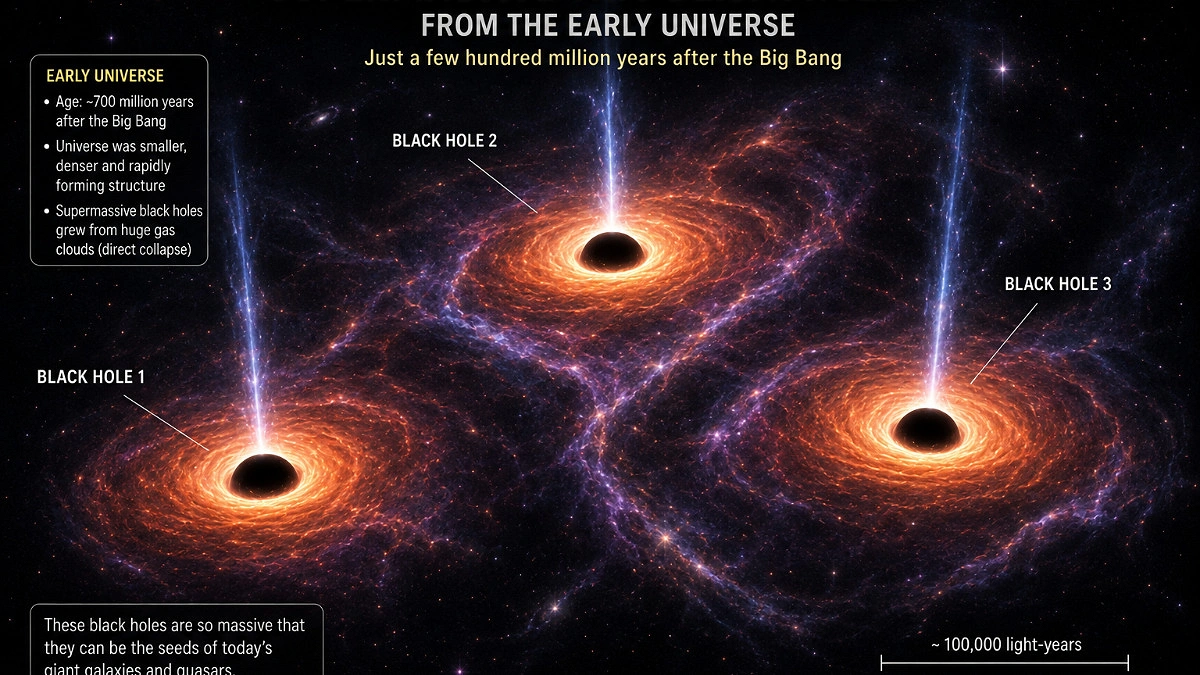
Representational image drawn by AI.
For the first time, scientists have detected what appears to be three supermassive black holes swirling together in a galaxy so distant that it existed just over a billion years after the Big Bang. This discovery, published on August 12 in the journal Astronomy & Astrophysics, is the earliest known example of a black-hole triplet — and it could reshape our understanding of how these cosmic giants grew so massive so quickly.
“This system is in the very, very early universe,” says Dougal Dobie, an astrophysicist at the University of Sydney who was not involved in the study, to New Scientist. “So how did these three supermassive black holes form and get so close together in only about a billion years?”
Most large galaxies harbour a supermassive black hole at their core — our own Milky Way hosts Sagittarius A*. But finding three such objects packed into one ancient galaxy is a rare and revealing catch, reports Smithsonian Magazine.
The research team began their hunt two years ago, aiming to uncover early-universe galaxies containing pairs of black holes. Their goal was to better understand how black holes grow: while they typically gain mass by slowly consuming gas, they can also balloon rapidly through mergers. To catch such a merger in action shortly after the cosmos began, the scientists pointed the James Webb Space Telescope (JWST) at a galaxy designated J0148-4214. This object is so far away that its light has travelled some 12.5 billion years to reach us, offering a glimpse of the universe in its infancy.
The JWST data revealed that the galaxy's centre emitted light with “a peculiar shape,” says co-author Hannah Übler, an astrophysicist at the Max Planck Institute for Extraterrestrial Physics, to New Scientist. Using an instrument that splits light like a prism, the team detected hydrogen atoms moving at extreme speeds — a signature that pointed not to one, but to two black holes in close proximity.
By employing distance-measuring techniques, the researchers determined that two of the black holes are separated by a mere 620 light-years — destined to merge within a few hundred million years. A third black hole lies about 5,500 light-years away from the pair.
“The JWST data allowed us not only to identify the three black holes, but also to estimate their masses, accretion rates and the stellar mass of the galaxy,” explains co-author Giovanni Mazzolari, also of the Max Planck Institute, in a statement.
The team calculated that the two central black holes have masses equivalent to 80 million and 600,000 Suns, respectively, while the more distant one tips the scales at about 2 million Suns. Interestingly, the largest black hole is feeding on its surrounding disk of matter at a much slower pace than its smaller neighbour — in fact, the smaller one appears to be gobbling up material faster than current theoretical models suggest is possible.
What about the loner black hole? It might eventually join the cosmic dance, or it could have been ejected there during an earlier merger, speculates Julie Comerford, an astrophysicist at the University of Colorado Boulder who was not part of the study, in an interview with The New York Times.
Overall, the findings offer a fresh window into the early universe, revealing how common and how active black holes may have been in its first billion years.
“This discovery shows us that processes in the early universe were efficient at bringing massive black holes together,” Übler tells New Scientist. “It also suggests that black hole merging may have been an additional, fast route for their rapid growth in the early universe.”
Source: Smithsonian Magazine

