

Power Plant Turns Into a ‘Time Extension Machine’

Graphics: Agamir Somoy
The government aimed to increase electricity generation using the same amount of fuel by upgrading old equipment through modern technology under the ‘Ghorashal 3rd Unit Re-Powering’ project. However, the project has yet to achieve its target and has instead turned into what critics describe as a ‘time extension machine.’
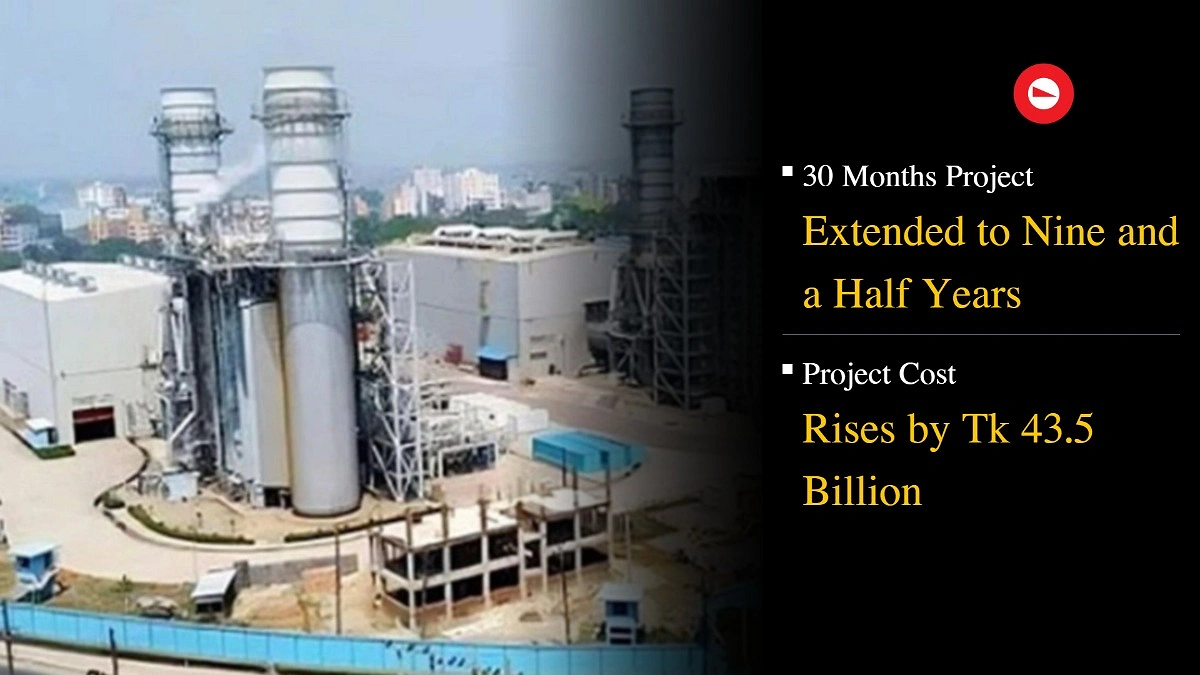
Although the project was scheduled for completion within two and a half years, its timeline has now stretched to nine and a half years. Costs have also increased significantly. While officials cite 13 reasons for the delay, including contractor breaches of contract and cancellations, questions have emerged over the efficiency, planning, and accountability of those involved in implementation.
Stakeholders say it took nearly two years at the beginning just to activate the foreign loan agreement. They add that the project faced repeated disruptions due to accidents, legal cases, and various international legal complications.
The encouraging development is that physical progress reached 97 percent as of March. However, financial progress remains comparatively lower at 77.29 percent.
A draft report from the Implementation Monitoring and Evaluation Division (IMED) highlights the project’s delays, cost overruns, and multiple implementation challenges.
Former Planning Secretary Mamun Al-Rashid told Agamir Somoy that such an extended delay is not acceptable under any circumstances. He said the underlying causes must be properly examined. He added that project planners should have anticipated implementation challenges from the outset, which would have prevented many of the current obstacles. He further said authorities must identify any negligence and take necessary action.
According to sources at the Implementation Monitoring and Evaluation Division (IMED), the project was originally approved with a timeline from January 2015 to December 2017. However, it failed to complete within the stipulated period, leading to repeated extensions.
Authorities first extended the deadline by two years, pushing it to December 2019. It was then extended by another year during the first revision, and by an additional two years in the second revision, setting a new deadline of December 2022.
As the work still remained incomplete, the timeline was extended again in three phases by another 3 years and 7 months, fixing the final deadline at October 2026. As a result, a project originally planned for two and a half years is now set to take nearly nine and a half years to complete. Overall, the extension rate stands at 290 percent from the initial schedule.
Not only the time frame but also the project cost has increased. The initial estimate stood at Tk 25.193 billion, which has now risen to Tk 29.54 billion—an increase of about Tk 4.35 billion. As of March, Tk 22.83 billion had already been spent on the project.
The draft IMED report says that installation of the gas turbine unit and auxiliary equipment, along with other related machinery, was completed and handed over to the chief engineer of the Ghorashal power plant on January 22, 2019. At that time, the gas turbine was made ready for operation in open cycle mode (ICO), and the unit was prepared for generation.
Over the next two years and seven months, the unit generated approximately 92 crore units of electricity. However, operations were suspended for 15 months due to gas shortages.
In July 2021, while the unit was still in operation, a mechanical failure occurred in the gas turbine compressor, forcing a shutdown in power generation. A contract was signed with Switzerland-based GE company to repair the damaged components. However, international legal complications related to importing the equipment led to significant delays.
Finally, in June 2025, after the legal issues were resolved, the equipment arrived at the project site. The contractor’s expert team has since begun repair and commissioning work.
The report also says audit activities under the project have been completed up to the 2024–25 fiscal year, raising 13 audit objections. Of these, one has been resolved, while the remaining objections are still pending settlement.
The report identifies delays in loan disbursement, delays in advance payments, repeated extensions of the project timeline, and multiple revisions of the loan agreement as key weaknesses in project implementation.
It also flags reliance on foreign loans, the unreliability of aging equipment, fuel availability concerns, and various technical challenges as major risks that could negatively affect project execution.
Project officials said the contract required a 15 percent advance payment to the contractor. However, delays in fund disbursement from the lender, the World Bank Group’s MIGA, made this impossible. As a result, implementation faced an early setback.
They added that the project repeatedly suffered disruptions due to site handover and clearance complications, the global COVID-19 pandemic, delays in constructing a 230 kV GIS substation by PGCB, international legal complications, post-repair commissioning issues, domestic and international litigation, the Swiss-related contractual crisis, and mechanical failures.
The main components of the project include installation of a 260.30 MW gas turbine generating unit, a gas booster compressor, and diesel generator systems with auxiliary equipment. It also includes modernization of the existing 210 MW steam turbine generating unit, procurement of heat recovery steam generators, step-up transformers, switchgear, auxiliary transformers, and other equipment, as well as renovation of the existing power evacuation system.
In addition, the project involves setting up a new power evacuation system for the gas turbine, construction of a water treatment plant, installation of measuring and control instruments, and execution of various civil works.

