
Special Surveillance on 70 MPs

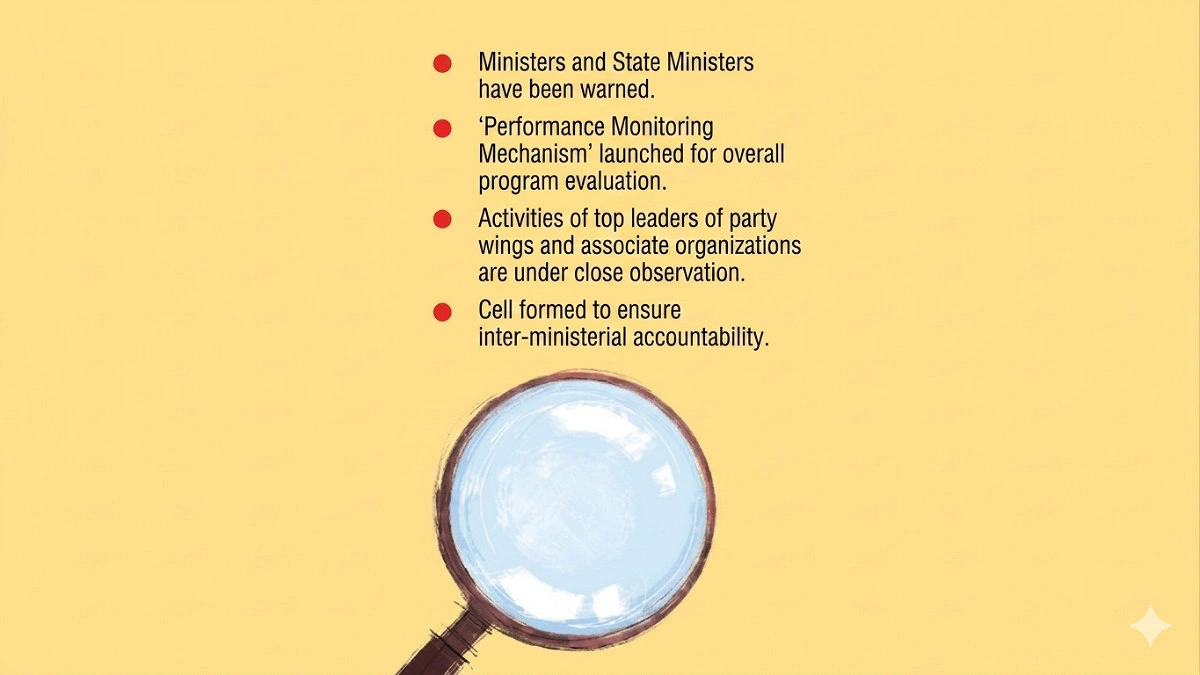
Image generated by AI.
Prime Minister Tarique Rahman is closely monitoring the overall activities of ministers and MPs to control corruption, ensure administrative discipline, and implement election promises. As part of this effort, at least 70 members of parliament have been placed under "special surveillance." Additionally, three ministers and deputy ministers have been verbally warned. Furthermore, the activities of top leaders of party wings and affiliated organizations are also under intensive scrutiny. These details have been obtained from policy-making sources at various levels of the government.
According to these sources, the Prime Minister has introduced a "performance monitoring mechanism" since assuming office. Through this system, the activities of ministers, deputy ministers, and MPs are being regularly evaluated. The Prime Minister has made it clear in internal party meetings that if any allegations of corruption, irregularities, abuse of power, or anti-people activities are found, he will take action personally.
Why the surveillance?
BNP policymakers have stated that the Prime Minister has adopted a cautious stance based on past political experiences. During various previous governments, the abuse of power, corruption, and lack of accountability had a negative impact on the public mindset. To prevent a repeat of such incidents, Tarique Rahman has pursued strict surveillance from the very beginning.
This surveillance has been intensified specifically to accelerate the implementation of election promises, prevent irregularities and influence-peddling at the local level through party influence, ensure transparency and accountability in administrative activities, and maintain the overall image of the government. Additionally, allegations of negligence in implementing development projects, lobbying for undue benefits (lobbying-business), contractor syndicate influence, harassment in public services, and abuse of power at the grassroots level are also being monitored seriously.
Not only ministers and MPs, but the activities of top leaders of party wings and affiliated organizations have also been brought under this surveillance to ensure coordination between the party and the government, leaving no room for indiscipline or irregularities at any level. The Prime Minister's Office is also directly receiving reports on the activities of district and upazila-level administrations.
It has been learned that MPs who are not regularly present in their constituencies, are facing allegations of irregularities in development projects, or are unduly interfering with the administration are being specifically identified. Similarly, allegations of contractor syndicates, tender manipulation, and lobbying for undue benefits are also being taken seriously.
According to multiple sources, at least 70 MPs are under the Prime Minister's strict surveillance, including: one from Rangpur division, three from Rajshahi division, two from Khulna division, two from Barisal division, three from Mymensingh division, nine from Dhaka division, two from Sylhet division, and ten from Chattogram division.
Committee to ensure accountability:
Sources from the Prime Minister's Office have stated that a cell has been formed on the Prime Minister's orders to enhance inter-ministerial coordination and ensure accountability. The committee includes: the Economic Adviser, the Prime Minister's Principal Secretary, the Prime Minister's Personal Secretary-2, the concerned Director of the ministry/division/department, Assignment Officer-1, Research Officer-1, and Protocol Officer-1.
It has also been learned that BNP Chairman Tarique Rahman has issued directives to ensure that ministers and MPs are accountable to the party as well. To this end, organizational meetings of the party will be held every three months. In those meetings, performance evaluations will be conducted in the presence of the Prime Minister.
Learning from the UK model:
Several close associates of the Prime Minister have said that since Tarique Rahman lived in the United Kingdom for 17 years, he had the opportunity to closely observe the governance and accountability mechanisms there. He now wants to gradually implement those methods in Bangladesh as well.
According to these leaders, the UK government has several robust accountability frameworks that are considered a model worthy of emulation by many developing countries. A key part of the parliamentary system there is "Questions to the Prime Minister," where the Prime Minister must directly answer questions from members of parliament. This process keeps the government regularly accountable. Additionally, Parliamentary Select Committees oversee the work of various ministries and interrogate ministers when necessary. The National Audit Office also plays a crucial role in ensuring transparency in government expenditure, independently auditing public spending. Another important aspect is the civil service, where administrative officials strive to work free from political influence and are subject to strict codes of conduct.
An adviser to the Prime Minister told Agamir Somoy that it is from these experiences that the Prime Minister is attempting to build an effective monitoring and accountable administrative culture in Bangladesh.
BNP Standing Committee member Salima Rahman said, "The government is initially working to implement a 180-day action plan. For this, relevant stakeholders must be kept under observation. Apart from leading the party, the way the Prime Minister is paying attention to everything is remarkable. This reminds us of our martyred President Ziaur Rahman."
"The government has adopted a 'zero tolerance' policy on corruption from the very beginning. Ministers and MPs have a significant role to play in eliminating corruption and implementing the Prime Minister's promised programs. Not only ministers and MPs, but party workers must also act as a supporting force in this regard. The Prime Minister's vision and ideals must be embraced by all ministers, MPs, and party members. Only then will the Prime Minister's programs be easy to implement and corruption be eliminated," Salima Rahman added.
Monitoring ministers and MPs is good – Badiul Alam Majumdar:
Badiul Alam Majumdar, secretary of the citizens' good governance organization Shushasoner Jonno Nagorik (SUJAN), views the Prime Minister's public welfare initiatives positively overall. He told Agamir Somoy, "The fact that he has placed ministers and MPs under a kind of monitoring to implement the programs is good."
However, he expressed his opinion: "The Prime Minister is giving ministers and MPs responsibility for local development and providing them with places to stay in their upazilas. Moreover, I am hearing that female MPs from reserved seats are being given responsibility to oversee development in opposition MPs' constituencies. If this happens, keeping them under control will become difficult. My concern is that monitoring may then fail to work. Because they will want to control everything, which leaves the possibility of their becoming involved in wrongdoing. We must remember that one of the major reasons for Hasina's downfall was the involvement of ministers and MPs in various misdeeds."
