

Lower Tier to Get Higher Increment
Increment under new rules of new pay scale

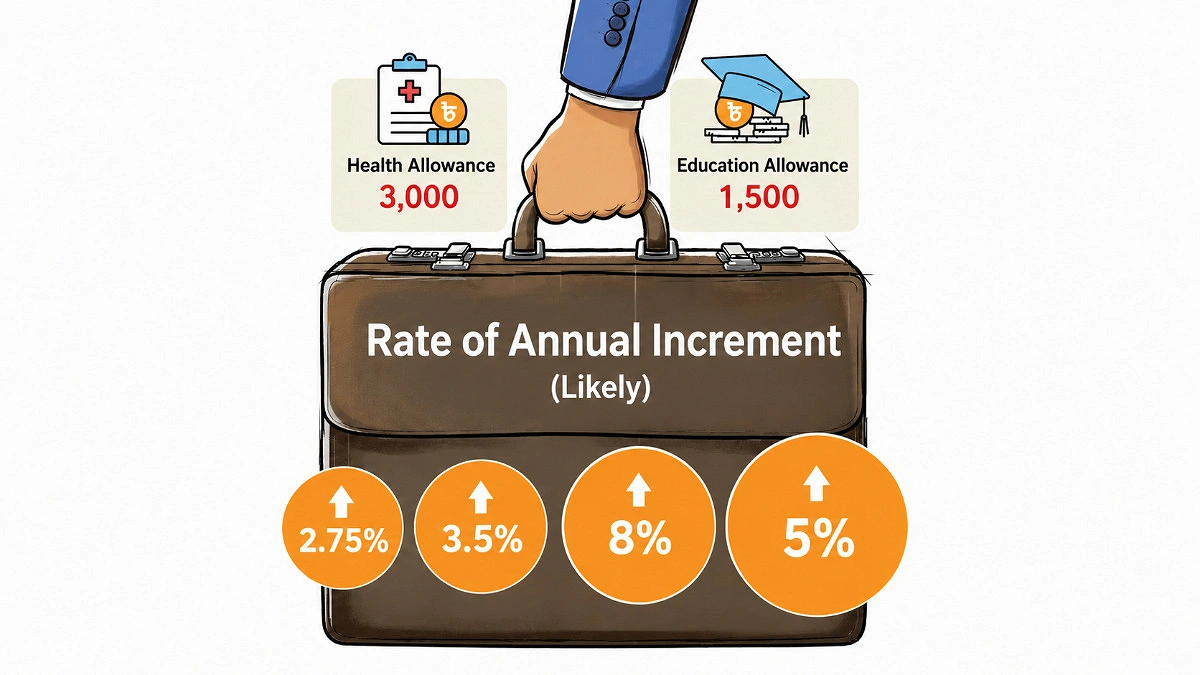
Agamir Somoy representational graphics regenerated by AI.
The public employees will receive increments under a new system in the upcoming pay scale. Low and mid-level officers and employees will enjoy relatively higher benefits compared to those in higher grades. This will effectively scrap the old system of flat-rate increments across all grades.
According to the preliminary draft of the 9th pay scale, the proposed annual increment for the 6th to 20th grades is set at 5% of the basic salary. The increment for the 5th grade is proposed at 4%, while the 3rd and 4th grades are set at 3.5%. Additionally, the increment for the 2nd grade is fixed at 2.75%, and the 1st grade remains fixed. Under the current scale, the annual increment is implemented at an average flat rate of 5% across all grades. These details have been obtained from Ministry of Finance sources.
Sources said before finalizing the increment structure, the government gathered opinions from 167,500 public servants, 61,500 ordinary citizens, and 3,513 institutional heads across the country. Only 5.6% were in favor of the current system. On the other hand, 50.43% opined that increments should be adjusted according to inflation, while 31.54% of respondents felt that the annual increment should be based on the cost of living. However, 79.05% believed that the rate of annual salary increments should be higher for the 11th to 20th grades.
It is reported that the Secretary Committee on Pay Scale Review and the Ministry of Finance are now working at full speed to finalize the draft. A gazette notification in this regard will be issued soon, which will take effect from July 1. Before this, the government conducted both offline and online surveys regarding the rationality of the pay scale, increments, and living expenses, and many decisions have been made based on that feedback.
The National Pay Commission had recommended a maximum medical allowance of Tk5,000, but it is being reduced to Tk3,000. Meanwhile, the monthly education allowance for children is being fixed at Tk1,500, against the commission's recommendation of Tk2,000.
An official from the Finance Division associated with this process stated that along with increasing the basic pay scale, the rates of certain allowances are being reduced compared to the Pay Commission's recommendations, although they remain higher than current rates. However, all types of allowances will take effect from the 2027-28 fiscal year. In the first phase, 100% of the basic salary will be implemented, and the allowances will be provided in the following fiscal year.
Mahbub Ahmed, former Senior Finance Secretary, who was in charge of implementing the 8th pay structure, noted that there are multiple past records of implementing public servant pay structures in two phases. Therefore, implementing the 9th pay scale in two stages is nothing new. This method is primarily followed due to financial constraints. He added that there is no historical precedent of pay scale implementation causing inflation, but additional funds will be required, meaning more focus must be given to revenue collection to meet that demand.
According to sources, under the 9th pay structure, the National Pay Commission has recommended increasing the 1st grade salary from Tk78,000 to Tk160,000 and the 20th grade salary from Tk8,250 to Tk20,000. However, the latest Secretary Committee on Pay Scale Review is reportedly considering reducing the 1st grade salary to Tk 150,000. Discussions are also underway regarding a slight reduction from the proposed Tk20,000 for the lowest grade.
Relevant sources indicate that the Pay Commission framed the new scale based on a maximum-to-minimum salary ratio of 1:8. The Secretary Committee is considering lowering this to 1:7.5. For context, the minimum-to-maximum salary ratio in the first pay commission of 1973 was 1:15.4, while it stood at 1:9.4 in the latest 2015 pay commission.
An analysis of the government survey reveals that a 20th-grade employee currently working in the Dhaka City Corporation area receives a basic salary of Tk8,250, which amounts to a total of Tk16,950 including house rent and other allowances. Under the proposed new pay scale, the total salary and allowances for a 20th-grade employee would reach Tk41,908, combining the potential basic salary of Tk20,000 with allowances.
Similarly, allowances from the 19th grade up to the 1st grade will see significant increases. However, in the interest of reasonable consideration and equity, the rate of increase for higher grades will be comparatively lower. Certain allowances are exclusively provided to employees from the 10th or 11th grade down to the 20th grade, such as transport allowance, tiffin allowance, washing allowance, and risk allowance (where applicable). Consequently, the rate of allowance increase for the 1st to 9th grades is being tapered down.
Meanwhile, prior to implementing the new pay structure, the government conducted an online survey involving 4,143 individuals. In that survey, only 49 respondents (1.18%) felt that the current salary structure was sufficient to cover necessary monthly expenses. Conversely, 4,094 respondents (nearly 99%) stated that it is impossible to meet essential living expenses with the existing salary.
When asked how much salaries should be increased, 87% out of 4,055 respondents favored a substantial salary hike. Another 10% proposed a 40% to 50% salary increase. Alongside this, many recommended setting the maximum-to-minimum salary ratio at 1:4 or 1:5, as well as restructuring and merging the salaries of employees in the 18th to 20th grades.
Furthermore, the "Living Standard Survey-2025" conducted by the Bangladesh Bureau of Statistics (BBS) highlighted the realistic picture of living expenses in the country. According to the survey, the national average family size is 4.16 members, with an average monthly expenditure of Tk35,311. This expenditure stands at Tk32,532 in rural areas, Tk37,344 in urban areas, and Tk46,778 in city corporation areas. For a six-member family, the average monthly expenditure rises to Tk43,347, escalating to Tk66,253 within city corporation areas. As a result, the highest priority has been given to determining the new pay structure in light of inflation, cost of living, and the practical needs of employees.

