
More Small Vehicles, Fewer Buses

Collected Photo
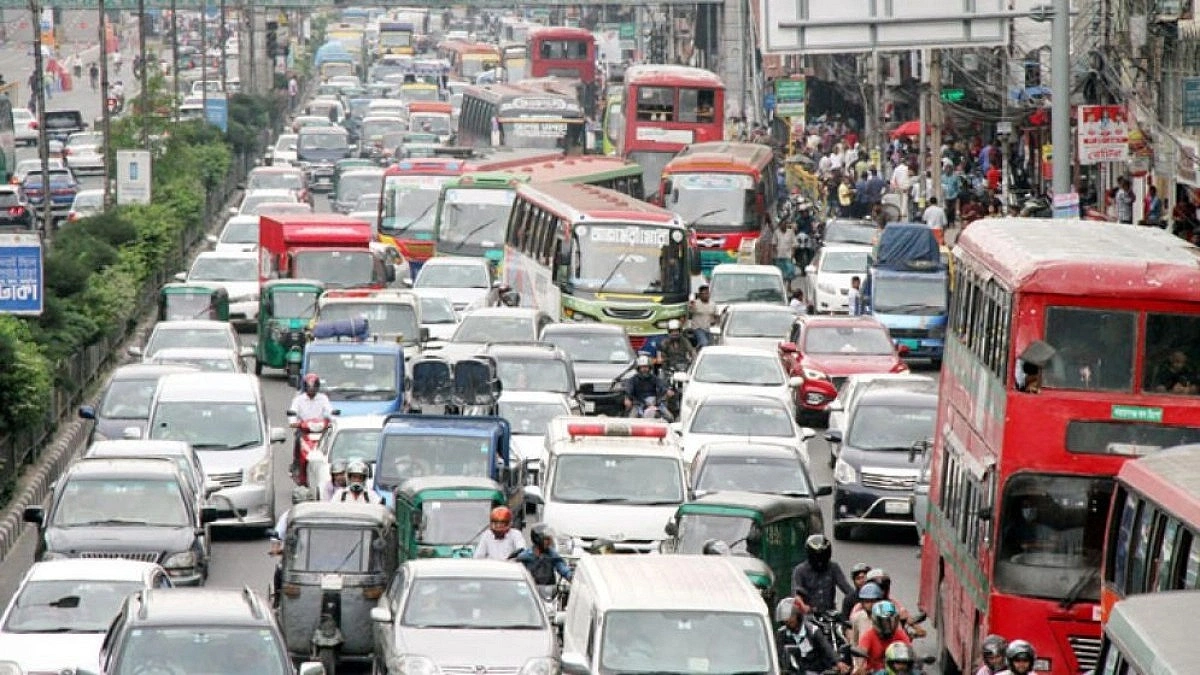
A grim reality unfolds beneath the capital’s gleaming new Metro Rail and Elevated Expressway. Dilapidated buses with broken windows and rusted frames crawl along the roads, spewing dark smoke that clouds the surroundings. Amid the congestion, passengers struggle to reach their destinations. This is the daily reality for millions of Dhaka residents, who face both travel hardship and safety risks. Public transportation was supposed to serve as the backbone of urban mobility. Instead, private cars and motorcycles now dominate the roads. These vehicles, which carry far fewer passengers, continue to consume a growing share of the city’s limited road space, while the entire urban transport system bears the burden.
An analysis of the latest vehicle registration data published by the Bangladesh Road Transport Authority (BRTA) in June shows that Dhaka registered 21,751 new buses between 2016 and 2025. During the same period, authorities registered 906,872 motorcycles and 136,981 private cars.
In other words, nearly 42 motorcycles and six private cars were registered for every bus added over the past decade. Put differently, motorcycle registrations exceeded bus registrations by about 42 times, while private car registrations were more than six-and-a-half times higher. According to BRTA's overall registration data, Dhaka had 1,325,394 registered motorcycles as of May this year, compared with 44,746 buses. The number of registered private cars stood at 359,915.
Transportation experts say a single bus can typically carry between 40 and 60 passengers. By contrast, a private car usually carries one to four people, while a motorcycle accommodates one or two. As a result, transporting the same number of people with smaller vehicles requires several times more road space than buses. In a densely populated city like Dhaka, this trend is rapidly eroding the road network’s capacity. Road space is not expanding, yet the number of small vehicles continues to grow at a geometric rate.
Asked why private car and motorcycle ownership continues to rise, transportation expert Professor Shamsul Haque of Bangladesh University of Engineering and Technology (BUET) said, “The primary reason is people’s lack of confidence in public transportation. Long waiting times, overcrowding, route-based disorder, and safety concerns have pushed a large segment of the middle class toward private cars and motorcycles. Motorcycle use has increased even further, particularly after the introduction of app-based ride-sharing services.”
Urban planners have long argued that Dhaka’s transportation crisis cannot be solved by increasing the number of private vehicles. Instead, the city needs more high-capacity public transportation. In reality, however, the opposite trend continues. Although new buses are being added, their growth remains far below population growth and rising travel demand. As a result, many commuters have become increasingly dependent on motorcycles and private cars. This dependence is prolonging and intensifying traffic congestion, increasing fuel consumption, worsening air pollution and carbon emissions, and raising the risk of road accidents.
The State of Buses Remains Unchanged
A smoke-belching bus standing on one of Dhaka’s busy roads has become a symbol of the city’s entire public transport system. Broken windows, rusted frames, malfunctioning doors, and worn-out engines that fill the air with black smoke have become a familiar sight for passengers. With few alternatives available, millions of people travel daily in buses that pose safety risks and have long exceeded their economic lifespan. According to the law, many of these vehicles should no longer be operating on the roads. The reality, however, tells a different story.
Under BRTA policy, buses and minibuses in Bangladesh have an economic lifespan of 20 years. For freight vehicles, including trucks and covered vans, the limit is 25 years. A BRTA notification issued in 2023 set these limits. The Ministry of Environment, Forest and Climate Change subsequently instructed BRTA to remove buses older than 20 years and trucks older than 25 years from the roads. Yet anyone traveling through the capital can see that these regulations largely remain confined to paper.
Officials at the government regulatory body, BRTA, said that more than 16,000 registered buses and minibuses in Dhaka have already exceeded their lifespan. In other words, nearly 30 percent of the city’s registered buses are more than 20 years old. The figure does not include many unfit vehicles that fall outside this count. More alarmingly, nearly half of all buses and minibuses across the country do not have updated fitness certificates. This raises a critical question: How are vehicles that should have been retired under the law still carrying passengers?
BRTA Chairman Mohammad Habibur Rahman said, “We are taking action through regular enforcement drives against old buses. In addition to fines, we are also sending buses to dumping yards.”
Old Buses Are Not Being Scrapped
Under the Road Transport Act of 2018, operating unfit or unsuitable vehicles is a punishable offense. In February this year, the government issued the Motor Vehicle Scrapping and Recycling Policy, 2026. The policy states that owners will not be able to register new or used vehicles without scrapping or retiring vehicles that have exceeded their economic lifespan. It also allows vehicles whose fitness certificates have not been renewed for more than one year to be scrapped. Violators may face fines or imprisonment.
The policy is considered the country’s first comprehensive vehicle scrapping framework. The question, however, remains: the policy exists, but where is its implementation? Authorities first announced in 2010 that buses older than 20 years would no longer be allowed on Dhaka’s roads. Similar initiatives followed in 2015. Each time, however, pressure from transport owners, administrative weaknesses, and political influence stalled enforcement efforts. In 2025, BRTA once again launched a nationwide drive. On the first day alone, authorities filed hundreds of cases and seized dozens of vehicles. In reality, however, the campaign produced little meaningful change.
Experts say a few days of enforcement cannot provide a lasting solution. Removing expired vehicles from the roads will not be possible without continuous monitoring and strong political commitment.
Old buses are not merely an eyesore; they also pose a major threat to public health and road safety. The Ministry of Environment says aging diesel-powered buses are among the leading sources of air pollution. For that reason, it has recommended mandatory emissions testing for older vehicles. Meanwhile, the Dhaka Metropolitan Police says dilapidated and unsafe buses frequently break down on roads, causing traffic congestion. Mechanical defects in such vehicles also increase the risk of accidents. Authorities have therefore been conducting special drives against expired and unsafe vehicles.
Why Are Old Buses Still on the Roads Despite Everything?
Transport expert Professor Md. Hadiuzzaman believes several factors have prevented the removal of old buses. “First, the cost of purchasing new buses is extremely high. Many owners find it more profitable to keep repairing and operating old vehicles. Second, there is a shortage of public transport. Removing thousands of buses at once could create a transportation crisis for passengers. Third, weaknesses in the fitness certification and route permit systems, along with a lack of effective oversight over many years, have allowed old vehicles to remain in service. As a result, reality has often proven stronger than the law,” he said.
Buses Ignore Approved Routes: Data from the Dhaka Transport Coordination Authority show that 7,091 buses are registered to operate on 128 routes in Dhaka. In reality, however, no more than 4,500 buses are currently in operation. Many buses also operate on unauthorized routes. Of the total, 3,427 buses run on their designated routes, while 2,018 operate on other routes. Another 1,646 buses have no route permits at all.
Meanwhile, despite talk of Metro Rail, the Elevated Expressway, and a modern city, the state of Dhaka’s public transportation still falls short of the development narrative. When smoke-belching buses that are 20 to 25 years old continue to run alongside shiny new vehicles on the capital’s roads, the issue goes beyond transportation. It reflects the wide gap between policymaking and implementation.
Dhruva Alam, Deputy Transport Planner at DTCA, believes the situation can improve with the cooperation of transport owners. “The current leaders of the transport owners’ associations are quite interested in reform. This time, the initiative to bring all buses under a single company is likely to materialize. That would improve discipline in the public transport system and also encourage the introduction of new buses,” he said.
The government has introduced a new scrapping policy and periodically conducts enforcement drives. Yet one question remains: Will these efforts fade away within days like previous initiatives, or will they finally bring an end to the era of expired buses on Dhaka’s roads? The answer remains unresolved. What is clear, however, is that passengers in the capital continue to endure smoke, safety risks, and daily hardship—evidence that the shameful state of Dhaka’s public transport has yet to change.
Asked why this troubling picture of the bus sector remains unchanged, Mozammel Hoque Chowdhury, Secretary General of the Bangladesh Jatri Kalyan Samity, said, “The Road Transport and Highways Ministry is not controlled by the minister or the secretary. It is effectively run by leaders of transport owners’ associations. If the ministry can be freed from the influence of transport owners, not only will the condition of buses improve, but the entire transport sector can be transformed.”
