


Russian strikes destroy 12m books in Ukraine

Collected Photo
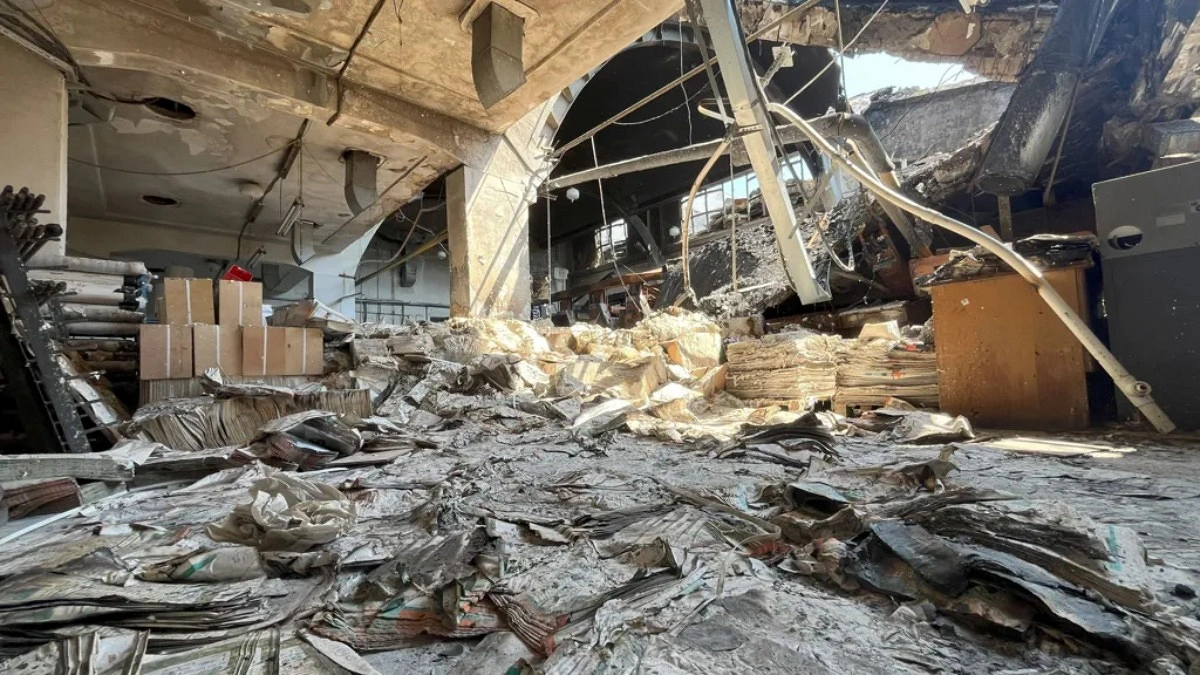
Viktoria Haidai, the commercial director of the Konvi publishing firm, carefully inspects the twisted, ruined metal of a printing press on the outskirts of Kyiv, Ukraine.
Just hours earlier, workers expected this facility to print crucial textbooks for Ukrainian children returning to school. Instead, an overnight Russian missile strike reduced the factory to ashes, wiping out a planned run of 1.3 million textbooks - representing 10 percent of Ukraine’s schoolbooks.
Amid the smoking rubble lies a single, half-burned page of an English textbook, “My name is William, I’m from the UK. My grandmother lives in Nottingham. It’s a beautiful city.”
This devastating blast belongs to a broader, systematic Russian air campaign targeting printing presses and publishing houses throughout Ukraine. These recent strikes have obliterated 12 million books and severely damaged precious landmarks of Ukrainian history and culture.
Local media outlets report that Russian attacks have wiped out one-third of all books printed in Ukraine this year. At the ruined Kyiv press, the devastation is absolute, as firefighting water and exposure to rain through the collapsed roof ruined even the pages that escaped the flames.
Regarding the pattern of destruction, Viktoria Haidai stated, “I believe it is deliberate on the part of the Russian Federation,” adding, “Over the past two months, some of the largest publishing houses have lost their logistics warehouses, where very large quantities of books were stored.”
She observed, “The Russians are also destroying printing houses in an attempt to erase Ukraine as a nation. But frankly they will not succeed.”
Over the past few weeks, Russian forces have struck more than 35 publishing facilities. The attacks did not spare older literature either, as a strike on Kyiv’s Pochaina second-hand book market demolished hundreds of individual merchant stalls and countless rare volumes.
Before emergency crews could fully douse the flames, Liliya Velyka, a 28-year-old book blogger, searched the smoking ruins to find salvageable works, clutching a waterlogged science-fiction novel. Velyka noted, “Books are saving us and losing this is like losing our hearts.”
The conflict has also damaged museums, art galleries, film studios, libraries, and opera houses across the country. At the medieval Kyiv-Pechersk Lavra monastery, a vital cultural heritage site, a strike hit the golden domes of the Dormition Cathedral. Although caretakers moved precious religious artifacts to safety beforehand, a drone strike set a massive portion of the roof on fire.
Officials estimate that rebuilding the roof will cost $11.2 million (£8.2 million) and require two years of intensive work. UNESCO originally listed the monastery complex in 1990, placing it on its register of world heritage sites in danger in September 2023.
During recent celebrations commemorating the 975th anniversary of the monastery’s founding, Unesco’s Director-General Khaled El-Enany expressed profound sadness over the extensive destruction.
Speaking to assembled dignitaries, including Ukrainian President Volodymyr Zelensky, Khaled El-Enany declared, “UNESCO firmly condemns all attacks against cultural property protected under international law.”
Following the speech, El-Enany inspected the damaged cathedral alongside Ukraine’s Minister of Culture Tetyana Berezhna. Berezhna argued that observers cannot separate the cultural destruction from the military realities of the war.
She explained, “This is an existential war, so Russia wants to destroy us as a nation, to erase us as a nation, like Ukrainians do not exist and have never existed. That’s why Russia targets our cultural heritage, the symbols of our presence here for a long time.”
Berezhna added, “They understand that it’s very important for us because we protect our identity, we protect our culture, and Russia wants to ruin everything that it cannot appropriate.”
According to Berezhna, Russian forces have hit more than 1,900 historical heritage items and over 2,000 cultural institutions across Ukraine. To combat this cultural destruction, Ukrainian officials are actively digitizing art and literature to protect them and ensure children can continue their education.
Experts warn that Ukraine’s entire publishing sector faces collapse and desperately requires international funding to remain viable.
Back at the destroyed printing facility in Kyiv, Viktoria Haidai emphasized the absolute necessity of defending their literary industry to keep Ukrainian writing alive.
Haidai concluded, “The word is everything. It is our development, our culture, and our historical heritage that is passed down from generation to generation.”
Source: BBC (adapted)


