


10 lakh farm families need urgent agricultural aid: FAO

Graphics: Agamir Somoy
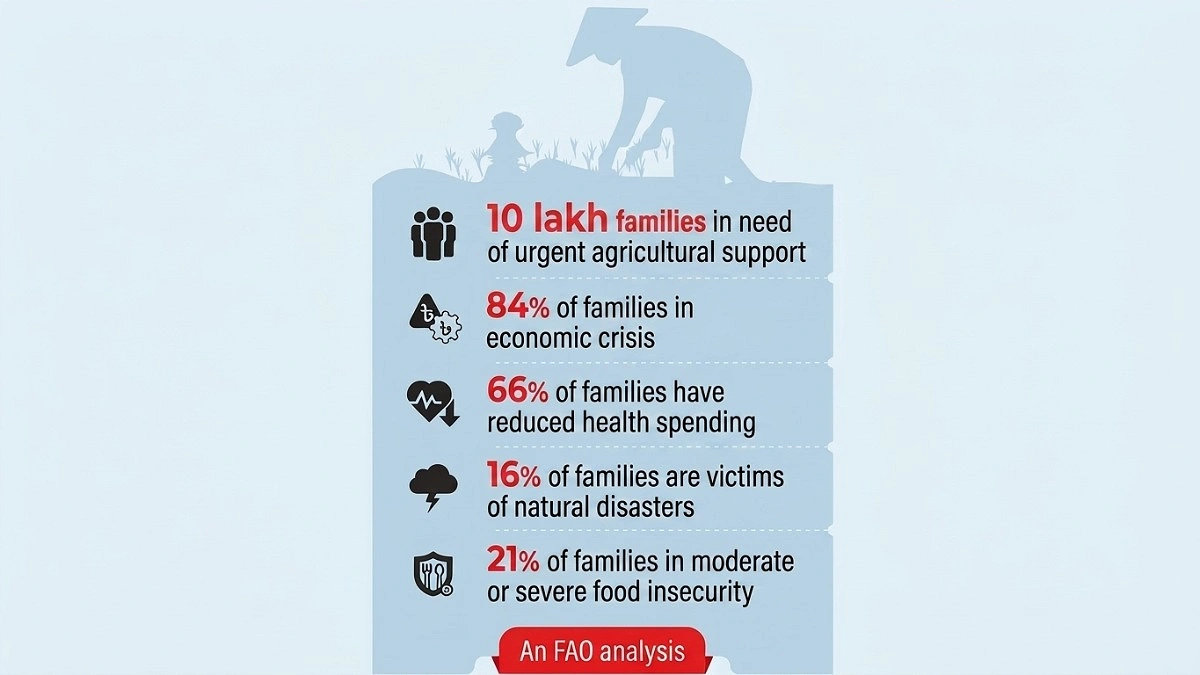
Nearly 10 lakh agricultural families in the country require emergency agricultural assistance and the total number of members in these affected households is around 50 lakh.
Among affected families, 84 percent have fallen into economic crisis, 67 percent have resorted to buying food on credit, 66 percent have slashed healthcare spending, and 30 percent have cut back on agricultural inputs.
These findings emerged in the DIEM-Monitoring report on agricultural assistance in emergencies, published by the Food and Agriculture Organization (FAO) of the United Nations.
The organization’s July report said compared to the monitoring of November 2025, the number of families requiring emergency agricultural assistance has increased by 2 lakh. These families will need agricultural assistance from June 2026 until November 2027.
The survey, conducted from 20 April to 27 May, gathered data on the income, production, crop sales, food habits, farming, and various shocks of 6,143 families. It also collected the families’ opinions regarding potential assistance needs up to November 2027.
According to the FAO, the intensification of the monsoon season, floods, reduced income, high food prices, and shortages of agricultural inputs have caused difficulties for these families in continuing cultivation.
Sylhet has the highest rate of agricultural families needing emergency assistance at 7 percent, followed by Rangpur at 6 percent. Mymensingh, Chattogram, and Rajshahi each stand at 5 percent, while Dhaka and Khulna report 4 percent each, and Barisal the lowest at 2 percent.
However, Chattogram leads with 1,87,408 families in need, followed by Rangpur at 1,62,159, Rajshahi at 1,42,875 Mymensingh at 1,12,200, Khulna at 1,11,959, Sylhet at 95,162, and Barisal at 27,130. Dhaka’s figure has jumped sharply from 50,000 to 1,57,249 since the last survey.
Among risk-prone areas, the rate of families needing assistance in riverbank regions rose from 4 percent to 6 percent. In haor and flash flood-prone areas, this rate increased from 3 percent to 5 percent.
Based on the FAO data, Agamir Somoy spoke to several farmers who were affected by the submersion of crops in the haors of Sunamganj this year.
One of them, Girish Chanda Das, a farmer from Bahara village in Sallah upazila, said regarding his rice production on 3 acres of land, “Because of the lack of sunlight, all our rice sprouted, turned black, and was ruined. It is roughly an 80 percent loss, we got only about 20 percent. The government does not look out for us.”
According to him, 80 percent of the families dependent on labor are working as day laborers in Dhaka, Sylhet, and various cities.
Among the families requiring assistance, 57 percent cultivate less than 1 hectare (around 7.5 bighas) of land. For all agriculture-dependent families in the country, this rate is 35 percent. 60 percent of these families belong to the least affluent one-third financially. For all agricultural families in the country, this rate is 33 percent. The primary source of income for only 16 percent of families is crops, livestock, or fisheries production.
Most families rely on irregular income such as day labor, agricultural labor, and temporary work in non-agricultural sectors. 33 percent of families said their main income has decreased compared to the same period in a normal year.
Due to limited land, low assets, and irregular income, these families have low savings and additional capital. As a result, when production is disrupted or crop prices in the market decrease, it becomes difficult for them to handle the situation.
Among the families requiring emergency agricultural assistance, 16 percent fell victim to natural disasters, a rate that was 10 percent in the previous survey. 65 percent of agricultural families expressed the need for some form of assistance. To tackle food shortages, 67 percent of families bought food on credit, and 66 percent reduced healthcare spending.
Nearly one-third of families cut expenditure on agricultural inputs including seeds, fertilizer, and animal feed. This could create a risk of reduced production and income in the subsequent season.
The report mentioned that 21 percent of agricultural families suffer from moderate or severe food insecurity. More than one-third of families have been forced to adopt crisis or emergency measures to sustain their livelihoods.
Nearly half of the crop-producing families reported production-related problems. These include excessive water accumulation on land, crop diseases, difficulties in obtaining fertilizer, and fuel and electricity shortages.
Compared to the previous survey, the number of families reporting crop diseases increased by 30 percent. Similarly, families reporting difficulties in obtaining fertilizer increased by 17 percent. Farmers also faced problems in selling crops.
In the previous survey, 9 out of 100 agricultural families reported problems in selling crops, but this number has now risen to 30. All families identified low selling prices as the primary obstacle.
As a result, even though production costs have increased, many farmers cannot recover those costs by selling crops. 91 percent of families rearing livestock reported animal diseases, and 17 percent reported problems regarding the cost or availability of feed.
Among the families, 72 percent sought crop inputs. Fifty-seven percent wanted cash assistance, 51 percent requested livestock feed, and 33 percent requested veterinary services. In addition, 26 percent of families sought infrastructure support for crop production and preservation, and 18 percent wanted food assistance.
FAO said merely providing agricultural inputs to help farmers will not suffice; timely cash, livestock feed, veterinary care, and water management assistance must also be ensured ahead of the upcoming Aman season.
When asked about the FAO’s observations, Agriculture, Fisheries and Livestock Minister Mohammad Aminur Rashid told Agamir Somoy, “Farmers in the haor region and Chittagong have been affected by floods.
“From next year, haor farmers will be given a new variety of rice, Bri Dhan-118. This variety can be planted 10-15 days earlier than the current season’s variety. As a result, farmers can harvest their crops before the floodwaters arrive.”
He said the government has several cash assistance programs running for small and marginal farmers. A rehabilitation plan has already been taken for farmers in flood-affected areas. They are being provided with fertilizer and seeds. Affected fish farmers are also being assisted. If needed, the FAO’s cooperation will be taken in this work.
Writer and researcher Gowhar Nayeem Wahra added that a major portion of farmers in Bangladesh do not own the land they cultivate. They have to rent others’ land with advance money. To solve this problem for farmers, there is no alternative to introducing the Tebhaga system.
He noted, “There are various problems in Bangladesh in providing one-time cash assistance. It is difficult to reach the actual beneficiaries with this assistance. Often, local political party leaders decide who will get assistance and who will not. If the Tebhaga system can be introduced, farmers will get a fair share of the produced crops, and their income and livelihood will be somewhat protected.”


