
26 August: The day Nepal became a global security story

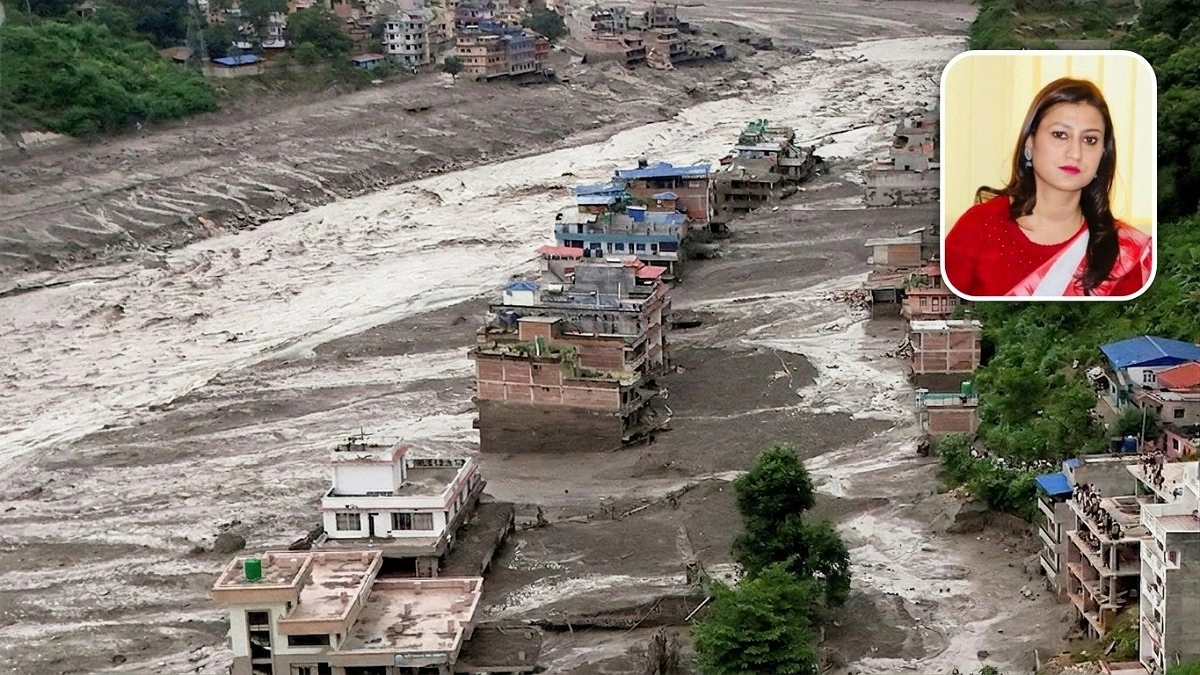
What began as a sudden high-altitude collapse along the Nepal-China border quickly developed into a cascading disaster.
There are disasters that destroy communities. And then there are disasters that force a country, a region and eventually the international community to reconsider the relationship between nature, development and security. For Nepal, 26 August 2026 may become one of those moments.
What began as a sudden high-altitude collapse along the Nepal-China border quickly developed into a cascading disaster. A massive volume of ice and rock detached from a glacierised slope near Langtang Lirung and plunged into the valley below. The material entered the Lhende Khola, temporarily obstructing the river before releasing a powerful surge of water, mud, ice and rock downstream into the Bhote Koshi and Trishuli systems.
The speed was terrifying. Within a short period, settlements were inundated, roads and bridges disappeared, border infrastructure around Gyirong and Rasuwagadhi was severely damaged, and multiple hydropower installations were knocked offline. Hundreds of people have been confirmed dead; more than a thousand remain missing, among them large numbers of foreign nationals. Secondary debris-dammed lakes have added further danger.
What made the event particularly extraordinary was its seismic signature. Initial reports interpreted the signal as an earthquake. Subsequent analysis by the US Geological Survey indicated that the seismic energy—initially logged near magnitude 4.4 and later assessed at approximately 5.2—was generated by the massive movement of ice and rock rather than by a conventional tectonic earthquake.
That distinction reveals the deeper nature of the disaster. This was not a single hazard. It was a cascade. Ice and rock collapsed. The river was obstructed. Water accumulated. The blockage failed. A high-energy surge moved downstream. Infrastructure failed. Communities were isolated. Trade routes were interrupted. Energy infrastructure was affected.
A geological process became a humanitarian emergency. A mountain disaster became an infrastructure crisis. An infrastructure crisis became an economic and energy-security problem. And within hours, a remote Himalayan valley became an international humanitarian story.
When a local disaster becomes a global humanitarian crisis
The speed with which international media responded was itself significant. Reuters, the Associated Press, BBC, The Guardian, Al Jazeera and other major outlets began following the disaster as casualty figures rose and the scale of destruction became clearer. The presence of foreign tourists, workers and other nationals among the missing further transformed the event into an international concern.
Yet the international significance runs deeper than the nationality of those affected. The humanitarian crisis is fundamentally about human life. Families have lost homes. Communities have lost bridges and roads. People have been separated from relatives. Villages have been cut off. Rescue teams are operating in dangerous terrain with disrupted communications. Access to food, medicine and emergency services has become difficult.
This is the precise point at which a natural disaster becomes a humanitarian crisis: when the capacity of affected communities and national institutions is overwhelmed by the scale and speed of destruction. That is why international support matters. In a major disaster, humanitarian assistance is not charity alone. It is an expression of international solidarity and shared human responsibility.
When leaders, organisations and neighbouring governments express concern, offer assistance or mobilise support, they recognise something fundamental: a catastrophe of this scale cannot always be contained within national borders or addressed through national capacity alone.
Why the world is watching the Himalayas
The attention is not accidental. The Himalayas are not simply a spectacular mountain landscape. They form part of Asia’s environmental, economic and strategic infrastructure. They support tourism, agriculture, hydropower, trade and pilgrimage. Their rivers sustain enormous populations downstream. Their valleys contain critical roads and border corridors. Their glaciers and snow systems influence water availability across some of the world’s most densely populated regions.
For Nepal the relationship is even more direct. The mountains are the foundation of much of the country’s development strategy. Hydropower is expected to provide electricity for domestic transformation and an increasing source of export revenue. Roads are expanding into mountain regions. Tourism continues to grow. Cross-border connectivity with China and India remains strategically important.
But the same geography that creates opportunity also creates vulnerability. That is the paradox Nepal must now confront.
Hydropower: Nepal’s greatest opportunity and a growing climate-risk question
Nepal’s hydropower potential has long been described as one of its greatest economic advantages. Steep terrain and powerful rivers create favourable conditions for electricity generation. Hydropower can support industrialisation, reduce energy insecurity and generate export revenues as regional electricity markets become more interconnected. Electricity exports can strengthen economic ties with India and provide foreign currency. Domestic supply can underpin manufacturing, electric transport and digital infrastructure.
Yet 26 August raises a fundamental question: can Nepal build a large hydroeconomy while the mountain environment on which that economy depends is itself becoming more uncertain? The answer must be yes—but only if resilience becomes part of the definition of development.
Hydropower cannot be evaluated solely by megawatts, investment and financial return. A project must also be assessed according to its exposure to upstream glacier hazards, extreme precipitation, landslides, debris flows and changing river behaviour. A plant may survive a flood while its access road is destroyed. A dam may remain structurally intact while transmission infrastructure fails. A project may be technically sound yet become inaccessible because a critical bridge disappears. The vulnerability is systemic.
Nepal’s future energy strategy must therefore move from simply asking how much electricity the mountains can produce to also asking how resilient is the infrastructure that converts Himalayan water into economic value. That is a fundamentally different way of thinking about hydropower.
The climate question must be handled carefully
There is a temptation after every Himalayan disaster to declare that climate change caused it. That would be scientifically irresponsible. Glacier avalanches, rockfalls, landslides and debris flows are natural processes. Establishing the exact contribution of global warming to this particular collapse requires detailed scientific attribution that is still under way.
The opposite argument—that climate change has nothing to do with the broader risk environment—would be equally misleading. The Himalayan cryosphere is changing. Across the Hindu Kush Himalaya, glaciers are losing mass at an accelerated rate. Assessments by the International Centre for Integrated Mountain Development show that mass-loss rates roughly doubled after 2000 relative to the preceding period. Between 1990 and 2020 the region’s glaciers lost roughly 12 per cent of their area and 9 per cent of estimated ice reserves; some areas show ice-thickness losses of up to 27 metres since the mid-1970s. Snow-cover patterns are shifting. Certain glacial lakes are expanding. In parts of the region, permafrost and frozen ground are becoming less stable.
The important question is therefore not whether climate change caused this single event. The question is whether climate change is altering the conditions under which Himalayan hazards occur. Increasingly, the answer is yes. The interaction between ice, snow, rock, water and mountain slopes is complex. When temperature and precipitation regimes change, the physical relationships within that system also change. That can create new combinations of risk and greater uncertainty. And uncertainty itself is a security problem.
The Himalayas as Asia’s water tower
The consequences extend far beyond Nepal. The Hindu Kush Himalaya contains tens of thousands of glaciers and feeds major river systems, including the Ganges, Brahmaputra and Indus. These rivers support agriculture, drinking water, ecosystems, cities, industry and hydropower across multiple countries. The mountains are therefore both a water source and a strategic vulnerability.
Water does not respect political borders. Neither do floods. Neither do changing climate systems. This is why climate change in the Himalayas must increasingly be understood through the language of water security, energy security and human security.
From territorial geopolitics to climate geopolitics
For much of the twentieth century, Himalayan geopolitics was primarily discussed in terms of territory, borders, roads and military posture. Those issues remain. But the strategic map is expanding. It now includes glaciers, rivers, hydropower, infrastructure, food security, potential climate-related displacement, disaster preparedness and information-sharing.
Nepal’s location between China and India makes this particularly important. A high-altitude disaster along the Nepal-China border can affect trade routes and connectivity. Changes in Himalayan rivers can affect downstream communities in India and beyond. Hydropower links Nepal’s economic future directly to regional electricity markets. Environmental processes therefore increasingly intersect with diplomatic interests.
This makes scientific information strategically valuable. Real-time data on glacier conditions, rainfall, river levels and potential hazards should be treated as part of regional security infrastructure. Cross-border early-warning mechanisms are not merely humanitarian tools; they are instruments of preventive diplomacy.
Almost one year after Gen Z
The timing carries a wider institutional lesson. 26 August came almost one year after Nepal’s Gen Z movement of September 2025. The two events are fundamentally different—one a political movement, the other a natural disaster—yet both raise questions about the capacity of institutions to respond to a changing society and a changing environment.
Gen Z demanded greater accountability, transparency and responsiveness. The Himalayan disaster demands preparedness. Who monitors high-altitude glaciers and unstable slopes? Who receives the warning? Who has the authority to act? How quickly can communities be evacuated? How effectively can Nepal and China exchange information? Who decides where hydropower projects, roads and settlements should be built? And what happens when scientific warnings exist but institutional systems fail to translate them into action? These are not merely technical questions. They are questions of governance.
International solidarity must become long-term partnership
The global response to 26 August should not end with emergency relief. Rescue and humanitarian assistance are essential. But the deeper challenge is adaptation. Nepal needs international partnerships that strengthen scientific monitoring, satellite observation, early-warning systems, climate-resilient infrastructure and disaster-response capacity. It needs access to climate finance and appropriate technology. It needs partnerships that recognise that resilience in the Himalayas is not only a Nepalese interest—it is a regional and global interest.
The international community benefits when Himalayan communities are safer, when hydropower infrastructure is more resilient, when trade corridors remain open and when water systems are better understood. Climate cooperation should therefore be treated as an investment in regional stability.
What Nepal should do now
The immediate priority is rescue and relief. Then comes reconstruction. But reconstruction should not mean simply rebuilding what was destroyed. If a bridge was located in a high-risk debris corridor, rebuilding the same bridge in the same place without changing the design is not resilience. If settlements lie in known hazard zones, reconstruction must include land-use planning. If hydropower infrastructure faces previously underestimated upstream risks, those risks must be reassessed.
Nepal needs stronger glacier and slope monitoring, integrated early-warning systems, better hazard mapping and resilient infrastructure standards. Hydropower planning must incorporate climate and geological risk from the beginning—not as an environmental appendix after the financial model is complete. And Nepal must deepen operational cooperation with China and India on river monitoring, weather information, disaster communication and emergency response.
26 August was not the beginning
The most important lesson is that this disaster did not begin on 26 August. The physical transformation of the Himalayan environment has been developing for decades. Glaciers have been retreating. Temperatures have been rising. Snow regimes are changing. Some glacial lakes are expanding. Mountain communities are experiencing greater uncertainty. Scientists have measured these changes. Satellites have observed them. Communities have lived them.
What happened on 26 August brought many of these risks together in one terrifying cascade. For a brief period, ice, rock, water, infrastructure, energy systems and human settlement became part of a single chain of failure.
That is why 26 August should not be remembered simply as another Himalayan flood. It should be understood as a warning—about climate change, about infrastructure, about hydropower, about governance, and ultimately about security.
In the twentieth century, Himalayan geopolitics was largely about territory and borders. In the twenty-first century, it will increasingly be about territory, water, energy, climate and human security together. Nepal cannot control the Himalayas. It cannot prevent every collapse. It cannot solve global warming alone. But it can decide how intelligently it builds, how seriously it listens to science, how resilient it makes its hydropower economy, and how effectively it works with its neighbours and the international community.
The international media have brought the tragedy into the world’s living rooms. Global leaders and humanitarian organisations have recognised the urgency. The next challenge is to ensure that international concern becomes sustained partnership. Because the real test will come after the cameras leave.
The legacy of 26 August will not be measured only by the number of lives lost, bridges destroyed or megawatts temporarily taken offline. It will be measured by whether the tragedy changes the way Nepal—and the world—understands the Himalayas.
The Himalayas are changing. The question before Nepal and the international community is whether our institutions, infrastructure, diplomacy and imagination can change fast enough with them.
Writer: A senior Nepali journalist and former member of the Press Council
