

Arakan Army Restores Historic Names in Rakhine

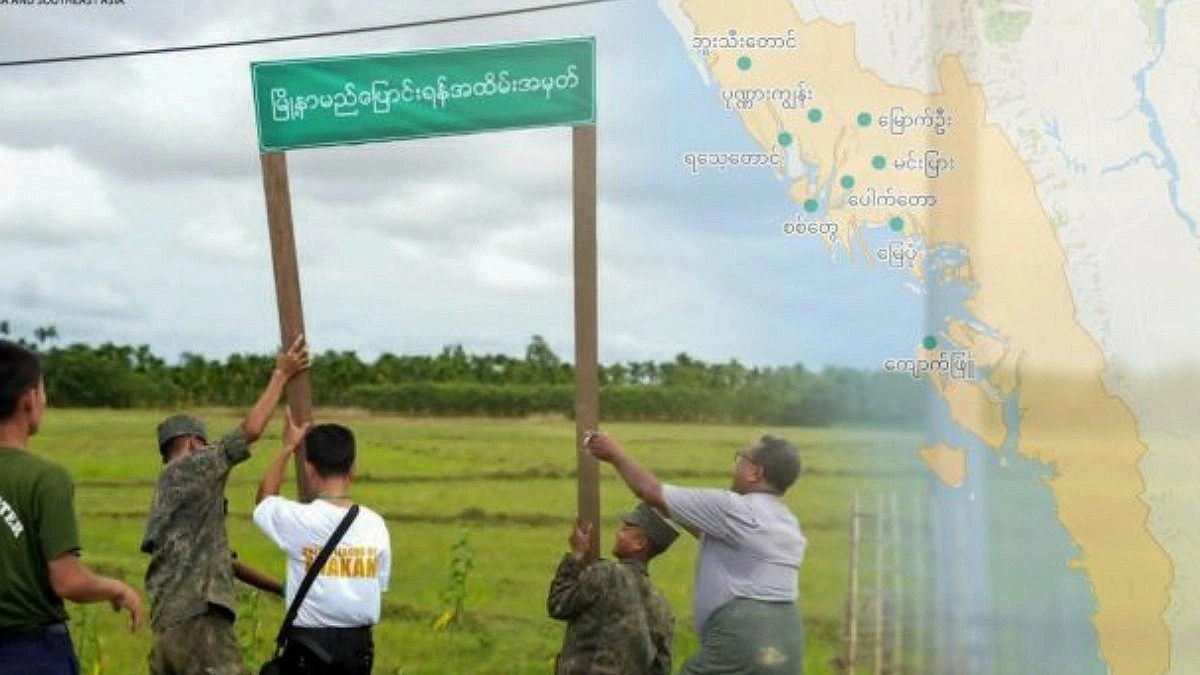
Several more towns in Maungdaw and Sittwe districts may also be renamed, according to sources close to the Arakan Army.
Myanmar’s ethnic armed group, the Arakan Army, is preparing to rename several towns in a move aimed at reinforcing Rakhine identity and historical continuity. The planned changes include Pauk Taw and Minbya. The Arakan Army currently controls 14 of the 17 townships in western Rakhine State.
The group plans to rename Pauk Taw, which it captured on January 19, 2024, as Virattani (Abode of the Brave). Minbya, which it seized the following month, will be renamed Anjanapura (City of Anjana). The Lemyo River, which flows through Rakhine State, was known as Anjana in ancient times. The nearly 230-kilometer river originates in southern China and flows into the Bay of Bengal, splitting into several branches before reaching the sea.
Sources close to the Arakan Army said the group may also rename several towns in Maungdaw and Sittwe districts. However, it has not yet disclosed details.
One source said, “We have heard that they are planning to rename many towns. They are starting with Pauk Taw and Minbya for now. Other towns may also receive new names later.”
The Arakan (Rakhine) Kingdom flourished under four dynasties, Dhanyawadi, Vesali, Lemro, and Mrauk-U, from the fourth century to the late eighteenth century. During that period, the kingdom had 17 royal capitals and numerous settlements. Burmese forces conquered the kingdom nearly 240 years ago.
A Minbya resident in his seventies said, “These names come from history. Minbya was an important fortified town during the Lemro and Mrauk-U eras.”
According to local residents, the Arakan Army’s political wing, the United League of Arakan (ULA), the Green Arakha Project, and local youth groups have been planting trees along roadsides in Pauk Taw and Minbya as part of preparations for the renaming initiative.
Under the ULA, the Arakan Army has established a parallel administration with separate departments for governance, justice, education, and health. Its education department is developing a new curriculum in the Rakhine language. Under the plan, schools will introduce Rakhine as the language of instruction in Grade 12 in place of Burmese.
Sources said the Grade 12 Rakhine-language curriculum has already been completed and is awaiting publication.
An education official said, “It will not be introduced this year. It will likely take effect from the next academic year.”
In 2025, the Arakan Army reorganized the 14 townships under its control in Rakhine, along with neighboring Paletwa Township in Chin State, into eight districts.
Arakan Army chief Tun Myat Naing has pledged to capture the remaining townships of Sittwe, Kyaukphyu, and Manaung by 2027. He has vowed to continue fighting until achieving what he describes as a “final victory.” Local residents said clashes are still ongoing in Sittwe and Kyaukphyu.
Analysts say the Arakan Army aims to reconnect present-day settlements with the cultural and political heritage of the ancient Rakhine kingdoms. Through the initiative, it seeks to restore Rakhine’s historical legacy and integrate it into contemporary governance.
A young Rakhine resident told The Irrawaddy, “It seems they want to bring back the old names and historical identity. For us, what matters more than changing names is whether people are governed properly and kept safe.”
Source: The Irrawaddy

