
Palak Lake: the mystery of a lost village beneath the blue water

Collected Photo
The roads through the hills are never easy. In the southernmost part of Mizoram, they seem even more winding and isolated. There are steep hills on one side and deep ravines on the other. In some places, dense forests lean over the roads while small settlements appear along the hillsides. The farther one travels, the more the familiar sounds of civilization fade into the background.
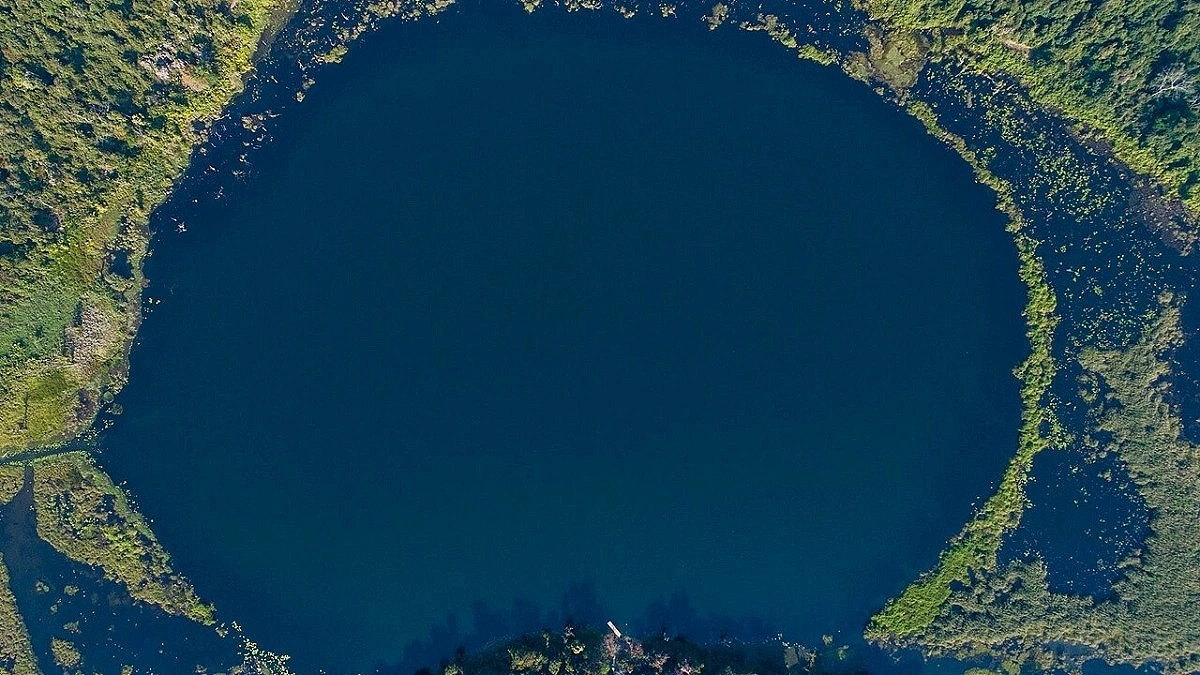
Then suddenly, a door to wonder opens ahead. A vast mirror of blue water appears amid the green hills.
From a distance, it looks as if someone has perfectly painted a piece of sky onto the body of the hills. The smell of the forest fills the air. Silence surrounds the area. In the middle of that silence lies Palak Lake.
But if one gazes at this beauty for a little longer, a question may arise. Is there really an old story hidden beneath these waters?
The story that local people have passed down through generations is not simply a tale of travel. It involves a lost village, a giant snake, a widow and a devastating flood. And at the end of that story, the lake is born.
That is why Palak Lake is not merely the name of a natural beauty spot. It is a remarkable blend of nature and folklore in the southern hills of Mizoram.
Palak Lake is located near Fura village in Saiha district in southern Mizoram within the Mara Autonomous District Council area. Locals know it as “Pala Tipo” or “Pala Tipa.”
In the Mara language, the name is associated with the meaning “to swallow” or “to drown.” The name itself seems to hint at the lake’s most famous folklore.
Palak is one of Mizoram’s largest natural lakes. It is located within the Indo Burma biodiversity hotspot. The lake and the surrounding hill forests are therefore important not only for their beauty but also for biodiversity.
The lake is an important part of the Palak Wildlife Sanctuary. The Palak Wetland Reserve covers about 18.5 square kilometers. Its main water body covers about 1.5 square kilometers.
Two water bodies are also mentioned here, Tipo Pino and Tipo Tao. Their water levels change with the seasons.
The lake’s surface is about 274 meters above sea level. The surrounding Liapahlo mountain range has elevations of about 500 to 589 meters. As a result, a natural amphitheater of hills, forests and water has formed around Palak Lake.
The hilly landscape of Mizoram may seem somewhat familiar to readers in Bangladesh, with its green hills, clouds, rain and dense forests. But Palak has a different kind of solitude. There are no crowds of tourists or the bustle of a major tourist destination. Rather, the distance and difficult access have preserved the place’s unique character.
Palak Lake is about 360 kilometers from Mizoram’s capital Aizawl and about 97 kilometers from Saiha town.
The nearest village to the lake is Fura, about six kilometers away. For tourists, Fura is essentially the gateway to Palak Lake. Settlements such as Tongkalong and Longban villages are also nearby.
However, reaching Palak Lake cannot be described as easy.
The road becomes difficult after Fura. Small or light vehicles are relatively convenient for traveling there. This difficult route may itself be one of the reasons behind Palak’s beauty. When a place is not easy to reach, the joy of getting there is different too.
As one travels through the hills, the surroundings gradually change. Human settlements become fewer. The forest becomes denser. The sounds grow quieter. Then suddenly, when blue water appears ahead, it feels as though everything along the way had been preparation for reaching that very scene.
The most famous story associated with Palak Lake begins many centuries ago.
According to local folklore, there was once a village called Hnichaw at the site of the present lake. About 300 families lived there.
In the middle of the village stood a huge rock. Beneath the rock was a deep cave. A giant snake lived inside the cave.
The next part of the story seems like a dark chapter from a hill folklore tale.
At one point, the villagers began noticing that children and livestock were disappearing one after another. There was no trace of them. No one knew who or what was taking them away.
After some time, suspicion fell on the giant snake.
The villagers decided that they had to catch the snake by any means necessary.
After many attempts, they created a huge fishing stake or trap like arrangement. In some versions of the story, a goat was used as bait while other versions say a dog was used to lure the snake out of the cave.
Eventually, the snake was caught.
It was then killed and its meat was distributed among the villagers.
And that is where the most terrifying part of the story begins.
According to one popular version of the story, a widow and her two children received the snake’s head as their share.
When she brought it home and began cooking it, she suddenly noticed something unusual.
The dead snake’s eyes were apparently still moving.
Terrified, the woman threw the cooking pot outside the house.
Then the disaster began.
Water started flowing out of the pot and collecting in the yard. At first, there was only a little. Then there was more. The water kept rising.
Realizing the danger, the woman fled with her two children.
But the water did not stop.
Within moments, it spread across the entire village.
Hnichaw was submerged.
Hundreds of people lost their lives.
And according to local folklore, Palak Lake was later formed at the site of the submerged village.
That is why it is called “Pala Tipo,” the lake that swallowed or drowned.
However, another version of the story is also locally told.
According to this version, the villagers managed to catch the snake but could not fully control it. Eventually, the snake’s body was cut in the middle.
The lower part of the snake’s body struck the deep cave.
A powerful earthquake supposedly began immediately afterward.
The ground split open and water emerged through the cracks, quickly spreading in all directions. Eventually, the entire village went under water.
The details of the two stories are different. But the ending is the same. A village disappears and a vast body of water is formed in its place.
In reality, there is no confirmed historical or scientific evidence for this folklore. It is a belief and story that has been passed down orally among local people for generations.
But the truth of folklore cannot always be found only in historical records. When a story becomes part of a community’s memory, it develops a life of its own.
The same appears to have happened with Palak Lake.
The story of Hnichaw village is not the only mystery surrounding Palak.
For generations, local people have told various stories about invisible people, strange sounds at night, the presence of unknown creatures or a mysterious force living deep beneath the lake.
Some believe that the spirits of the people from Hnichaw village who drowned in the lake are still connected to the area.
It is difficult to verify the truth of these beliefs. But when standing beside a vast lake amid the silence of the hills late at night, it is not difficult to understand how human imagination can easily blend with stories.
Another strange story is also associated with Palak Lake.
It is said that a British officer once dropped a sword into the lake. He asked a local man to retrieve it. The man returned three days later.
When asked why it had taken so long, his answer was even more astonishing.
He reportedly went beneath the lake and found the sword. He became so engrossed in eating and drinking there that it took him three days to return!
It is not known whether the story is true. But in the mysterious atmosphere surrounding Palak Lake, such a story does not seem unusual either.
Looking at the lake, one may wonder. Who knows whether the story of a lost world is really hidden beneath the water?
Folklore has made Palak mysterious, but nature has given it an even greater identity.
Because Palak Lake and its surrounding forests are located within the Indo Burma biodiversity hotspot, the area is extremely rich in biodiversity.
The lake is home to various types of fish, shrimp, snails, crabs, turtles and other aquatic animals. The dense hill forests around it are also home to numerous birds.
More than 70 bird species have been documented in the area. They include the Nepal Fulvetta, White Bellied Yuhina, Little Spiderhunter, Streaked Spiderhunter, Yellow Wagtail, Black Capped Kingfisher, Hooded Pitta, Spot Breasted Scimitar Babbler and White Rumped Munia. Bird calls, dense forests and blue water make Palak an undoubtedly attractive destination for nature lovers.
Local people also report the movement of wild elephants in the area because of the dense forests.
Palak Lake has significant potential for tourism. But that potential also comes with responsibility.
As tourism increases in places of natural beauty, plastic waste, unplanned construction, noise pollution and pressure on forests also increase. Such impacts can be harmful to sensitive wetlands and hill ecosystems like Palak in the long term. Therefore, conservation must be given equal importance alongside tourism development here.
There are also reports of an initiative to bring an area of about 15 kilometers around the lake under conservation. The main goal is to protect the lake and the surrounding forests, wetlands and wildlife habitats.
Because Palak’s beauty is not only in its water.
Its beauty lies in the hills, forests, bird calls, silence and people’s stories.
Travel is not only about going to a new place. Sometimes, taking home the stories connected to a place is also part of the journey.
Palak Lake is such a place.
When you go there, the blue water catches your eye first. Then the green hills. Then the dense forest. Then perhaps the call of a bird.
But if you stay a little longer, you may feel that there is something more within the silence.
Perhaps the memory of Hnichaw village.
Perhaps the story of the giant snake.
Perhaps the terror of a widow.
Perhaps the folk memory of hundreds of people lost in the water.
Or perhaps there is nothing at all. Perhaps it is simply the natural mystery of the hill landscape, to which people have given meaning through stories.
Whatever the truth may be, that is where Palak Lake’s appeal lies.
Looking at its waters, it feels as though the history of some places is not written in books. It is passed from mouth to mouth and from one generation to another.
Perhaps the history of Palak Lake is like that too.
Yet when standing in the silence of the hills and looking at the lake, one question keeps returning.
Is a village really lost beneath these blue waters, or is the story of that lost village what has kept Palak Lake mysterious forever?
Perhaps it is better not to find the answer.
Because the beauty of some mysteries does not lie in solving them. They remain beautiful by remaining mysteries.


