
Government to drill 150 gas wells by 2031

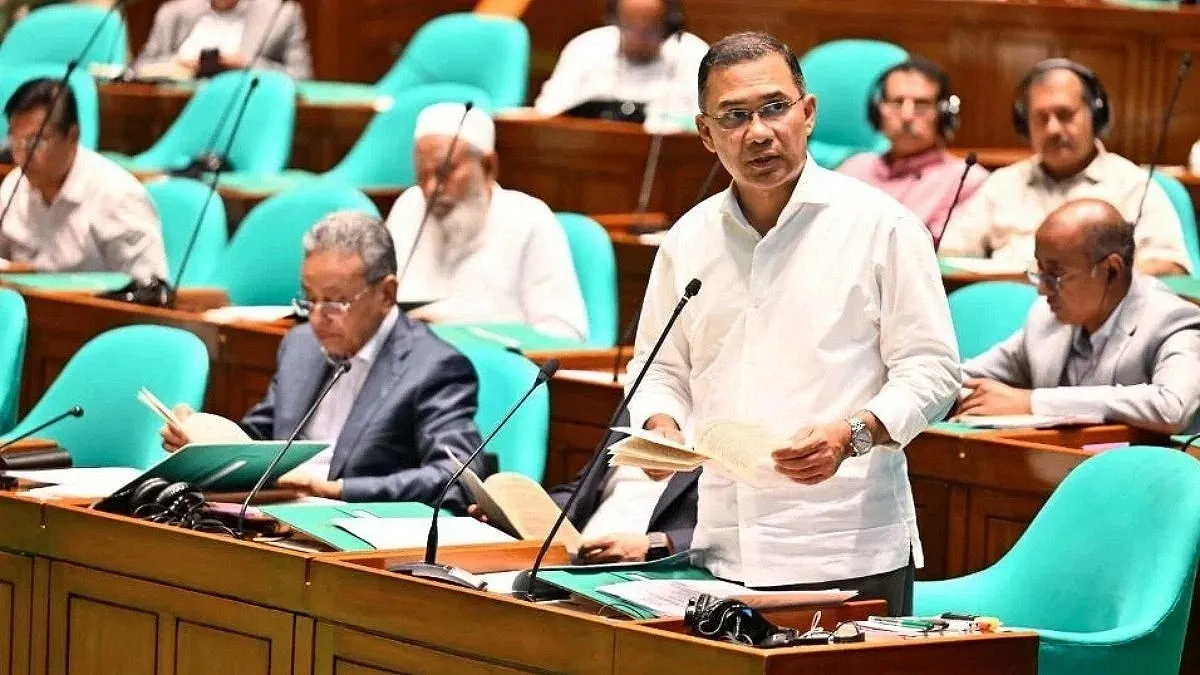
Prime Minister speaks in Parliament. File photo
The government has adopted a new plan to prevent gas shortages in the industrial sector. Prime Minister Tarique Rahman said the government has set a target of drilling 150 gas wells by 2030 to 2031. He made the disclosure during the question-and-answer session in Parliament on Wednesday (September 9).
The prime minister said, “A total of 4,500 km of 2D seismic surveys and 4,200 square km of 3D seismic surveys will be conducted to explore domestic gas sources.”
He said an international bidding round was invited on May 24 to appoint international companies for oil and gas exploration and extraction in 26 offshore blocks. The deadline for submitting bids has been set for November 2026. To attract international investment in onshore oil and gas exploration, the government has undertaken the process of formulating the Bangladesh Onshore Model PSC 2026.
New LNG Terminals
The prime minister informed Parliament that another LNG terminal will be built in the country. He said, “The country’s existing two floating LNG terminals can supply an average of around 935 million cubic feet of gas per day. To ensure that the industrial sector does not face major losses due to sudden gas shortages in the future, activities are underway to establish a new floating LNG terminal at Kutubjom in Maheshkhali and a land-based LNG terminal at Matarbari.”
“According to the plan, regasified LNG will be supplied from the Kutubjom floating LNG terminal in 2028 and from the land-based LNG terminal by 2030,” he added.
The prime minister said feasibility assessment activities are underway to urgently establish a new floating terminal at a suitable location in the deep sea, considering the Payra or Mongla port areas or the coastal areas of the southwestern region.
On Bhola’s Gas
In response to a supplementary question from Parliament member Sultana Ahmed, Prime Minister Tarique Rahman said, “If a plan is made to bring Bhola’s gas to the mainland through a pipeline, it will take at least seven years to implement. We want to establish industries there in Bhola. Some industrial entrepreneurs are already trying to establish their industries there. If industries are established in Bhola, employment opportunities will be created there and the size of the local economy will also increase.”
Apart from this, the head of government said there is a plan to establish a fertilizer factory there to ensure proper use of Bhola’s gas. He also mentioned plans to build a 500 MW power plant.
Projects, Extensions and Corruption
In response to a supplementary question from Mobasher Alam Bhuiyan, a Parliament member from Cumilla 10, the prime minister said, “The current government is taking steps based on the white paper prepared by the interim government on the corruption of the past 17 years.”
He said, “The economy of this country has been wasted and looted in various ways. The white paper presents a clear picture of these issues. The current government is taking steps keeping that paper in front of it.”
Regarding extensions in project timelines and increases in costs, the prime minister said, “The extension of timelines and increases in costs of government development projects in the country generally do not occur for a single reason. Rather, multiple weaknesses in project formulation, approval, land acquisition, financing, procurement and management are interconnected and create this problem. After the trend of extending project timelines and increasing costs came to the government’s attention, various measures have been taken.”
Outlining the measures, the prime minister said steps have been taken to ensure accurate feasibility studies before taking up new projects; expedite implementation preparations after project approval; revise existing guidelines to make them timely in relation to project formulation, processing, approval and revision; and establish dashboards in the relevant ministries and divisions to strengthen monitoring of implementation progress of ongoing projects.
Initiatives have also been taken for regular project reviews and increased close supervision at the field level.
In addition, coordination among relevant agencies has been strengthened to expedite land acquisition and utility relocation activities. For projects that were not completed within the stipulated time, ministries have been instructed to review the causes of delays, irregularities, cost increases and revisions and take action against individuals and institutions responsible for delays according to the rules.
For projects with less than 30 percent implementation progress, the government has instructed ministries and divisions to take appropriate measures regarding restructuring, changing the scope or continuing the projects after considering their utility and effectiveness.
Instructions have also been given to take up cluster projects under integrated programs instead of taking up projects separately; expand the use of e GP in the government procurement system; appoint project directors giving the highest priority to professional qualifications, skills and practical experience; ensure continuity of responsibilities where necessary; update existing policies; and give importance to taking up projects under the Public Private Partnership (PPP) model.
The prime minister said an initiative has also been taken to update the Public Procurement Rules 2025 to make government procurement more competitive and accountable.
