
Ministers’ foreign trip hotel rent to rise 47%

Graphics: Agamir Somoy
The hotel rent and daily cash allowance for ministers and state ministers during foreign trips are being increased by up to 47 percent.
A government committee formed for hotel rent and allowance redetermination has finalized a framework, which will soon be presented to the finance minister for approval. Ministry of Foreign Affairs and Ministry of Finance sources confirmed the matter to Agamir Somoy.
According to the Ministry of Foreign Affairs, hotel rent and allowances for the chief justice, the speaker of the Parliament, ministers, and state ministers during official foreign trips have not been increased in more than a decade.
As a result, considering market conditions, the rising cost of living, and major fluctuations in the US dollar exchange rate, a decision was made to review hotel rent and cash allowance rates. Earlier, travel-related daily allowances and facilities were re-determined in 2012, as well as in 2001 and 1995.
During a recent official visit to London, a standard room at a five-star hotel was booked for a minister at $850 per day, which was more than double the set limit. Finance Division later approved the expense.
However, booking a moderate suite at the same hotel would have exceeded the ceiling by five to six times. In light of these circumstances, Ministry of Foreign Affairs sent a proposal to the Ministry of Finance on 18 April, requesting that hotel rent ceilings for official foreign visits by ministers, state ministers, and advisers be fixed based on actual expenses.
Following the proposal from the Ministry of Foreign Affairs, the Finance Division formed a seven-member committee, which reviewed the matter and finalized a recommendation. The committee divided countries worldwide into high-cost, medium-cost, and low-cost categories.
The highest allocations for hotel rent and daily allowances were recommended for stays in high-cost countries, while ceilings were progressively reduced for medium-cost and low-cost nations.
The high-cost category includes the United States, Canada, United Kingdom, Switzerland, France, Germany, Italy, Belgium, Netherlands, Austria, Sweden, Norway, Denmark, Finland, Spain, Portugal, Ireland, Russia, Japan, Singapore, South Korea, Australia, New Zealand, China, Hong Kong, the United Arab Emirates (Dubai), Qatar, Saudi Arabia, Kuwait, Bahrain, and Oman.
The medium-cost category consists of Malaysia, Thailand, Indonesia, Vietnam, Philippines, Sri Lanka, India, Pakistan, Malé (Maldives), Turkey, Poland, Hungary, Czech Republic, Romania, Kazakhstan, Uzbekistan, Brazil, Argentina, Mexico, Chile, Colombia, Egypt, Jordan, Morocco, and Lebanon.
The low-cost category includes Nepal, Bhutan, Afghanistan, Myanmar, Kenya, Uganda, Tanzania, Nigeria, Sudan, Ethiopia, Zimbabwe, Laos, Cambodia, and Papua New Guinea.
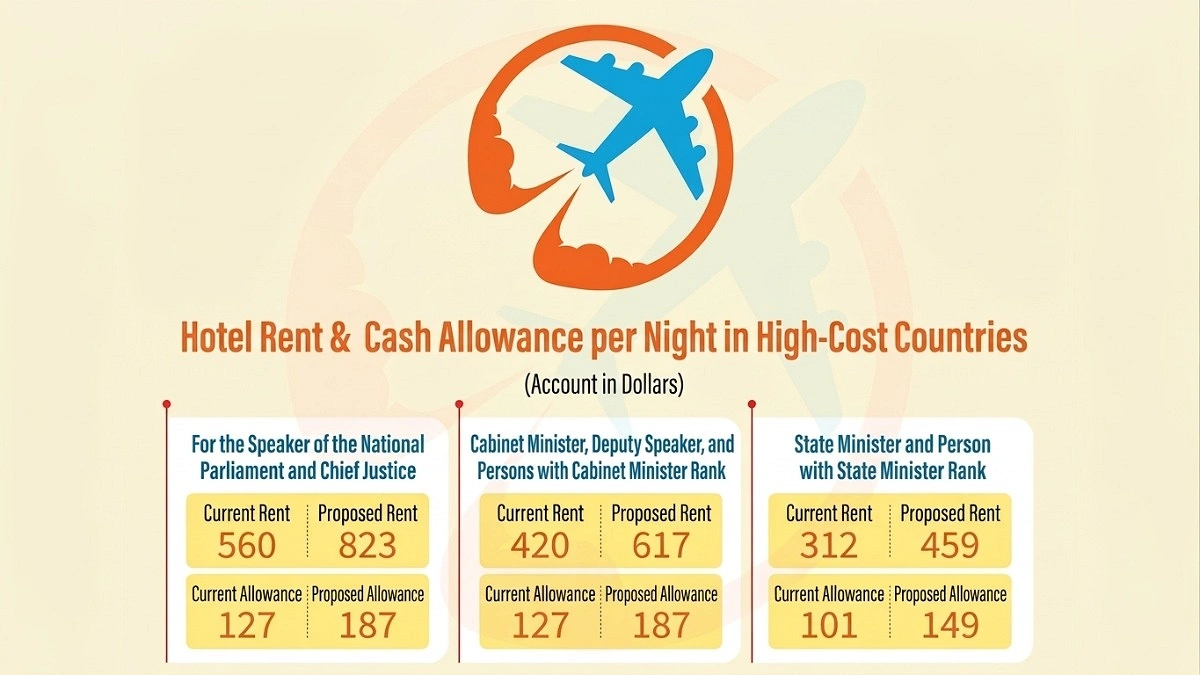
The committee on “Redetermination of Payable Allowances and Other Facilities in Foreign Currency During Official Foreign Travel” recommended raising the hotel rent ceiling for the speaker and the chief justice in high-cost countries from $560 to $823.
For medium-cost countries, the proposed increase is from $459 to $675, and for low-cost countries, from $393 to $578, representing a 47 percent increase over current rates. For the aforementioned dignitaries, the daily cash allowance in high-cost countries is proposed to rise from $127 to $187.
For medium-cost and low-cost countries, maintaining the same ceiling, the daily cash allowance is recommended to increase from $101 to $149, reflecting a 47 percent increase under the new proposal.
For ministers, the deputy speaker, and persons holding minister rank, the proposed nightly hotel rent in high-cost countries increases from $420 to $617. For medium-cost countries, it is proposed to increase from $346 to $509, and for low-cost countries, from $295 to $434, which is 47 percent higher than current rates.
The daily cash allowance for these individuals in high-cost countries is set to rise from $127 to $187, while for medium-cost and low-cost countries, maintaining the same ceiling, it is recommended to increase from $101 to $149, an increase of 47 percent.
For state ministers and persons holding state minister rank, the recommended hotel rent in high-cost countries increases from $312 to $459, in medium-cost countries from $262 to $385, and in low-cost countries from $230 to $338, marking a 47 percent rise over existing rates.
Their daily cash allowance for high-cost countries is set to increase from $101 to $149 per day. Keeping the same ceiling for medium-cost and low-cost countries, the cash allowance is proposed to rise from $87 to $128, also an increase of 47 percent.
Ministry of Finance Additional Secretary and head of the committee Mohammad Azad Sallal told Agamir Somoy on Tuesday, “Considering the changes in the US dollar exchange rate and the increase in the cost of living, a decision has been made to increase the hotel rent and cash allowance rates for ministers and state ministers staying abroad. However, the matter is still in process. The proposal has been finalized. Upon receiving approval, it will be published.”
The proposal submitted by the Ministry of Foreign Affairs to the Ministry of Finance noted that official foreign trips and participation in international conferences by ministers, state ministers, and advisers are steadily rising to implement the government’s foreign policy - Bangladesh First - and strengthen global economic diplomacy.
However, foreign travel allowances and benefits are being received according to the 2012 ceilings. Under those rules, the maximum daily hotel rent for Group 1 countries is fixed at $420 for ministers and $312 for state ministers.
Due to global inflation and rising expenses - especially in cities hosting international conferences or high-level meetings - it has become impossible to secure suitable accommodation while preserving diplomatic protocol and state dignity within these established ceilings.
The proposal emphasized that many countries do not enforce a fixed upper limit on hotel rent for minister-level delegations, paying instead based on actual costs. During international conferences, delegates must adhere to requirements regarding diplomatic protocol, security, and staying at designated hotels.
Therefore, to safeguard the country’s image, diplomatic protocol, and accommodation standards, the Ministry of Finance was requested to raise the hotel rent ceiling set in 2012 and fix hotel rent for official foreign trips of ministers, state ministers, and advisers based on actual expenditure.


