
Scientists probably finally find a hint of 'Dark Matter'
- It is that puzzling, invisible stuff that glues universe together

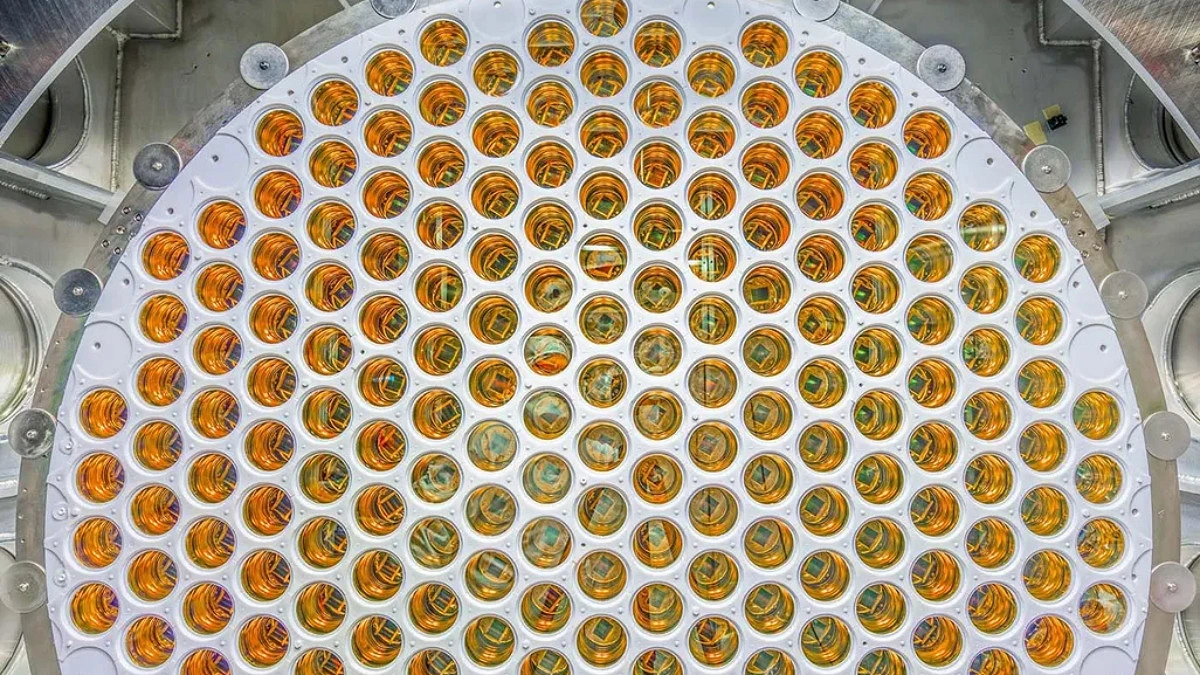
Underground liquid xenon chambers to catch any glimpse of a flash of light caused by 'unknown matter'. Photo courtesy: Smithsonian Magazine.
An underground detector in South Dakota has picked up an unusual signal that may be a sign of dark matter—the invisible, hypothetical substance estimated to account for roughly 85 percent of all matter in the universe.
While researchers from the LUX-ZEPLIN (LZ) dark matter experiment emphasize they are not officially claiming a discovery, the observation could mark a major milestone in detecting the hidden framework of the cosmos.
"It could be the first hint of a dark matter observation," Sam Eriksen, a particle physicist at the University of Bristol, told Reuters.
The team presented their findings on September 1 at the 2026 TeV Particle Astrophysics conference in Japan and uploaded a preprint of their paper to arXiv, with plans to submit it to Physical Review Letters.
Uncovering the Signal
Dark matter cannot be observed directly because it does not emit, absorb, or reflect light. Its presence is inferred primarily through gravitational effects on visible matter, such as the way large galaxies bend passing starlight far more than their visible mass should allow.
A leading hypothesis suggests dark matter consists of Weakly Interacting Massive Particles (WIMPs)—theoretical entities that rarely interact with ordinary matter.
The anomalous signal emerged from 220 days of data gathered between March 2023 and April 2024. After searching low-energy ranges without success, researchers expanded their analysis to higher energy thresholds, revealing a single high-energy interaction that standard particles fail to easily explain.
If the event was caused by dark matter, the candidate WIMP would have a mass more than 200 times that of a proton. However, statistical calculations indicate a 0.5 percent chance that the readout resulted from background noise or other known processes, falling short of the strict statistical threshold required for an official discovery.
Scientific Community Reacts
The announcement has drawn a range of responses across the astrophysics community:
Cautious Skepticism: Dan Hooper, a theoretical physicist at the University of Wisconsin–Madison, noted to Science News that a single event makes it difficult to draw firm conclusions. Similarly, Nicole Bell of the University of Melbourne described it as an "interesting observation," but stressed that it remains "very early days."
Enthusiastic Optimism: Katherine Freese, a theoretical astrophysicist at the University of Texas at Austin, expressed excitement over the finding and praised the research team's data analysis techniques. Wick Haxton, a theoretical physicist at UC Berkeley, told Science that the finding feels "like seeing a present under the Christmas tree."
Co-author Richard Gaitskell of Brown University tells the New York Times that after extensive internal review, the team felt ready to present the data to the wider scientific community for feedback and further evaluation.
Scientists first hypothesized the existence of dark matter nearly a century ago. In the 1930s, Swiss-American astronomer Fritz Zwicky observed that galaxies within the Coma cluster were moving at speeds high enough to sling them into deep space, yet they remained gravitationally bound together. American astronomer Vera Rubin further strengthened this theory in the 1970s after discovering that individual galaxies rotated at speeds far too fast to hold themselves together without an invisible cosmic glue.
(Source: Smithsonian Magazine)
