


Magnitude 7.7 quake kills 20 in Eastern Indonesia

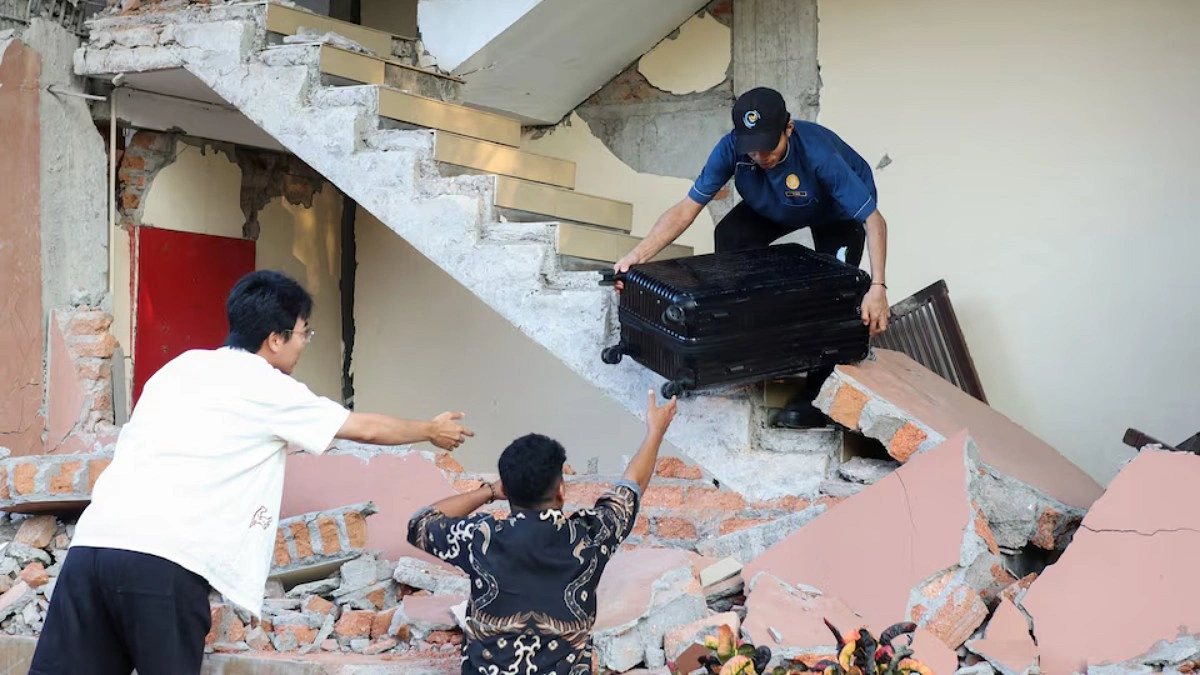
Photo: REUTERS
At least 20 people died after a powerful magnitude 7.7 earthquake and dozens of aftershocks struck eastern Indonesia on Saturday, according to a rescue agency.
Emanuel Melkiades Laka Lena, the governor of East Nusa Tenggara Province, informed a press conference that the five victims died when collapsing rubble fell on them while they were sleeping.
While the national disaster mitigation agency (BNPB) initially reported a toll of one dead and four injured, the governor’s count indicated a higher number of fatalities.
Authorities recorded tsunami waves of less than 1 meter (3 feet) in several areas of the Southeast Asian nation, leading officials to lift the tsunami warning roughly three hours after the tremor.
In Maumere, the main town of Sikka Regency on Flores Island, verified video showed buildings collapsing into dust and rubble as residents screamed and fled into the streets.
Nona, a 51-year-old resident of Talibura village in East Nusa Tenggara, described the terrifying moment, saying, “The quake was massive, the shock was so strong, we were resting at home. There were 13 of us inside the house and we all ran to save ourselves.”
BNPB reported that strong shaking lasted for about one minute across East Nusa Tenggara, West Nusa Tenggara, and parts of South Sulawesi. In a statement, the agency observed that “Most of the people felt the shock and scattered out of their homes.”
In the Ende district, Kompas TV footage captured a hospital moving patients outdoors, while Kompas.com reported at least one landslide. In Nagekeo, around 2,000 residents evacuated as the quake damaged houses, warehouses, and government facilities. BNPB also noted traffic congestion and power outages throughout the regency.
Indonesian geophysics agency (BMKG) recorded the initial quake at 4:58 am at a depth of 15 kilometers (9 miles), which was followed by multiple aftershocks.
Meanwhile, Australia’s tsunami warning center confirmed that the undersea earthquake posed no tsunami threat to the Australian mainland, islands, or territories. Indonesia remains highly susceptible to such events because it straddles the “Pacific Ring of Fire,” a seismically active zone where various tectonic plates meet to create numerous earthquakes and volcanoes.
Source: Reuters (adapted)

