
Bangladesh to establish SDG villages following China’s model
- Three issues prioritized in village selection
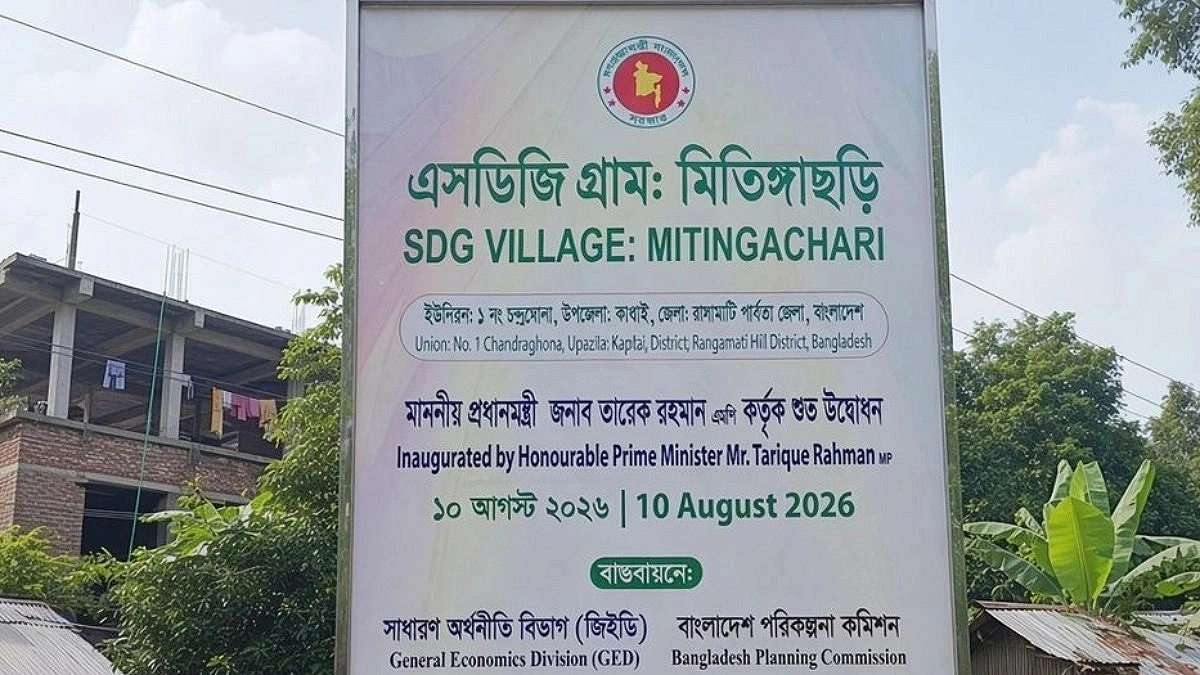
- Nafanagar, Pankhali and Mitingachhari villages to serve as laboratories
- 20 problems identified

Collected Photo
Bangladesh has always shown a particular interest in imitation and has made relatively little effort to create its own models. This time, the country is adopting China’s SDG Village concept. With China’s success presented as a model to follow, three SDG villages are now being established in Bangladesh. So far, 20 problems in these villages have been identified. The General Economics Division of the Planning Commission will oversee everything, from selecting and identifying the villages to implementing the initiative.
The villages are Nafanagar in Bochaganj of Dinajpur, Pankhali in Dacope Upazila of Khulna, and Mitingachhari in Kaptai Upazila of Rangamati. Three issues were prioritized in selecting the villages. These are poverty prone areas, areas vulnerable to climate and environmental risks, and hilly areas.
Dr. Manzur Hossain, Member and Secretary of the General Economics Division, told Agamir Somoy, “There is nothing to imitate. Not only China, but many other countries, including Thailand, have implemented this village initiative. We are also taking this initiative for the first time in the country. It will be like conducting an experiment in a laboratory. No special allocation or project will be undertaken for these villages. Instead, existing government services will be coordinated. After one year, the condition of the villages will be evaluated. It would be wrong to say that we are copying or following any particular country here.”
Sources said the three villages have been selected as a pilot program. The plan is to ensure that poverty, child marriage and unemployment do not persist, that villages do not disappear because of river erosion, and that they are not completely submerged by floods. The government has developed a plan for the three villages under which their problems will be addressed and the villages will be presented to the world as examples. From these villages, the light of the Sustainable Development Goals, or SDGs, will spread across the country.
China’s SDG Village
According to a report by the General Economics Division, the SDG Village initiative in China was undertaken through a joint initiative of the China International Center for Economic and Technical Exchange, the Women’s Federation of Yunnan Province and the Yongren County Government, with financial support from Mary Kay Inc. The SDG Village activities were implemented in two phases.
Beginning in 2017, the first phase focused on eliminating extreme poverty among ethnic minority women in mountainous areas, particularly in Yunnan Province. After achieving the target in 2020, the second phase, covering 2020 to 2025, emphasized sustainable development and a strong rural economy at the village level as part of the rural revitalization strategy. Under the UNDP China Gender Equality and Social Inclusion program, women, poor people and older people were given priority. The initiative included various women friendly activities, such as local women’s organizations, women’s handicraft groups and environmentally friendly agricultural training centers for women.
In addition, to ensure women’s participation, women were appointed not only as beneficiaries but also as management staff, consultants and experts. The SDG Village initiative brought significant changes to Yipula Village. The poverty rate was 28 percent in 2017, but it has now fallen to zero percent. Average income increased from 5,000 yuan in 2015 to 14,218 yuan in 2021. A total of 607 women were empowered through employment, increased income and community leadership. As a result of local employment and entrepreneurship opportunities, 120 long term migrant workers and 210 seasonal migrant workers returned to the village. In 2021, the total income of the Yipula Rural Ecotourism Cooperative reached 300,000 yuan.
Bangladesh’s Three Villages
Sources at the General Economics Division of the Planning Commission said the six challenges facing the hilly village of Mitingachhari are geographical remoteness and communication problems, inadequate maternal and child healthcare services, relatively low educational attainment, landslides caused by climate change, excessive rainfall and a high unemployment rate. The village’s main challenge is its remote hilly geographical location.
Nafanagar has been included in the list of government and various development initiatives for transformation into a model village, or SDG Village, by ensuring poverty reduction, quality education, good health, safe water and sanitation. The problems in Nafanagar include being a poverty prone area, wage inequality between men and women, and men’s reluctance to work. In addition, the village is prone to seasonal storms and faces seasonal unemployment, a shortage of safe drinking water, a high rate of child marriage and a high school dropout rate.
The problems in Pankhali include severe river erosion and salinity, climate risks, shortages of safe drinking water and irrigation facilities, and unemployment among educated people as well as seasonal unemployment.
