
Everyone India has sheltered, from the Dalai Lama to Sheikh Hasina

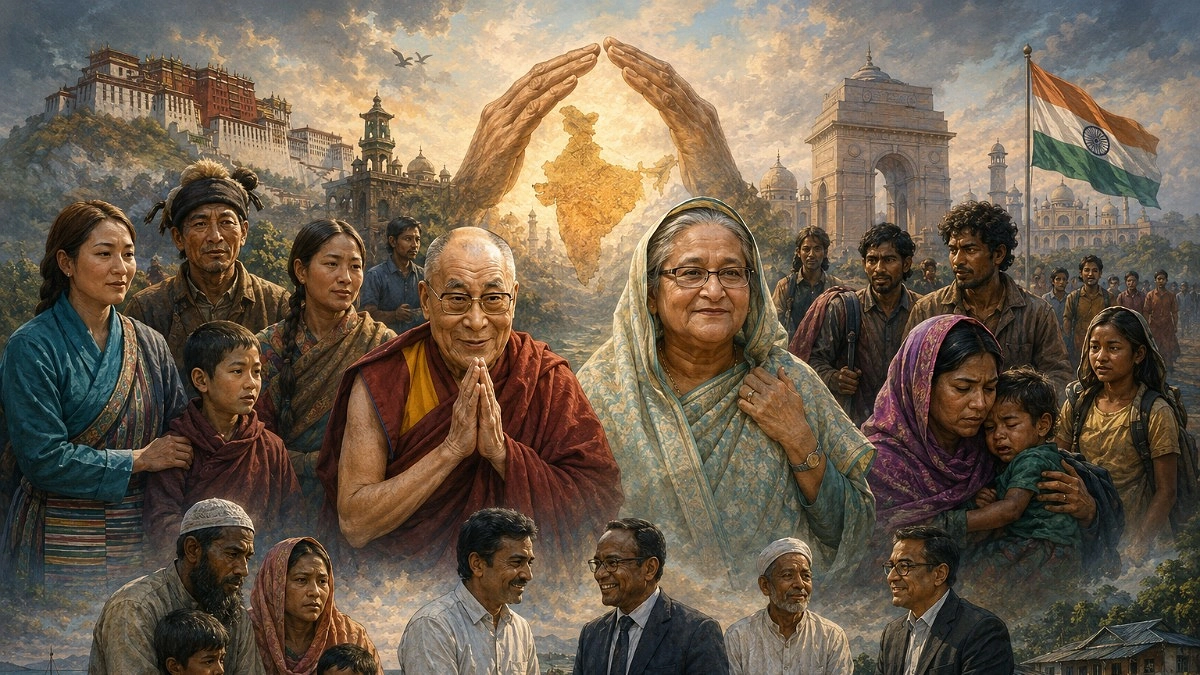
Picture: Generated by AI
When Sheikh Hasina landed at the Hindon airbase near Delhi on August 5, 2024, hours after resigning as Bangladesh’s prime minister, she joined a long and unusual guest list.
For more than seven decades, India has quietly opened its doors to kings, presidents, spiritual leaders, and hundreds of thousands of ordinary people running from war, persecution, or a mob at their gate. None of them arrived through any formal asylum process, because India simply does not have one. Yet the country has still become one of the largest hosts of displaced people in Asia.
Here is a look at who has found shelter in India, and how each story unfolded.
The Dalai Lama, 1959
The most famous case remains the Dalai Lama’s escape from Lhasa in March 1959, after a failed uprising against Chinese rule in Tibet. He crossed into India on foot and by mule over the Himalayas and wrote directly to Prime Minister Jawaharlal Nehru asking for protection. India granted him asylum on April 3, 1959, according to the Deccan Herald’s account of the episode, and he eventually settled in Dharamshala, in Himachal Pradesh, which became the seat of the Tibetan government in exile.
Tens of thousands of Tibetans followed him over the following decades. India’s Ministry of Home Affairs recorded 72,312 Tibetan refugees in the country as of December 2020, according to Tibetan Review, while the Central Tibetan Administration’s own census work has put combined numbers across India, Nepal, and Bhutan at around 66,000 in more recent counts. A 2024 study cited by the Migration Policy Institute found the exile Tibetan population in the subcontinent had actually fallen by about 17 percent since 2007, from roughly 123,000 to 102,000 in 2022, as younger Tibetans increasingly migrate onward to the United States, Canada, and Europe. NPR reported in November 2025 that schools built for Tibetan refugee children in Dharamshala, once at capacity, are now running at about half strength.
Sheikh Hasina, twice over
Sheikh Hasina’s relationship with India as a place of refuge did not begin in 2024. It began in 1975. Her father, Bangladesh’s founding leader Sheikh Mujibur Rehman, was assassinated along with most of the family on August 15 that year. Hasina, then abroad with her husband and children, escaped the killing and eventually made her way to Delhi, according to reporting by Newslaundry and the Deccan Herald. She lived quietly in the city for six years, reportedly working part time at All India Radio, before returning to Bangladesh in 1981 to take charge of the Awami League, the party her father had founded.
Nearly half a century later, history repeated itself. Hasina resigned and fled Dhaka on August 5, 2024, as protests that began over civil service job quotas turned into a mass uprising against her fifteen year rule. She has remained in India since, and this time the arrangement has proven far more diplomatically fraught. Bangladesh’s interim government has demanded her extradition, and in November 2025 a Dhaka court sentenced her to death in absentia over the crackdown on protesters, according to the Deccan Herald. India has not sent her back. A parliamentary standing committee report presented to the Lok Sabha, also covered by the Deccan Herald, revealed that New Delhi told Dhaka it was continuing to host her in line with what it called a civilisational principle of assisting anybody who seeks help during an existential crisis, while maintaining that she is not being allowed a political platform from Indian soil. Bangladesh’s foreign ministry has objected sharply, particularly after Hasina delivered a public address from India, which it called an affront to the Bangladeshi people, Al Jazeera reported.
Sri Lankan Tamils, since 1983
The largest single refugee population India has ever hosted came not from a single dramatic escape but from a long civil war. Sri Lanka’s ethnic conflict, which pitted the government against the Liberation Tigers of Tamil Eelam, sent waves of Tamil civilians across the Palk Strait into Tamil Nadu starting in 1983. According to figures from India’s Ministry of Home Affairs cited in a ScienceDirect study, more than 304,000 Sri Lankan refugees entered the country between July 1983 and August 2012. Tens of thousands remain. As of January 2022, roughly 58,600 refugees were still living in more than a hundred camps across Tamil Nadu, with another 34,000 registered as living outside the camps, the same study found. Tamil Nadu’s government under Chief Minister M K Stalin has since renamed these settlements rehabilitation camps rather than refugee camps and has funded new housing for residents, many of whom are now second or third generation arrivals who have never seen Sri Lanka. Smaller, more recent waves have continued too. The Tribune reported that since 2022, 315 Sri Lankan Tamils arrived in Rameswaram by boat, driven out by Sri Lanka’s economic collapse rather than war.
The Chakma and Hajong communities
A quieter but equally significant story involves the Chakma, who are Buddhist, and the Hajong, who are Hindu, both originally from the Chittagong Hill Tracts of what was then East Pakistan. They were displaced in the 1960s when the Kaptai hydroelectric dam flooded their homeland, and many also fled religious persecution. They entered India through Assam’s Lushai Hills and were eventually settled by the government in what is now Arunachal Pradesh. India’s Supreme Court ruled in 2015 that eligible members of both communities should be granted citizenship, a decision that has met sustained resistance from local groups in Arunachal Pradesh who argue it would alter the state’s demographic balance, as Scroll and the Observer Research Foundation have both reported. Estimates of the community’s size run close to 100,000, according to Gulf News, though implementation of the court’s order has moved slowly and remains contested.
Maldivian leaders
India has also become a landing spot for Maldivian politicians who fell out of favour at home. Mohamed Nasheed, the Maldives’ first democratically elected president, took refuge inside the Indian High Commission in Male in 2013 after a court there issued a warrant for his arrest, the Deccan Herald reported. Ahmed Adeeb Abdul Ghafoor, a former Maldivian vice president, arrived in Tamil Nadu seeking asylum but was later handed back to Maldivian authorities, who arrested him in 2019.
Rohingya, a harder case
Not every group fleeing across India’s borders has been welcomed the same way. Rohingya Muslims escaping a brutal military crackdown in Myanmar’s Rakhine state have found India far less accommodating. The government told Parliament that more than 14,000 Rohingya registered with the UNHCR were living in the country, though aid groups have estimated the real figure closer to 40,000, according to Gulf News. India’s government has repeatedly told the Supreme Court and Parliament that it does not regard the Rohingya as refugees at all but as illegal migrants, arguing they have no fundamental right to remain and can be deported under the Foreigners Act. Former home minister Rajnath Singh said in one parliamentary address that Rohingya had not followed any proper asylum procedure and that India was not violating international law by considering deportation, since it is not a signatory to the 1951 Refugee Convention. The United Nations has pushed back, arguing that the principle of non refoulement, which bars sending people back into danger, binds India regardless of whether it signed the convention.
A pattern without a policy
What connects the Dalai Lama in 1959 to Sheikh Hasina in 2024 is that both were let in by political judgment rather than law. India has never signed the 1951 Refugee Convention or its 1967 protocol, and it has no domestic refugee statute. Instead, as legal researchers writing for the Lowy Institute and the Stimson Center have noted, each case is handled through ad hoc executive decisions, foreigner registration rules, and occasionally the courts. The result is a country that, by UN estimates, hosts roughly 213,000 refugees and asylum seekers overall, drawn mostly from Sri Lanka, Afghanistan, Tibet, and Myanmar, but where the difference between a welcomed guest and an illegal migrant often comes down to who that person is and what India stands to gain or lose by sheltering them.
That inconsistency is precisely what makes Hasina’s case so delicate. Unlike the Dalai Lama, whose presence never seriously threatened India’s ties with China’s government in exile, or the Tamil refugees, who arrived as ordinary civilians, Hasina is a deposed head of government whom her own country is actively trying to extradite and prosecute. It is a test of how far India’s old habit of offering shelter can stretch before it collides with the diplomatic cost of doing so.
Sources: Deccan Herald, Newslaundry, Al Jazeera, Tibetan Review, Phayul, Migration Policy Institute, NPR, ScienceDirect, The Tribune, Scroll.in, Observer Research Foundation, Gulf News, Lowy Institute, and Stimson Center.
