
Iran–US Agreement Triggers Sharp Political Fault Lines in Tehran

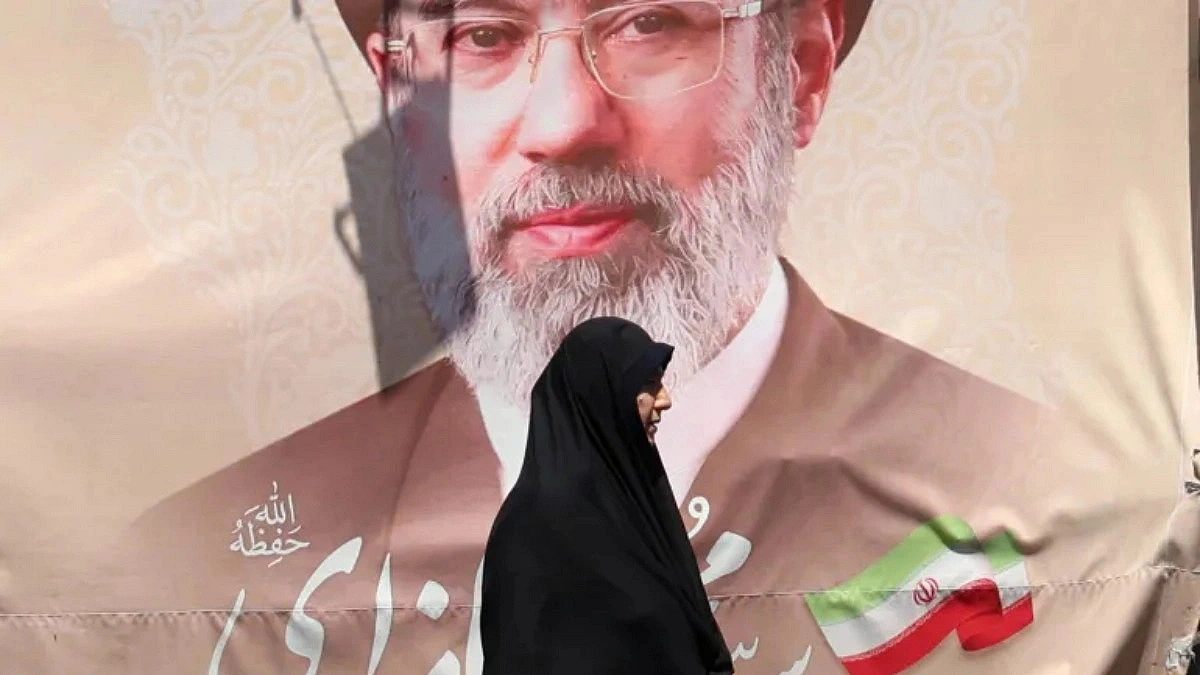
A woman walks past a billboard of Supreme Leader Ayatollah Mojtaba Khamenei in Valiasar Square in Tehran, the capital of Iran. Photo: Collected.
The interim peace agreement between Iran and the United States is not just a new chapter in the diplomatic relations between the two countries. It has also become a major test for Iran's internal politics.
After a long chapter of war, sanctions, economic crisis, and regional tensions, Tehran and Washington are again walking the path of dialogue. However, deep differences have emerged in Iran's political arena over this initiative. Some see it as an opportunity for peace and economic recovery. Others believe it could be the beginning of an even bigger crisis in the future.
At the center of this debate is Iran's new Supreme Leader, Mojtaba Khamenei. Since taking power, he has rarely appeared in public. However, his position on the understanding with the United States has come to light through a written statement.
There, he stated that, in principle, he had a different opinion regarding this agreement. But when President Masoud Pezeshkian personally took responsibility for it and promised to move the matter forward through the National Security Council, he gave his approval.
However, this approval was conditional. Khamenei made it clear that if the United States makes excessive demands or attempts to undermine Iran's fundamental interests, Tehran will not accept them. He commented that the upcoming direct talks do not mean accepting the opponent's position.
According to many analysts, Khamenei's stance is highly significant. He has kept the path to dialogue open while also keeping himself in a politically safe position. If the agreement succeeds, it can be presented as an achievement of the state. If it fails, the responsibility will fall on the government.
On the other hand, President Masoud Pezeshkian and his supporters see this understanding as a pragmatic decision. According to them, there is no alternative to normalizing international relations to emerge from years of sanctions, inflation, unemployment, and economic pressure.
Pezeshkian has described the agreement as a "historic document." He said it is the message of a strong Iran that seeks to establish peace based on mutual respect and equality.
The argument of the pro-government factions is that what could not be solved through war can be achieved through dialogue. Especially issues like economic recovery, attracting foreign investment, facilitating financial transactions, and easing sanctions are extremely important for Iran.
Parliament Speaker and chief negotiator Mohammad Baqer Qalibaf also agrees with this position. He has said, "Now is the time to utilize the political and military successes achieved during the war at the negotiating table." However, he has warned that this is not an easy process. In his words, this understanding is only the beginning of a long and difficult path.
But Iran's hardliner camp is in a completely different position. According to them, any understanding with the United States is inherently risky. They believe there is no reason to trust Washington. In past experience, the United States has broken its promises multiple times and has created pressure on Iran whenever it got the opportunity.
Hardliners are particularly worried. They fear that Iran may be gradually forced to reduce its regional influence through negotiations. They believe that making any concessions on issues like the Strait of Hormuz, the Axis of Resistance, and regional security will weaken the country's strategic position in the long run.
This is why, recently, fierce criticism has been seen against President Pezeshkian, Foreign Minister Abbas Araghchi, and Qalibaf at various state-sponsored rallies. In the eyes of hardliners, these three leaders are the main faces of the understanding with the United States.
At a rally organized in the Shahriar area near the capital Tehran, an influential religious speaker even directly warned the President. However, the President's office has described these remarks as an attempt to create division.
This opposition is also evident within parliament. Several hardline parliament members have demanded that the parliament, which has been operating with limited activities due to the war, be fully activated quickly. Their argument is that it is parliament's responsibility to prevent any understanding that goes against national interests.
Ayatollah Ahmad Alamolhoda, the influential religious leader of Mashhad, the religious city in the northeast, has also reiterated his anti-US stance. His remarks make it clear that the hardline faction still considers the United States as Iran's primary enemy. According to them, the chapter of conflict is not over yet.
However, the position of state institutions is relatively balanced. The Supreme National Security Council has stated that it will move forward with the negotiations while protecting the country's interests and the interests of the so-called 'Axis of Resistance.' At the same time, they have made it clear that plans for countermeasures have already been prepared in advance if the United States violates the agreement.
This entire situation indicates that Iran's internal politics currently stands at a critical crossroads. On one side are economic realities and international pressure. On the other are ideological positions, security concerns, and deep mistrust of the United States.
The future of the Iran-US understanding depends not only on the progress of the two countries' negotiations. It equally depends on the internal balance of power in Tehran, political disagreements, and the final position of the supreme leadership.
For now, one thing is clear: even though the agreement has been signed, the debate inside Iran has not ended. Rather, it can be said that the real political battle has just begun.
