

Women rally in South Korea against prosecution authority abolition

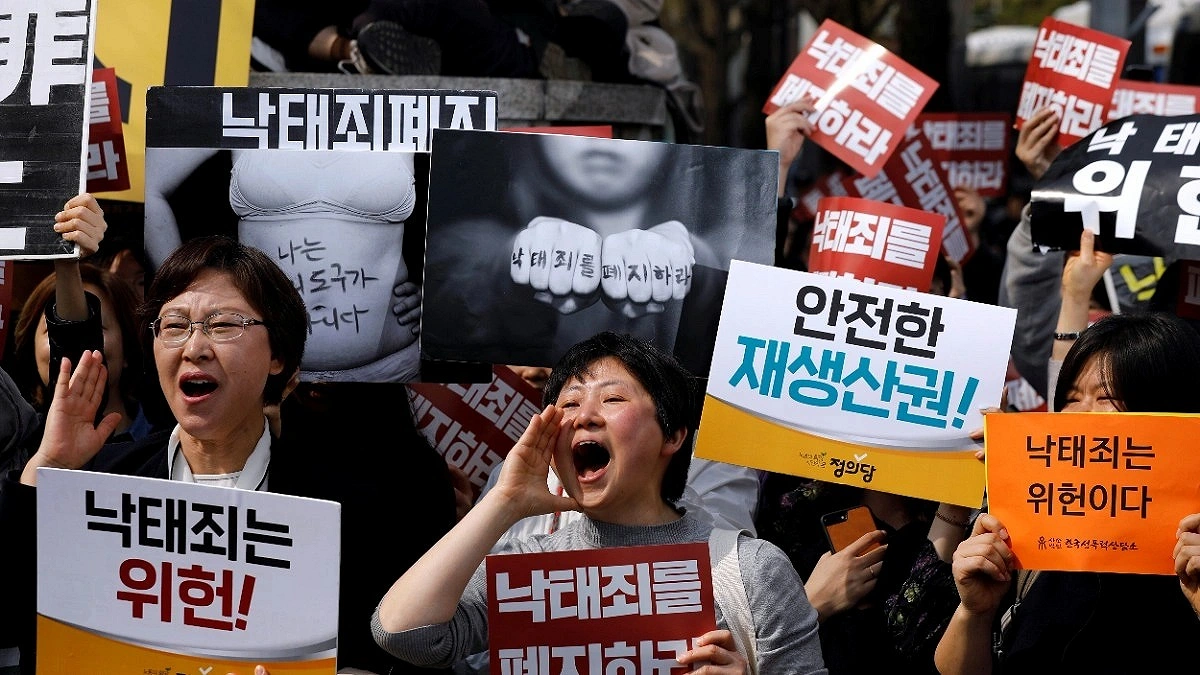
File photo: REUTERS
Women’s Party organized a protest in Seoul, South Korea on Sunday, where around 200 demonstrators gathered to condemn the abolition of the prosecution’s supplementary investigative authority following the Cabinet’s passage of the Criminal Procedure Act amendment on 4 August.
This legislative change, which completely eliminates the prosecution’s direct investigative power for the first time since the act’s 1954 enactment, drew condemnation as a “measure that kills victims twice.”
Demonstrators, many wearing hats and masks, held signs reading “Condemn the Abolition of Supplementary Investigative Authority That Ignores the Cries of Female Violence Victims” and demanded that “President Lee Jae Myung, Exercise Your Veto Power”.
Yu Ji-hye, the spokesperson for the Women’s Party, took the stage to urge President Lee Jae Myung to block the amendment.
She questioned the legislative process, saying, “The president did not even read it properly before the amendment passed the Cabinet meeting,” and asked, “Whose voices were heard in creating this law?”
Yu emphasized the necessity of oversight, adding, “If investigations in female violence cases are conducted poorly, a mechanism to uncover the truth is necessary,” and declared, “We aim to clearly convey our urgency in protecting victims’ rights here today.”
Following her, Park Jin-sook, the head of the Women’s Party’s emergency committee, compared the government’s approach to reckless construction, noting, “The government says it has completed prosecutorial reform and should now start police reform,” and “This sounds like saying we can just demolish the house’s pillars and then remodel.”
The protesters collectively shouted slogans such as “Repeated poor investigations kill victims,” “Improve investigative capabilities instead of complaining about investigative authority,” and “Do not disguise the expansion of investigative gaps as livelihood legislation.”
Female citizens also voiced their anxieties, including one office worker who asked, “Is it truly the executive branch’s role to eliminate the last national system for victim protection merely because the emergence of political prosecutors is feared?”
She expressed deep concern for women’s safety, saying, “In Korea, where there are many cases of violence and murder against women, it is terrifying for female citizens that police organizations, which unhesitatingly cause secondary harm, will have the sole investigative authority.”
Another participant warned of the burden on victims, adding, “If the police do not investigate, victims must gather evidence themselves, report to the media, and create public opinion”. She further challenged the Democratic Party, asking, “Should control mechanisms to prevent poor police investigations be removed simply because the prosecution is disliked?”
Closing the rally, Lee Kyung-ha labeled the amendment an “unprecedented and unparalleled evil law” that would “drive female victims to the brink.” She argued, “The amendment is a law where victims cannot receive any protection unless they become investigative agencies themselves.”
Directing her frustration at the president, she questioned, “They say President Lee Jae Myung has not even properly reviewed the amendment’s contents, but do the women’s desperate pleas to stop the abolition of supplementary investigative authority sound laughable?”
Finally, she issued a stern warning that “Women will not forget and will make the lawmakers and president who overlooked the amendment’s passage pay the price.”
This historic shift marks the end of the prosecution’s direct investigative authority, a system that had remained in place for 72 years.
Source: The Chosun Daily (adapted)