

The Tiny Creatures That Never Leave Your Side

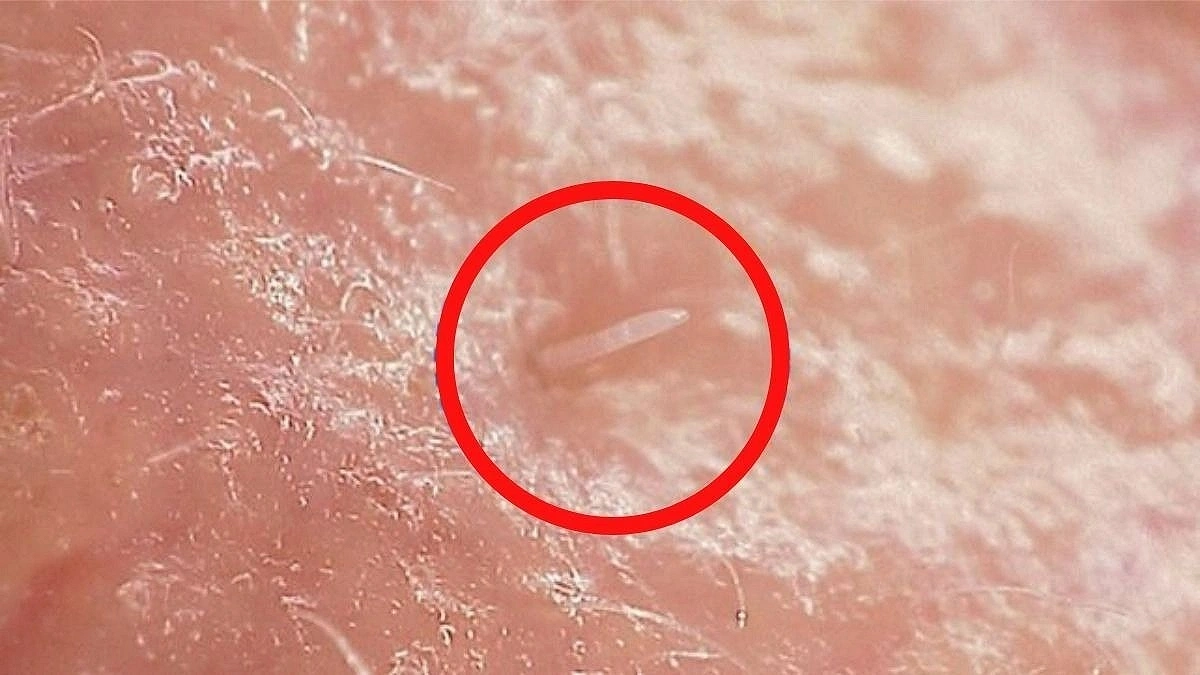
Demodex folliculorum mites seen under a microscope on human skin. Photo: University of Reading
Scrolling through Facebook or reading this article? You may think you’re alone—but you’re not.
At this very moment, millions of microscopic creatures are living on your face, making their homes deep inside your hair follicles.
There’s no need to panic. This isn’t the plot of a horror movie—it’s science.
Nearly every human carries a microscopic mite called Demodex folliculorum. These tiny organisms live almost exclusively in the hair follicles of human skin, particularly on the face. They are born there, feed on dead skin cells, reproduce, and spend their entire lives on the human body.
Now, a new study by researchers from the University of Reading, Bangor University, and the University of Vienna has revealed surprising insights into these tiny creatures.
Published in the journal Molecular Biology and Evolution, the study suggests that these mites may no longer be mere parasites. Instead, they appear to be evolving into permanent companions that have become completely dependent on humans for survival.
Genome Sequencing Reveals Surprising Evolution
For the first time, scientists successfully sequenced the genome of Demodex folliculorum, uncovering several remarkable evolutionary changes.
Alejandra Perotti, an invertebrate biologist at the University of Reading, said the mites possess a genetic makeup unlike that of their closest relatives.
According to Perotti, the protected environment inside human hair follicles has driven significant genetic changes, leading to unusual physical features and behaviors.
Because the mites have virtually no natural predators, face little competition, and rarely interact with other mite populations, their genome has gradually shrunk over time, retaining only the genes essential for survival.
Each of their legs is powered by just three single-celled muscles, and the species has fewer protein-coding genes than any other known mite.
Why They Only Come Out at Night
These tiny mites measure only about one-third of a millimeter in length. Their elongated, sausage-shaped bodies, with a cluster of legs and a mouth at one end, allow them to move easily through hair follicles.
Scientists say the loss of certain genes has also changed their behavior.
For example, they can no longer tolerate sunlight because they have lost the genes that protect against ultraviolet radiation and regulate daytime activity.
The mites also cannot produce melatonin, a hormone that helps regulate movement and reproduction in many small organisms. Instead, they absorb melatonin naturally released by human skin during the evening.
That is why they emerge from hair follicles only after dark, slowly crawling across the skin in search of mates.
An Unusual Reproductive Strategy
Researchers also found that Demodex folliculorum has an unusual reproductive anatomy.
Unlike most mites, the male reproductive organ is positioned toward the front of the body and curves upward, requiring males to maneuver beneath females during mating. The process typically takes place overnight while the mites remain attached to hair follicles.
Scientists believe the species’ extremely limited breeding population has resulted in very little genetic diversity, potentially placing it on an evolutionary dead end that could eventually lead to extinction.
Another unusual finding is that the mites have the highest number of cells during an immature developmental stage. As adults, however, they actually lose cells—a rare phenomenon among arthropods.
Researchers suggest this may represent one of the earliest examples of an arthropod becoming permanently adapted to living alongside humans.
Scientists Debunk a Long-Held Myth
For years, scientists believed Demodex mites lacked an anus, causing waste to accumulate inside their bodies until they died and burst open on human skin—an idea often linked to acne and other skin conditions.
The new study has disproved that theory.
Using advanced imaging techniques, researchers confirmed that the mites do, in fact, possess a tiny anus, meaning they regularly eliminate waste rather than storing it for life.
Bangor University zoologist Henk Braig said the harmless mites have long been unfairly blamed for skin problems.
“The fact that humans and these mites have coexisted for so long suggests they are not harming us,” Braig said. “Instead, they may actually benefit us by feeding on dead skin cells inside our hair follicles, helping keep our skin clean.”
So, the next time you look in the mirror, there’s no reason to be alarmed. Your skin is already home to an invisible team of microscopic caretakers working around the clock.

