
Gazipur
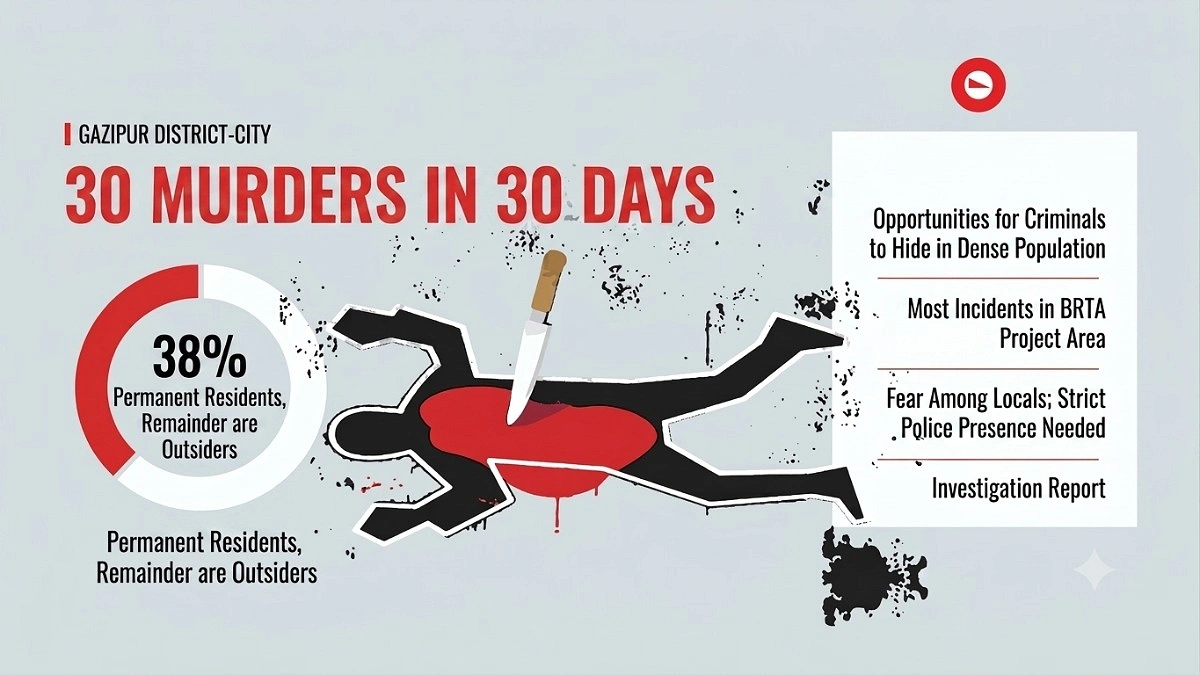
30 Murders in 30 Days
- Only 38% of residents are permanent inhabitants; the rest are migrants from other districts
- Dense population provides cover for criminals
- Most crimes occur around the BRT project area
- Residents want a tougher law enforcement response

Graphics: Agamir Somoy
Murders have increased in Gazipur due to a range of factors, including drug-related crime, robbery, dacoity, family disputes, and domestic conflicts. Authorities have also recorded cases in which perpetrators killed victims elsewhere and dumped the bodies in Gazipur. Law enforcement agencies struggle to effectively monitor criminal activity because of the area's dense population and constant activity. A total of 30 murders were reported across Gazipur district and metropolitan areas in May alone.
An investigation found that Gazipur's crime problem extends beyond homicide. Muggings, drug trafficking, illegal weapons activity, and clashes over control of unfinished urban development projects have also become common. Despite efforts by law enforcement agencies and local authorities, the situation remains difficult to control. Residents say murders have risen sharply in recent months, accompanied by growing social deterioration. A series of killings has heightened public fear, prompting calls for stricter action from law enforcement.
According to district statistics, only 38 percent of Gazipur's residents live in their own homes. The remaining population consists of tenants who have moved from other districts. Tongi's 17 slums, particularly Mazar Slum, are widely known as hubs for crime and drug trafficking. Although law enforcement agencies regularly conduct operations in these areas, criminal groups quickly re-emerge. Residents have also alleged that drugs are openly sold in the slums and that weapons are rented out there.
The unfinished Bus Rapid Transit (BRT) project along the Airport-Gazipur corridor has also contributed to crime, according to local sources. Muggings and murders frequently occur around the project's flyovers, stairways, and ramps. Multiple sources said most crimes in Gazipur occur in and around BRT project areas.
Official data show that Gazipur Metropolitan Police recorded 17 murders in May, while the district's five upazilas reported 13 killings during the same period. The figures were confirmed by the offices of the Gazipur Metropolitan Police commissioner and the district police superintendent.
Among the most widely discussed cases was the murder of five members of the same family, including a child, in Rautkona village of Kapasia upazila on May 9. Authorities later recovered the body of the prime suspect, Forkan Molla, from the Padma River in Louhajang upazila of Munshiganj.
On the evening of May 9, a BNP leader in his 60s was allegedly summoned to a local arbitration meeting in Faogan Bazar under Prahladpur Union over accusations of child rape. A Union Parishad member allegedly led an assault that left him critically injured. He died while undergoing treatment two days later.
On May 10, an angry mob in Bagchala village of Fulbaria Union in Kaliakair upazila beat three men to death on suspicion of cattle theft. The crowd also set fire to a truck allegedly used by the victims.
On May 12, assailants slit the throat of auto-rickshaw driver Shuvo and stole his vehicle in an area adjacent to Mohor's residence in Ojharpara village under Gacha Police Station in Gazipur City. Two days later, on May 14, police recovered the throat-slit body of another auto-rickshaw driver, 21-year-old Asif Hossain, from the Dwibari Gazari forest area of Rajabari Union in Sreepur. On the same day, police recovered the hanging body of Faruk Hossain, 37, from an under-construction building in Morkun Purbapara under Tongi East Police Station.
More recently, on June 2, police recovered the body of 49-year-old Saiful Islam from the Som area near Bangabandhu Bazar in Tumulia Union of Kaliganj upazila. SI Mojibur Rahman of Kaliganj Police Station said the victim was a resident of Alua village and had likely been killed elsewhere before his body was dumped at the site.
On June 4, police recovered the body of 27-year-old raw materials trader Naim from the Sheikh's Ghat area of Barkul village in Sreepur upazila. His hands were tied, and he had been missing for nearly 30 hours before the body was found.
Riaz Hasan, a resident of Tongi, believes drug addiction is driving much of the crime.
“Drug addicts are involved in many criminal activities. At the same time, auto-rickshaw robberies have increased. This is causing a serious deterioration in the law-and-order situation,” he said.
Ifthekhar Shishir, general secretary of the Gazipur district chapter of Shushashoner Jonno Nagorik, said swift punishment could significantly reduce crime.
“If offenders were brought to justice quickly after committing crimes, the crime rate would fall considerably,” he said. “A large number of people here are transient residents. People do not know one another, which creates opportunities for criminals to escape accountability.”
Gazipur Police Superintendent Md. Sharif Uddin said police continue to work in the field to maintain law and order.
“Operations are ongoing to identify and arrest those involved in various crimes,” he said.
Gazipur Metropolitan Police Additional Commissioner Md. Belayet Hossain said murders and other serious crimes occasionally occur in densely populated Gazipur, but police have been successful in apprehending those responsible.
“No one is escaping after committing crimes,” he said. “We are working tirelessly to bring all offenders, not only those involved in murder, but perpetrators of all types of crime, under the law.”
