
Govt firmly committed to peaceful, fastest resolution of the Rohingya crisis

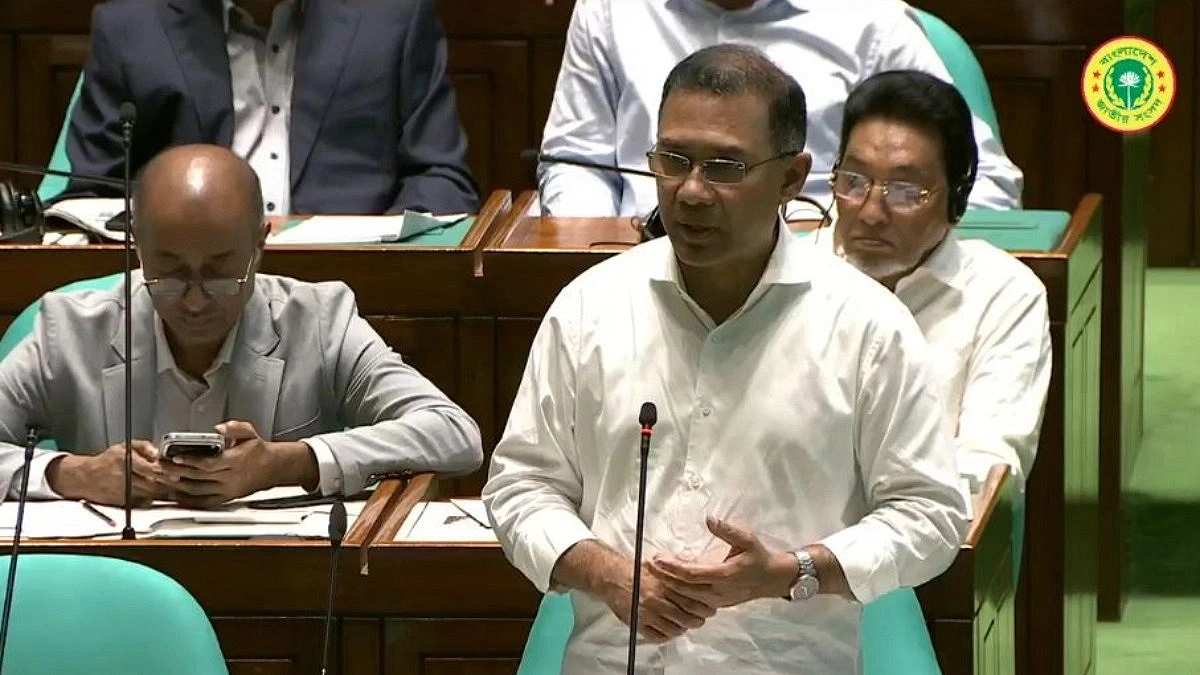
PM Tarique Rahman. File photo.
Prime Minister Tarique Rahman has said that the government is firmly committed to a peaceful and fastest resolution of the Rohingya crisis. He made this remark today, Wednesday, during the question-and-answer session in the national parliament, in response to a query by Md. Salim Reza, Member of Parliament for Sirajganj-1 constituency.
In the parliamentary session, Salim Reza asked if the government has any plan or not to resolve the Rohingya problem? If so, what is it, and by when can a permanent solution to this problem be accomplished?" In his response, the Prime Minister said, "Previously, in 1978, the government of Shaheed President Ziaur Rahman, and in 1992, the government of Begum Khaleda Zia, successfully resolved the Rohingya crises that had emerged at those times through successful diplomatic initiatives. Under their proper guidance, the Rohingyas who had taken shelter in Bangladesh at that time were able to return to their own country in the shortest possible time."
Tarique Rahman further said: "In the present time as well, following the light of that previous policy, we are seeking a sustainable, peaceful, and fastest solution. The BNP government is continuing very vigorous diplomatic activities on all fronts—bilateral, regional, and multilateral—with the aim of an immediate solution to the Rohingya problem," he added.
Noting that the government is actively working to place the Rohingya crisis at the center of global humanitarian discourse, the Prime Minister said, "In this process, regular communication is being maintained with top-level representatives of various countries and donor agencies, including the United Nations. Immediately after the current government assumed office, high-level delegations from UNHCR, UN Women, and the World Food Programme visited the Rohingya camps in Cox's Bazar, and detailed discussions were held on how humanitarian assistance could be further increased."
He mentioned that earlier this month, the Turkish Foreign Minister visited Bangladesh on an official trip and toured the Rohingya camps in Cox's Bazar. "We hope that through this visit, Turkey's humanitarian assistance for the Rohingya refugees will further increase."
Besides, last September, a high-level conference was organized at the United Nations with the aim of ensuring the quick and safe repatriation of the displaced Rohingyas. In the future as well, efforts to more effectively engage global public opinion through such high-level events on various global platforms, including the UN, will continue."
Stating that the Bangladesh government is placing special emphasis on ensuring justice and accountability, taking into account the root causes of the Rohingya crisis, the Prime Minister said, "To this end, Bangladesh has continued its moral support for the case filed by Gambia at the International Court of Justice. We believe that a sustainable and effective solution to the Rohingya crisis lies in Myanmar's Rakhine State itself. Therefore, our diplomatic activities have been intensified with the aim of continuing to increase international pressure on Myanmar to create a favorable environment for the safe, sustainable, and voluntary repatriation of the Rohingya."
The Prime Minister informed the House that on the bilateral front the matter of establishing possible contacts and holding discussions with all parties, including the junta government of Myanmar, for the repatriation of the Rohingya is under active consideration. Moreover, alongside mainstream diplomacy, the application of other processes in the area of confidence-building is under consideration. At the same time, the work of verification of Rohingya information, as the fundamental basis for repatriation, is being carried forward regularly. Activities for the resettlement or repatriation of Rohingya to third countries are also ongoing.
