
July Movement didn't stop because second-tier leadership was ready

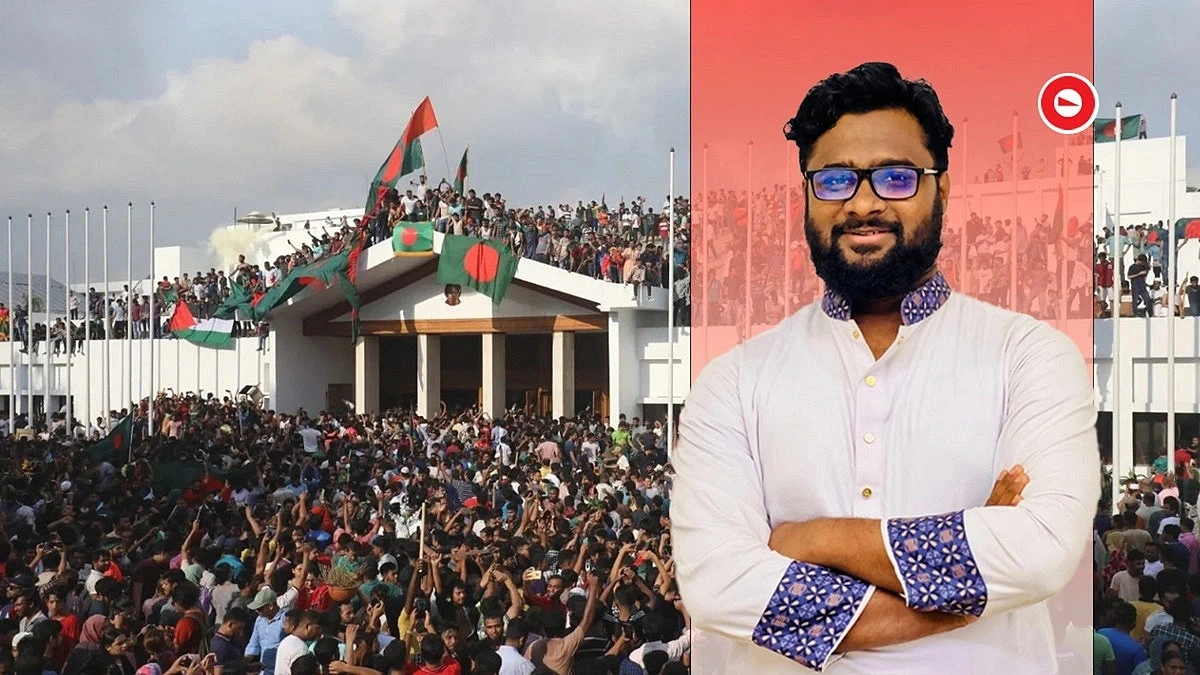
Zahid Ahsan, President of Jatiya Chhatra Shakti. Agamir Somoy collage.
Zahid Ahsan, President of the student organization Jatiya Chhatrashakti (affiliated with the National Citizens Party – NCP), spoke to Agamir Somoy on various issues, including the preparation for the July uprising, building alternative leaderships, strategies for creative programs, the participation of women and ordinary people, and post-movement expectations and realities. The interview was conducted by Amjad Hossain Hridoy.
Agamir Somoy: What was the biggest motivation to join the street struggle?
Zahid Ahsan: Since childhood, I have witnessed the persecution of people with opposing political views and their families. These events taught me to take a stand against injustice, particularly against the Awami regime. When I came to university, I faced the oppression of the "guest room culture." A senior student would decide whether I could stay in the hall, would abuse my mother, would come to hit me with a stamp, or would call me a 'Shibir member' just for wearing a cap and beard—I could not accept this. However, the biggest turning point was the murder of Abrar Fahad. After that incident, I decided that I would not just engage in movements, but would fight through organized politics, and I would not stop until Sheikh Hasina's fall.
Agamir Somoy: Why didn't the movement stop even after the internet shutdown and the abduction of the coordinators?
Zahid Ahsan: The biggest reason was long-term preparation. We not only planned the movement, but also built an alternative leadership structure. It was decided in advance who would take charge if any of the first-line coordinators were arrested or abducted. When first-line leaders like Nahid Islam and Asif Mahmud were taken away, the second-tier leadership stepped forward. Those who took charge—Masud, Rifat, Mahin, and others—did not appear suddenly. They had previous experience in student politics and movements. They knew how to sustain a movement and how to communicate with the public. Because of this preparation, no vacuum was created in leadership. At the same time, members of other organizations, including Shibir and Chhatra Dal, played a vital role in sustaining the movement across the country. In some places, people organized themselves and continued the fight even without designated leaders. Eventually, the people's struggle itself became the primary force—everyone became a leader, and everyone urged one another to take to the streets.
Agamir Somoy: How effective were the creative programs?
Zahid Ahsan: One of the greatest strengths of the movement was the novelty in the language and strategy of the programs. Over time, hartals (strikes) had become a monotonous program for the masses. The leaders presented the same program with new language, branding it as a "blockade." As a result, students and young people embraced it as their own movement's program. Later, through the "Remembering Our Heroes" program in memory of the martyrs, prayers and supplications were organized in mosques, temples, churches, and pagodas. This emotionally connected ordinary people even more deeply with the movement. Furthermore, when the government declared national mourning, we brought forward red as a symbol of protest instead of black. This transformation in the language and strategy of the programs is what broadened the movement further.
Agamir Somoy: How much of a turning point was the expulsion of Chhatra League from the halls?
Zahid Ahsan: In my opinion, this was one of the most important turning points of the movement. In Bangladeshi politics, the symbolic importance of Dhaka University is immense. When any political force falls here, its impact quickly spreads across the country. After Chhatra League was ousted from the halls on July 15 and 16, students from various universities and colleges across the country gained new courage. They understood that the force which had been considered invincible for so long could actually be resisted. That confidence is what rapidly spread the movement nationwide.
Agamir Somoy: The NCP and Chhatrashakti are often called the biggest "beneficiaries" of the uprising. What do you say?
Zahid Ahsan: I don't agree with the term "beneficiary" at all. The outcome of a mass uprising cannot be the acquisition of any political party. Its real achievement should be a democratic, humane, and equitable Bangladesh. The question should be who is playing the most responsible role in building that state, not who is profiting from it.
Agamir Somoy: The July movement succeeded, but why didn't previous movements succeed?
Zahid Ahsan: It's not that the first major movement against Sheikh Hasina happened in 2024. There have been large movements at various times since 2014. People had expectations from many programs, including the October 28 movement in 2023. But due to a lack of visionary leadership, proper planning, and firm stance at critical moments, those movements did not achieve their desired success. The leadership of the July movement was different in that regard. They did not compromise, and they were able to make the right decisions at the right time strategically.
Agamir Somoy: How do you evaluate the participation of women in the July movement?
Zahid Ahsan: From the very beginning of the July movement, the role of women was extremely important. Women students were active from the time of the quota reform movement. On the night of July 14, students from various halls clanged utensils and crossed hall gates to join the movement. Throughout the uprising, the participation of women students, mothers, and sisters gave new energy to the movement. Nearly ten women were martyred in the movement as well. Without this participation of women, the July mass uprising could never have become so widespread.
Agamir Somoy: How significant was the role of ordinary people beyond students?
Zahid Ahsan: I always say, this was not just a student movement; it was a mass uprising led by students. Students provided the leadership, but people from almost all walks of life in Bangladesh participated. Workers, teachers, parents, cultural activists—even street children—were part of this movement. Many street children were also martyred. These people did not want a share of power or political benefits. They wanted a Bangladesh where people would not be abducted, there would be no extrajudicial killings, no arrests without cause, workers would get fair wages, and ordinary people could live with dignity. This aspiration was the greatest strength of the mass uprising.
Agamir Somoy: Which moment of the movement still moves you the most?
Zahid Ahsan: There are many such moments. On July 17, during the attack on Dhaka University, we were marching completely unarmed. From all sides, RAB, BGB, and police were firing bullets, rubber bullets, and tear gas. Even though everyone scattered, no one gave up. Everyone tried to reorganize and mount resistance. That determination still moves me today.
Agamir Somoy: How important was the decision to advance the "March to Dhaka" program by one day?
Zahid Ahsan: Advancing the "March to Dhaka" by one day and announcing the program for August 5 was an extremely timely decision. By August 4 itself, it was clear that people did not want to wait any longer. If there had been a delay of even one more day, the government could have shut down the internet again, carried out mass arrests, or launched even harsher repression. This decision was highly strategic in capitalizing on the momentum and morale that the people had built up.
Agamir Somoy: What was the greatest strength of the movement's leadership?
Zahid Ahsan: The biggest strength was correctly understanding the people's sentiment. In Bangladeshi politics, there have been many large movements before, but often the leadership failed to gauge at what stage the people were and when to call for which program. The leadership of the July movement succeeded in that regard.
Agamir Somoy: How do you evaluate Nahid Islam's leadership?
Zahid Ahsan: To me, Nahid Islam is the chief leader of the July mass uprising. That does not mean others did not contribute. The BNP, Jamaat, Chhatra Dal, Shibir, various political and social organizations, expatriate Bangladeshis, and countless others played roles in this movement in various ways. Ordinary people also stood by the movement however they could. However, in a mass movement, there is ultimately a leader whose call unites the people to move forward. In my view, in the July mass uprising, that leadership was provided by Nahid Islam.
Agamir Somoy: How much of the aspirations of the July mass uprising have been realized?
Zahid Ahsan: The goal of the July mass uprising was not merely to change the government. The one-point declaration itself stated that alongside the fall of the government, the fascist state structure must be dismantled and a new Bangladesh built. Sheikh Hasina has fallen, but the fundamental reform of that state structure has not yet been fully completed.
Agamir Somoy: What is the biggest message of the July movement?
Zahid Ahsan: July has taught us that when people are united, no autocracy can survive for long. At the same time, this movement has shown that it is not just courage—it is a clear goal, organized leadership, timely strategy, and the participation of people from all walks of life that make a mass movement successful.
