
What will happen to one kilometer of Metro Rail?

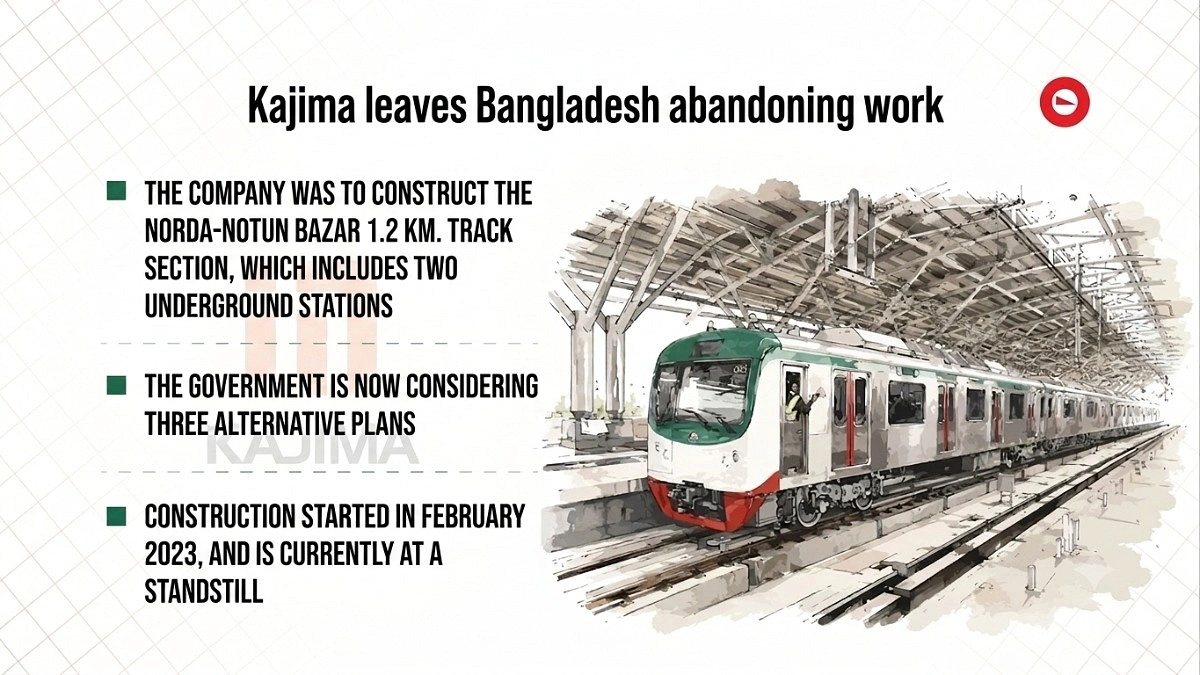
Representational image. Photo courtesy: BSS.
An uncertainty regarding construction of a section of Metro Line One that will connect three major areas of the city has surfaced as the constructing firm has left Bangladesh because of dilly-dally process.
This line which will connect Purbachal, Dhaka Airport and Kamalapur stretches across 31 kilometers of the city. One-third of it is above ground, and the rest will be built underground. The entire route was supposed to be divided into 12 parts or packages. Among them, the package for the Norda to Notun Bazar section was awarded to Kajima Corporation of Japan. However, the Japanese firm is frustrated because work did not start on time. Along with this, there are complaints that the authorities delayed decision-making. Citing these reasons, Kajima has abandoned the work and left. The question now is who will do the work they have left behind. The government is moving forward with three options, each carrying its own risks.
This situation has persisted for more than three years. Many events have taken place in the meantime. To start the metro work in Dhaka, the Japanese ambassador wrote to the government twice. The government proposed extending the deadline. But that did not satisfy Kajima. They have plenty of work elsewhere. The culture of indecision here did not suit them. Finally, Kajima made it clear they would not do the work and headed back to Tokyo.
This company was supposed to construct 1.2 kilometers of underground metro rail. They were also responsible for building two metro stations at both ends of this section—at Norda and Notun Bazar.
Now that Kajima Corporation has left, the big question is: what will be the future of the construction work for this section? However, the Dhaka Mass Transit Company Limited (DMTCL), the government agency implementing the metro, is busy finding an answer. The matter will be discussed in the company's upcoming board meeting.
Several officials of DMTCL have been consulted about the future. They say no decision has been reached on this matter yet. Several rounds of discussions have taken place. It has been placed on the agenda for the next board meeting. The rest will be decided at the meeting.
However, project sources say that DMTCL is currently considering three approaches. First, calling for fresh tenders, where the entire tendering process would start from scratch. Again, since Kajima was working on Package No. 5, there is also discussion about whether the contractors working on Packages 4 and 6 could be given parts of Package 5. Besides, fresh tenders might be invited only from those who had qualified initially (pre-qualified) in the first tender. This would save time and help determine the new cost.
Beyond this, another discussion is emerging. In that tender where Kajima Corporation was the lowest bidder, the party that came in second place could be directly offered the work. However, that would leave a cost difference. Again, the organization working on Packages 4 and 6 could be offered the work with an allocation 20% higher than Kajima's proposal. In that case, the cost would be close to that of the second-highest bidder. So, to save time, this method might also be adopted.
Japan Warned the Government: More Contractors May Withdraw Amid Metro Rail Delays
Amid all this, Japan had sent a letter to the government warning that further delays in Dhaka's metro rail expansion project (MRT) could lead to more international contracting firms withdrawing from the project. Japanese Ambassador to Dhaka, Saida Shinichi, sent this letter seeking urgent government intervention to swiftly conclude the project's procurement process and reassure the concerned companies.
In that letter addressed to the Road Transport Minister, it was mentioned that one company has already withdrawn from the project. Several other firms are seriously considering their next steps. The situation could become more complicated, especially if their bid bonds expire by mid-June. In this situation, to reassure all relevant companies, visible progress must be shown by quickly issuing Letters of Acceptance (LOA) or finalizing agreements through mutual negotiations. If delays persist, not only the main contractors but also their sub-contractors and suppliers will suffer.
Justifying the cost increase, the letter reads that most of the project's negotiation discussions are still based on the 2019 Development Project Proposal (DPP). However, construction material prices have increased significantly over the last six years. Added to this, instability in the Middle East has created fresh price pressures. This has created uncertainty among the bidders.
For this work that began in 2022, DMTCL has not yet been able to finalize contracts with all construction firms. Due to excessive delays in contracting, one firm has already left. Work on the two sections for which contracts were signed after tendering has come to a standstill.
The 31.24-kilometer route from Kanchan Bridge in the capital to Kamalapur will be known as the Mass Rapid Transit (MRT) Line-1. Of this, 19.87 kilometers will be underground, and the remaining 11.37 kilometers will be elevated. If the work had been completed by 2026, approximately 800,000 passengers could have traveled daily. This would have reduced traffic congestion, fossil fuel consumption, and time expenditure. Preparatory work for the project began in 2019. At that time, detailed surveys, designs, and land acquisition were completed.
The DPP was prepared based on the conceptual design proposal of 2018 for the construction of the country's first underground metro rail. The cost was estimated at Tk 52,561 crore. Project activities began in 2022 through an international tender process, funded by the Japan International Cooperation Agency (JICA).
In the pre-qualification phase, construction firms from various countries, including Bangladesh, India, China, Egypt, South Korea, Thailand, and Turkey, participated. The main tendering process began in 2023. After the tendering process, the cost stood at approximately Tk 96,500 crore. That is, even before the main construction work began, the cost had increased by about 85 percent.
Primarily, the cost has increased unexpectedly due to the rise in construction material prices and the depreciation of the Taka against the Dollar. Concerned parties believe that this cost could rise further if construction work cannot start quickly.
Communication expert Professor Md. Hadiuzzaman of Bangladesh University of Engineering and Technology (BUET) thinks, "Since a lot of time has already passed, let a little more pass, but a re-tender should still be called." He believes, "Changing the design could create a way to reduce construction costs. Moreover, because the construction method had several conditions attached, many firms could not participate in the previous tender. It should be considered whether those conditions can be waived and a fresh tender can be called for the entire underground section. Because this is our first underground metro. The subsequent ones will be built based on the example of this one. If the cost is too high, it will increase pressure on fares."
