

Tk 250 Billion Fund Proposed for Renewable Energy

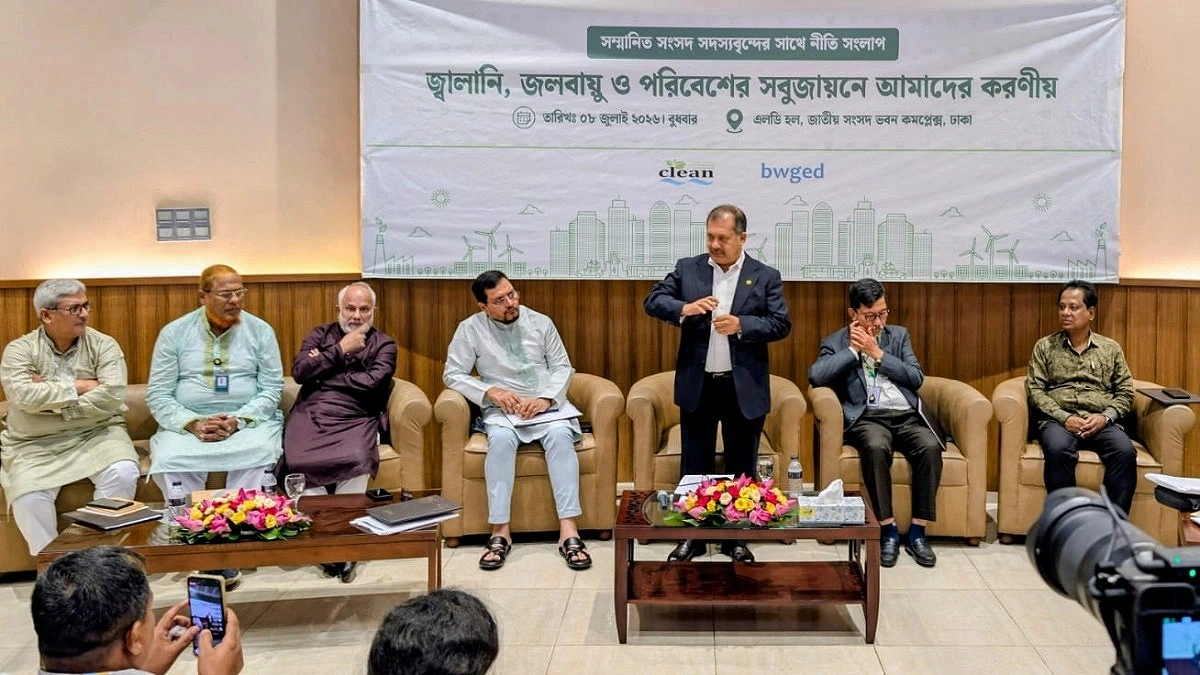
Photo: Agamir Somoy
The Bangladesh Working Group on Ecology and Development (BWGED) has proposed the creation of a special financing fund worth Tk 250 billion under Bangladesh Bank to increase investment in renewable energy. The organization has also called for a subsidy of Tk 25,000 per kilowatt for residential and agricultural solar power systems of up to three kilowatts.
BWGED presented a seven-point policy roadmap at a policy dialogue held at the Jatiya Sangsad Bhaban on Wednesday. Information and Broadcasting Minister Zahid Uddin Swapan attended the event as the chief guest. Members of Parliament, energy sector experts and various stakeholders took part in the dialogue.
Information Minister Zahid Uddin Swapan said, “Energy security is not only about ensuring an uninterrupted power supply. It is also linked to the country’s economic independence and development capacity. Therefore, we must move forward with a strong political commitment to expanding renewable energy.”
A study presented by BWGED at the dialogue said that installing 1 kilowatt of solar power in the country could save nearly Tk 30,000 annually in fuel import costs. Over the 20-year lifespan of a solar power system, the total savings could reach approximately Tk 550,000.
Hasan Mehedi, representative of the organization and chief executive of CLEAN, said, “Government support for rooftop solar power is not an expense; rather, it is an investment that reduces energy import costs in the long run and strengthens the country’s energy independence.”
According to BWGED’s proposal, loans for renewable energy projects would be provided through commercial banks from the special fund under Bangladesh Bank at an interest rate of up to 5 percent. The organization has also called for a direct subsidy of Tk 25,000 per kilowatt for residential and agricultural solar power systems of up to 3 kilowatts.
According to the organization’s estimates, achieving the renewable energy target for 2030 will require about Tk 217.5 billion annually. Of this amount, the government will need to provide approximately Tk 67.5 billion as direct subsidies. An additional 10 percent incentive has also been proposed for projects led by women, Indigenous people and marginalized communities.
The organization has called for the withdrawal of the National Board of Revenue’s (NBR) Statutory Regulatory Order (SRO), under which tax benefits have largely been limited to large projects based on long-term power purchase agreements. According to BWGED, equal tax incentives should also be ensured for rooftop solar power, solar irrigation and other decentralized renewable energy initiatives.
The organization also proposed developing renewable energy projects on 14,166 acres of unused land acquired for coal-based power projects. According to the organization, this could generate about 6,000 megawatts of solar and wind power without requiring additional land acquisition.
BWGED has also recommended launching a ‘Green District’ program in the country, creating 1 million green jobs by developing a skilled workforce in the renewable energy sector, and making battery storage systems mandatory for all newly approved large-scale solar power projects.
According to the organization, the country’s current renewable energy-based power generation capacity stands at around 1,679 megawatts. The government’s target is to increase that capacity to 10,000 megawatts by 2030.
According to BWGED, achieving this target will require more than relying solely on large investors; households, farmers, small entrepreneurs and local governments must also be involved in renewable energy generation.
The panel discussion at the dialogue was attended by Khulna City Corporation Administrator Nazrul Islam Manju and Members of Parliament ABM Mosharraf Hossain, Dipen Dewan, Kamruzzaman Kamrul, Mohammad Abu Sufian, Mohammad Shafiqul Haque Milon, Mahbubur Rahman Belal and Sultana Jasmin Jui.

