

Landslides, Floods Devastate Cox’s Bazar Amid Monsoon

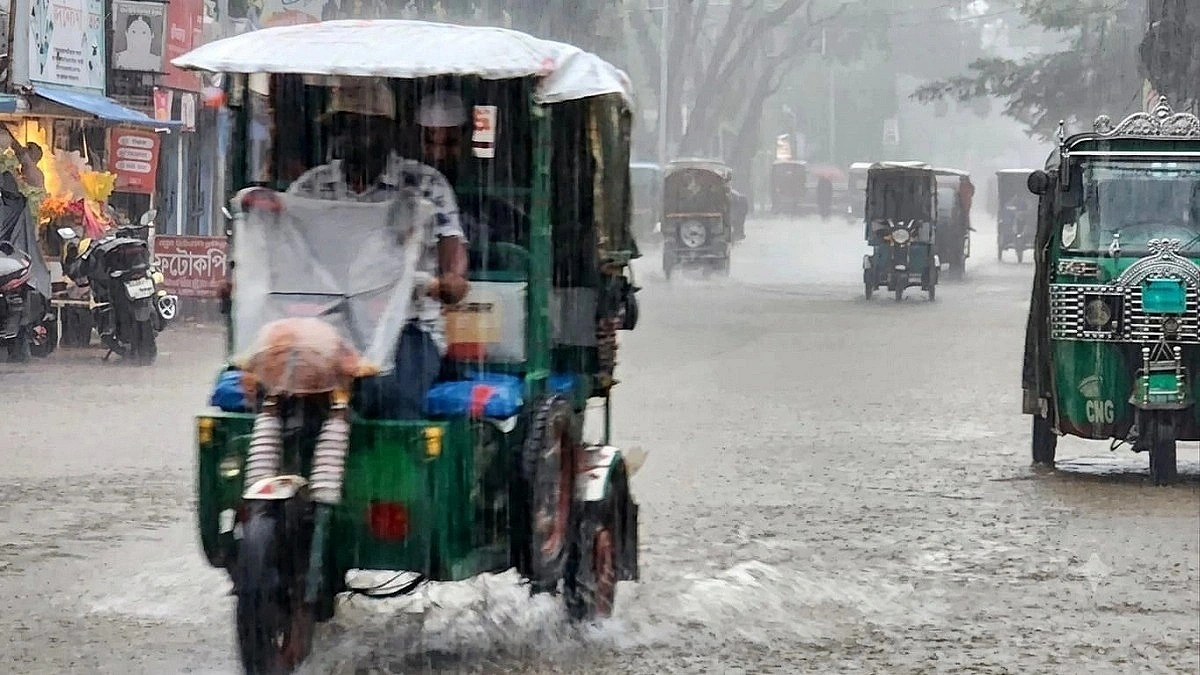
Photo: Agamir Somoy
Cox’s Bazar has long endured the monsoon, but recent years have unleashed a more violent version. Short, intense downpours now batter the district, unleashing landslides, flash floods, and persistent waterlogging that regularly cripple communities.
Experts believe that alongside the effects of climate change, hill cutting, deforestation, the filling of canals and drains, and unplanned urbanization are making the monsoon more terrifying than ever before.
At least 33 unions across nine upazilas of the district have been flooded due to continuous rain. So far, 13 people have died, and at least 1,00,000 individuals are waterlogged. Road communication has been disrupted, and several waterways remain closed.
Simultaneously, a humanitarian crisis emerged in the world’s largest Rohingya refugee camps.
Md Abdul Hannan, assistant meteorologist at the Cox’s Bazar Weather Office, told Agamir Somoy that 129 mm of rainfall was recorded in the 24 hours until Tuesday afternoon, preceded by 277 mm and 240 mm in the previous two 24-hour periods.
A total of 646 mm of rain fell in three days, the highest in recent times. He added, “Such ultra-heavy rainfall in a short period increases the risk of landslides and flash floods several times over. Local cautionary signal number 3 remains in effect at the Cox’s Bazar seaport.”
According to district administration data, vast areas of Cox’s Bazar Sadar, Ukhiya, Teknaf, Ramu, Chakaria, Moheshkhali, Kutubdia, Pekua, and Eidgaon upazilas remain submerged.
Roughly 40,000 people across at least 16 unions in the Chakaria and Matamuhuri areas are waterlogged, while at least 10 villages in Ramu have been flooded.
Hundreds of homes across the district have been inundated, rural roads are submerged, and power and communication systems are disrupted.
The situation in the Rohingya camps is alarming. According to the Inter-Sector Flash Situation Update, eight people died in Rohingya camps in Ukhiya. 160 disaster-related incidents occurred in the camps over the last three days, affecting 15,813 people.
Ten people were injured, and 3,182 were evacuated for safety. 1,614 shelters were partially damaged and 10 were completely destroyed, while hundreds of latrines, water sources, learning centers, roads, bridges, and retaining walls sustained damage.
Md Mizanur Rahman, director of the Disaster Response Department of the Bangladesh Red Crescent Society, told Agamir Somoy that hill slopes have weakened and natural water flow paths have narrowed. He added that the city’s drainage system cannot handle the pressure of excessive rain, putting Rohingya camps at the highest risk.
M Ibrahim Khalil Mamun, chief executive of the Youth Environment Society, said since the arrival of the Rohingya, deforestation, hill cutting for shelter construction, and population pressure in Ukhiya and Teknaf have reduced natural stability, increasing disaster risks.
Nazim Uddin, general secretary of Amra Cox’s Bazarbashi, added, “In addition to heavy rain, the reduction in the navigability of canals and drains, illegal occupation, and weak drainage systems have made waterlogging in the city a permanent problem. Just a few hours of rain results in knee-to-waist-deep water in various areas.”
Due to the turbulent sea, the Teknaf-Saint Martin waterway has been closed for seven consecutive days. Moreover, passenger vessel movements on the Cox’s Bazar-Moheshkhali and Pekua-Kutubdia routes have been suspended for three days, causing suffering for thousands.
Analysis of the last decade shows that while heavy rain is not new, the pattern has shifted toward extreme rainfall within a few hours. On 13 September 2024, a record 501 mm was recorded in one day, and nearly 694 mm was recorded in the first seven days of July 2025.
H M Nazrul Islam, organizational secretary of Bangladesh Poribesh Andolon (BAPA) in Cox’s Bazar, said, “This disaster has proven that the monsoon in Cox’s Bazar is now not only natural but also caused by unplanned human activities. This year’s monsoon has become much more horrific than any time before.”

