
Deaths Continue as Landslide Safety Recommendations Go Ignored

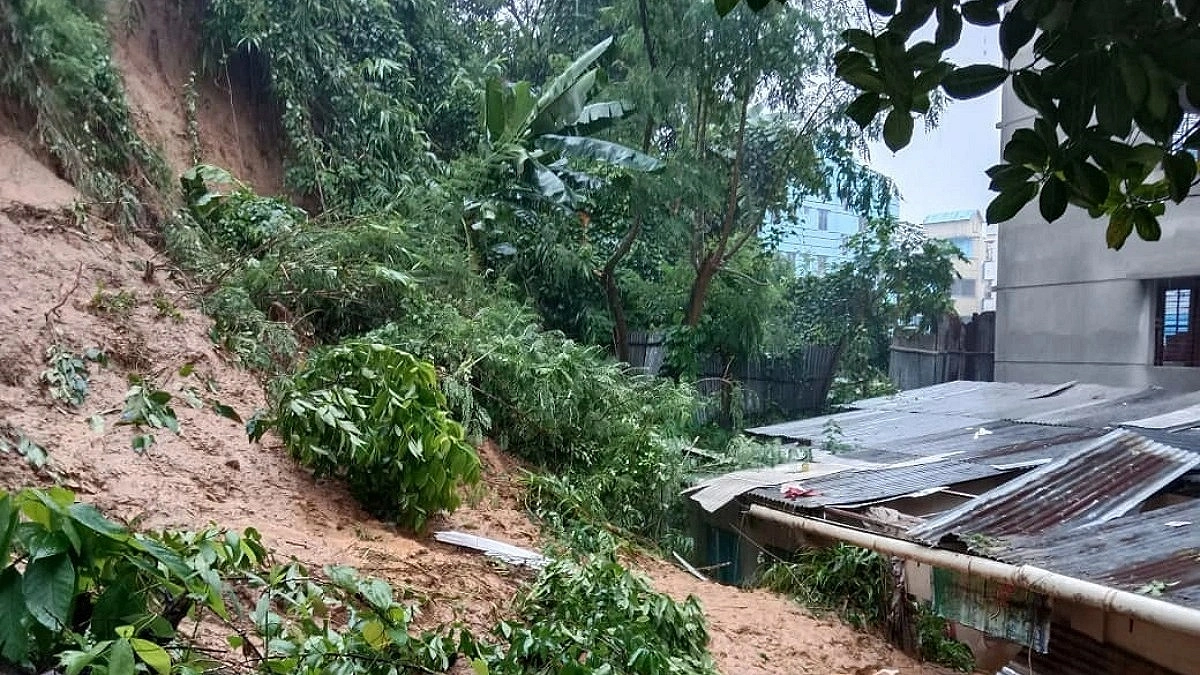
Photo: Agamir Somoy
Every monsoon season, the greater Chattogram region faces the threat of deadly landslides. After a landslide killed 127 people in Chattogram in 2007, an expert committee issued a 36-point set of recommendations, including the eviction and rehabilitation of residents living in high-risk hillside settlements to prevent future disasters. Another committee proposed 35 recommendations after landslides killed 170 people in Chattogram, Cox's Bazar, and the Chattogram Hill Tracts in 2017. Most of those recommendations remain unimplemented.
As a result, the number of risky hillside settlements has continued to grow each year, along with the number of fatal accidents. Heavy monsoon rains have already triggered landslides that killed four people in Chattogram, 18 in Cox's Bazar, and five in Bandarban.
Experts say those deaths could have been prevented if authorities had effectively discouraged illegal settlements in landslide-prone areas.
Neither the Chattogram district administration nor the Hill Management Committee has updated data on vulnerable hillside settlements. In 2020, authorities identified 6,558 families living in such settlements in Chattogram. The list has not been updated since then. However, last year the district administration sent the Ministry of Environment, Forest and Climate Change a separate list identifying 914 additional high-risk settlements.
Instead of implementing the core recommendations, authorities continue to focus on moving residents to temporary shelters whenever the monsoon arrives. They regularly use loudspeakers to urge people to evacuate, and this year was no exception. However, many residents ignore the warnings, allowing landslide disasters to recur.
Chattogram Deputy Commissioner Mohammad Zahidul Islam Miah acknowledged the problem during a disaster management meeting on Wednesday.
"We repeatedly instructed residents to evacuate and opened shelters for them. But some refused to leave their homes. As a result, four people died in the landslides," he said.
Officials and experts believe the number of high-risk settlements across 26 hills continues to rise because authorities have failed to implement the recommendations, avoided difficult decisions such as permanent evictions, and have not brought influential backers of illegal settlements to justice. They also say utility services, including electricity, water, gas, roads, and sanitation facilities, have encouraged further settlement in those areas.
Although the Hill Management Committee decides every year to disconnect utility services to illegal settlements, authorities usually conduct only a few token enforcement drives before halting the operations. As a result, both illegal utility connections and new settlements continue to increase.
Official figures estimate that around 7,500 families currently live in high-risk hillside settlements, although those familiar with the situation say the actual number is much higher. In 2014, only 666 families lived on 11 hills. That number has since increased severalfold.
Alok Pal, a professor in the Department of Geography and Environment at the University of Chittagong, said authorities must implement the committee's recommendations. He also called for stricter enforcement of laws to prevent illegal hill cutting and greater public awareness.
"Authorities must take strict action against the construction of structures on illegally cut hills and strengthen monitoring efforts," he said.
According to the Hill Management Committee, the largest concentration of vulnerable settlements is located on the hills surrounding Jhil Nos. 1, 2, and 3 in Akbar Shah Police Station, where about 4,500 families live. In 2022, two members of the same family died in a landslide at Jhil No. 1. Two more people were killed in the Bijoynagar area during the same period. Earlier, 22 people died in a landslide in the Akbar Shah Mazar area in 2012, while another 17 people were killed in a landslide and wall collapse at Batali Hill in 2011.
