
Human Encroachment on Hills Increases Deaths Every Monsoon

Collected Photo
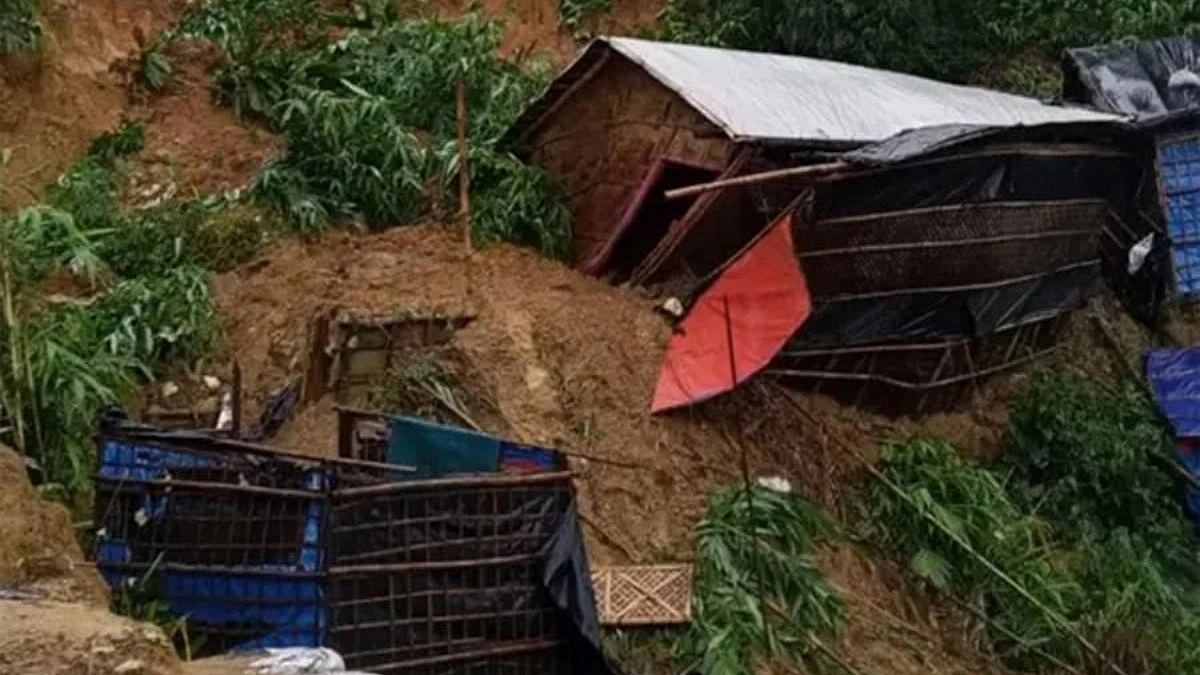
A series of landslides have occurred in Chattogram and the Chattogram Hill Tracts amid continuous heavy rainfall, killing at least 30 people. Cox’s Bazar has been the worst affected district, where 19 people have died. The tragedy has once again brought back memories of the devastating landslides of 2017, when more than 150 people lost their lives in Chattogram, Rangamati and Bandarban.
Experts say that while climate change is increasing the tendency for intense rainfall within a short period, deforestation, hill cutting, unplanned settlements, the expansion of jhum cultivation and weak law enforcement have multiplied the risk of landslides.
According to the Ministry of Disaster Management and Relief, 19 people have died in Cox’s Bazar, five each in Chattogram and Bandarban, and one in Rangamati due to landslides, flash floods and hill torrents. The highest death toll in Cox’s Bazar was recorded in the Rohingya camps. In Rohingya Camp No. 5 in Ukhiya, five teenage girls were killed when a madrasa was buried by a landslide. Fatalities were also reported in separate incidents in Ramu, Pekua, Chakaria and Cox’s Bazar Sadar. At least 13 of the dead were Rohingya. Since 2021, at least 58 people have died in landslides in Cox’s Bazar through July 2026.
Locals say these deaths are not merely the result of natural disasters. The natural stability of the hills has been destroyed by years of hill cutting, deforestation and unplanned development. On top of that, the increased tendency for intense rainfall in a short period due to climate change has further heightened the risk of landslides.
Environmental organizations say that at least 500,000 people are living on hill slopes and hilltops in the Cox’s Bazar region after forests were cleared. The long-running encroachment has been compounded by the Rohingya crisis, political influence and weak law enforcement. As a result, the hills turn into death traps every monsoon.
H.M. Nazrul Islam, organizing secretary of the Cox’s Bazar chapter of the Bangladesh Poribesh Andolon (BAPA), said, “Every year people die in landslides. The question is, why are the same mistakes being repeated? Why are new settlements being built on hill slopes, why are forests being destroyed, and why are hundreds of thousands of people living at risk of death in front of the administration’s eyes?”
According to him, a large portion of more than 223,000 acres of reserved forest land in Cox’s Bazar has already become denuded. “As a result of deforestation, the soil of the hills is becoming weak. Consequently, the hills collapse easily during heavy rainfall.”
Deaths from landslides are not new in Bangladesh. On June 11, 2007, 127 people died in landslides in Chattogram. In 2012, 28 people were killed in the Akbar Shah area, and on June 13, 2017, nearly 150 people died in Chattogram, Rangamati, Bandarban and Khagrachhari.
Sharif Chowhan, president of the citizen platform People’s Voice, which works on hill conservation in Chattogram, told Agamir Somoy, “One of the main causes of landslides is indiscriminate hill cutting. Landslides generally do not occur in areas where there has been no human intervention. But where hills have been cut to build settlements, roads or other structures, the risk of landslides is the highest.”
In his view, landslides occur every year not only in Chattogram but also in Cox’s Bazar and other hilly areas of the country. “The main reason is the lack of effective measures to stop hill cutting. Unless hill cutting is stopped, it will be impossible to prevent loss of life.”
He alleged that the agencies responsible for protecting the hills have not played an effective role. Those who cut and occupy hills to create plots or establish settlements are not subjected to strict action.
Citing examples from Jangal Salimpur and other areas, Sharif Chowhan said that although illegal structures have been built by cutting hills for years, no effective initiative has been seen to stop it. The situation has become more complicated due to the government’s weak policy position and poor enforcement of laws to protect the hills.
Environmental experts say that unplanned jhum cultivation, replacing natural forests with monoculture plantations, cutting hills to build tourist centers and infrastructure, and increasing pressure on forest resources have further weakened the ecological balance of the hills. As a result, the risk of landslides during heavy rainfall has increased significantly compared to the past.
Meteorologist Bazlur Rashid said, “As climate and weather patterns are changing, the tendency for intense rainfall within a short period is increasing. In the past, it used to rain for several days during the monsoon, but now rainfall equivalent to several days is occurring within just one or two days. The behavior of the monsoon winds has also changed. In many cases, the monsoon starts late, but when it rains, it becomes intense.”
Dr. Muhammad Muhibbullah, a professor in the Department of Geography and Environmental Studies at University of Chittagong, told Agamir Somoy that the geological characteristics of Bangladesh’s hills differ from those in many other countries. Most of the country’s hills are sandy, and in some places are composed of a mixture of sandy and clay soils. As a result, during intense rainfall, water quickly penetrates the hills and weakens the soil layers.
According to him, what is generally called a ‘landslide’ in Bangladesh is, in reality, mostly mudslides. “During the dry season, cracks develop in the hill soil. During the monsoon, water enters through those cracks and gradually loosens the soil. When enough water accumulates, the soil collapses downhill under the force of gravity.”
Dr. Muhibbullah said that three factors generally work together to cause landslides. “First, continuous or heavy rainfall. Second, the sandy composition of the hills’ soil. Third, human intervention, especially cutting hills to build settlements, roads or other structures. When these three factors are present together, landslides become almost inevitable.”
“By nature, a hill is a stable structure that survives with its natural slope and drainage system. But cutting the base of a hill, extracting soil from its middle, practicing jhum cultivation or intervening in hills in an unplanned manner destroys that balance. As a result, rainwater penetrates deep into the soil and makes the hills even more vulnerable,” he added.
Warning about the issue, he said that if unplanned development, hill cutting for road construction and the building of tourist centers and other structures continue in Chattogram, Bandarban, Rangamati and other hilly regions, the risk of landslides will increase further in the future. Therefore, the government must make a strict policy decision against hill cutting. Construction of new settlements and structures in the hills must be controlled, and risky and illegal settlements must be removed gradually. At the same time, development activities must be carried out while preserving the natural slopes and geological structure of the hills.
