


Chittagong stuck at 68th along list of top 100 ports

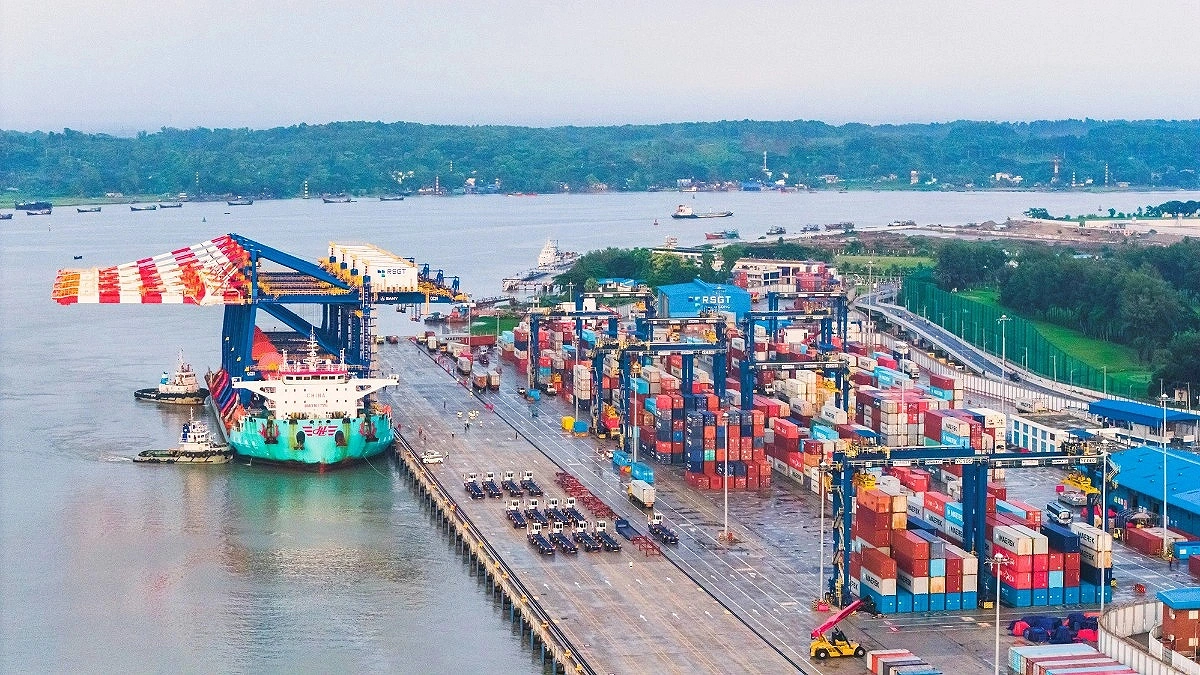
A portion of Chattogram sea port. Collected photo.
Bangladesh's premier seaport, Chittagong, remains stuck at the 68th position in the list of the world's top 100 container seaports. London-based shipping news media 'Lloyd's List' published this ranking of the best ports on Saturday morning. Chittagong Port's position remained unchanged from the previous year, at 68th.
This analytics publication annually releases the list of the top 100 container ports based on the highest container throughput (loaded and unloaded). The ranking does not consider port service quality, customs procedures, modern facilities, or vessel waiting times. It is not a qualitative or efficiency-based index. The sole criterion is volume. Therefore, the more containers a port handles, the higher its position on the list.
Based on handling 3.4 million TEUs (Twenty-foot Equivalent Units) of containers in 2025, Lloyd's List published this ranking in August 2026. In 2024, the port—built on the banks of the Karnaphuli River and considered the lifeline of the country's economy—had handled 3.275 million TEUs and was also ranked 68th.
When contacted regarding this matter, Chittagong Port Secretary and Spokesperson Syed Refayet Hamim said, "We have not yet received the Lloyd's List report. So, I cannot comment."
The primary reason Chittagong Port has failed to advance its position is its low growth rate. Most ports in the top 1 to 67 rankings have achieved growth rates between 4% and 11.5%. Chittagong Port managed only 4% growth. Consequently, despite handling a significant number of containers domestically, Chittagong lags behind the ports of regional competitors.
Among South Asian ports, two Indian ports have secured places in the top list. India's Mundra Port ranks 25th, and Jawaharlal Nehru Port ranks 30th. Sri Lanka's Colombo Port is in 29th position. Malaysia's Port Klang is 10th. Pakistan's Karachi Port, however, is 16 steps behind Chittagong, ranking 84th.
An official working for a foreign shipping line told Agamir Somoy that the primary strengths behind the rise of Sri Lanka's Colombo Port and India's Mundra Port are transshipment facilities and deep draft. India's private-sector Mundra Port has developed into a regional hub through modern automation, its own rail connectivity, and quick turnaround times. In contrast, Chittagong Port does not receive any transshipment cargo; it is limited solely to Bangladesh's own readymade garment exports and commercial imports.
He identified the lack of a deep draft and the inability to attract international transit cargo as the main reasons Chittagong lags behind Colombo and Mundra.
China continues to maintain its unchallenged dominance in Lloyd's List's top 100 container ports. Shanghai Port in China has once again secured the number one position as the world's largest container port. Seven of the top ten ports are controlled by China.
The top ten list includes: 1st – Shanghai (China), 2nd – Port of Singapore, 3rd – Ningbo-Zhoushan (China), 4th – Shenzhen (China), 5th – Qingdao (China), 6th – Guangzhou (China), 7th – Busan (South Korea), 8th – Tianjin (China), 9th – Jebel Ali (Dubai, UAE), and 10th – Hong Kong (China).
Furthermore, the list of the top 100 container ports includes 27 ports from mainland China. These ports collectively handled 310 million TEUs of containers annually, which accounts for approximately 45% of the total container handling (about 700 million TEUs) of all 100 ports on the list.


