
Anu Muhammad
Trade Deal Signatories Labeled 'Proxies for US Interests'

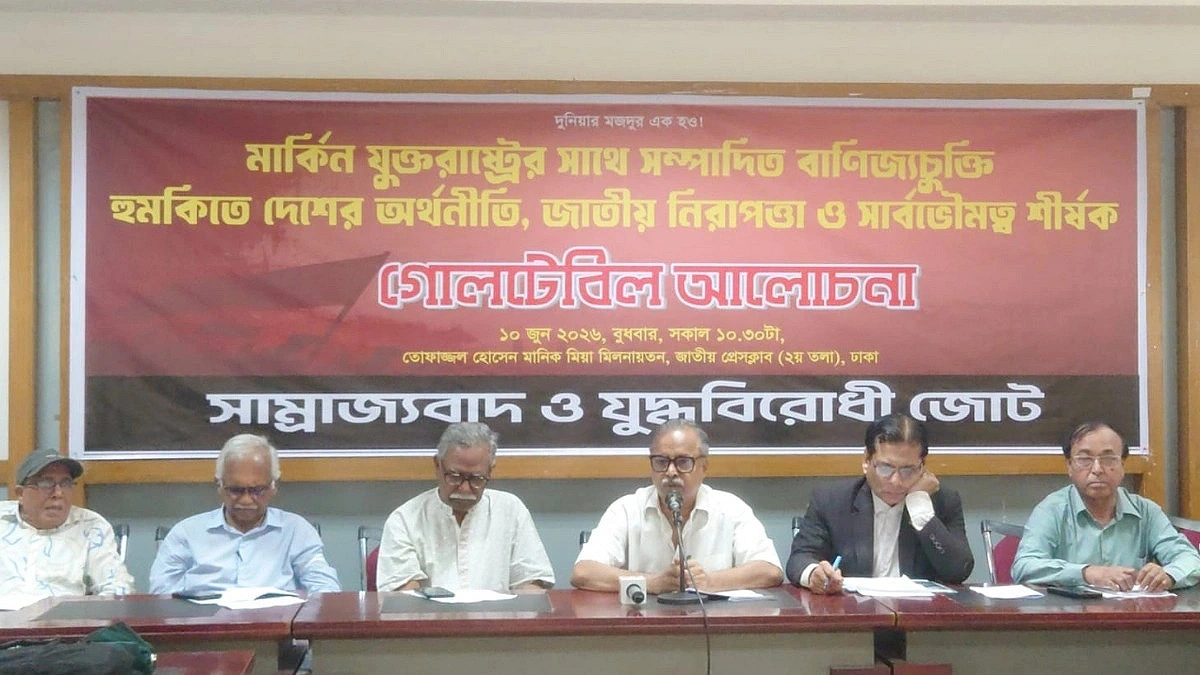
Photo: Agamir Somoy
Professor Anu Muhammad has raised the question of whether the trade agreement signed with the United States actually falls under the category of a "trade agreement." A 13-party alliance held a roundtable discussion on Wednesday demanding the cancellation of the unequal trade agreement with the US, an end to US-Israeli attacks on Iran, the genocide in Palestine, and the cessation of imperialist aggression and wars. Anu Muhammad spoke at the event.
He said, "It is normal for trade agreements to be signed between different countries, but it is worth considering whether this actually falls under a normal trade agreement. The rule of normal market balance is that a country imports what it needs and exports surplus goods, and goods are brought from wherever they are available at a lower price. However, reading this agreement, it seems that obligations have been imposed that go beyond the proverb 'might makes right.'"
"While other countries are thinking about this agreement, taking time, or even rejecting it, Bangladesh has completed this agreement on its own responsibility. Those who signed this agreement are essentially representatives of the US side," added this economist.
Noting that even the elected government has continued the agreement, Anu Muhammad expressed concern that if goods are imported at higher prices, they will not sell in the domestic market. Consequently, the government will have to provide subsidies there, and the state will lose revenue, the ultimate impact of which will fall on the general public.
The discussion was held on Wednesday at the Tofazzal Hossain Manik Miah Auditorium of the National Press Club. The 13-party alliance presented written statements at the meeting.
It was informed that just three days before the 13th National Parliament election, the then interim government signed an 'Agreement on Reciprocal Trade' (ART) with the United States, which has threatened the country's economy, security, and sovereignty. Through this agreement, the United States has ensured unilateral benefits and authority. Various unequal conditions, including tariffs and non-tariff barriers, have been imposed on Bangladesh.
Alliance leaders alleged that this agreement, made under a non-disclosure agreement or confidentiality policy, has not been published by either the country's interim government or the current elected government. However, a 28-page document has been published on the website of the US Department of Commerce.
Dr. Mostafizur Rahman, a guest invited to the meeting, commented, "The immense losses that Bangladesh will face if this agreement is implemented are clear from that 28-page document. The terrible thing is that foreign media reports indicate the original agreement is actually 177 pages long, meaning what kind of horrifying conditions are written in the remaining 149 pages are still unknown to everyone."
The discussion highlighted various detrimental aspects of the agreement. According to the terms, Bangladesh must purchase $15 billion worth of energy (LNG), 15 Boeing aircraft, and $3.5 billion worth of agricultural products such as wheat, soybeans, and beef annually for the next 15 years. Additionally, Bangladesh must allow nearly 6,710 US products to be imported duty-free, which poses an extreme threat to the development of local industries.
Professor Mosahida Sultana stated that none of Bangladesh's needs received priority in this agreement. She remarked, "It seems the country is moving towards a US-controlled economic system. Imperialist powers have become so reckless that all other countries must unite to stop them. To maintain Bangladesh as an independent country, this unequal trade agreement must be canceled."
At this roundtable against imperialism and war, representatives and top leaders from the Communist Party of Bangladesh (CPB), Bangladesh's Socialist Party-Basad, Bangladesh JASAD, Revolutionary Communist League, Bangladesh's Socialist Party (Marxist), Bangladesh's Communist Movement, Democratic Revolutionary Party, Basad (Mahbub), Ganamukti Union, Bangladesh's Samajtantrik Party, Bangladesh's Socialist Party, National People's Front, and Sonar Bangla Party were present and unanimously demanded the cancellation of this agreement.
