
Says Dr. Debapriya
'I don’t see any outline in the budget or the 100-day measures'

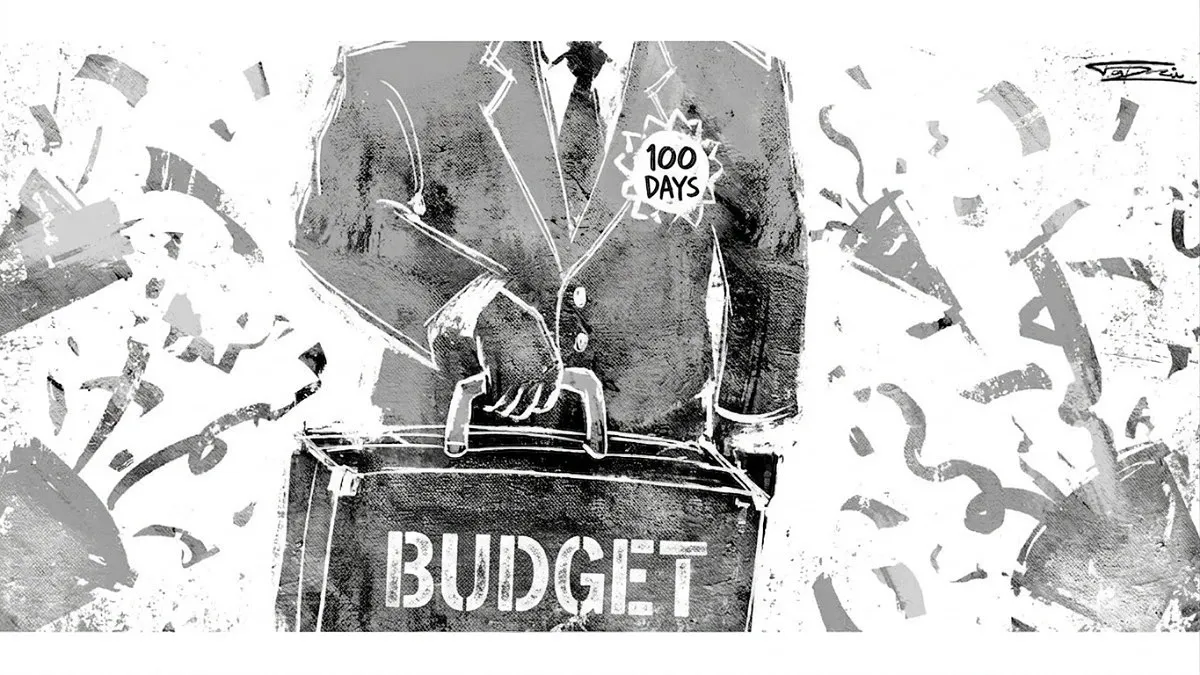
Agamir Somoy image regenerated by AI.
Soon after the BNP government that came to power through the 13th national parliamentary election completed its first 100 days, the 2026–27 budget was presented. After the interim government that came amid the July mass uprising, expectations of the newly elected government were high for many reasons. In this context, renowned economist and analyst Dr. Devapriyo Bhattacharya was interviewed by Agamir Somoy. The interviewer was taken by Saaid Jubary.
Agamir Somoy: After a major mass uprising and the interim government’s tenure, the newly elected government has presented its first budget. Do you see any major change in this government’s “budget philosophy”?
Dr. Debapriya Bhattacharya: I don’t see any abrupt major change in the traditional philosophy. Any new government’s first budget has to first assimilate the inherited economic situation, various constraints, and opportunities. At the same time, there is the pressure of confronting the current global economic and political crises. Besides that, the government faces several specific realities. A budget’s real philosophy is revealed through its allocations and implementation. Philosophically, they are speaking about building a humane society and a welfare state. We must see what concrete economic measures are included in the budget to achieve this humane society. The finance minister repeatedly uses the words liberalization and decontrol. We will need to see what kinds of decontrol they undertake, through which business costs will fall and production, investment, and productivity will increase. The finance minister says this is a budget for everyone. But merely showing conventional or nominal allocations does not make it “everyone’s budget.” The big question is whether those allocations can be preserved in the face of resource scarcity. They cannot step outside the current capitalist market economy or the globalized economic order. Within that framework, the question is what practical, welfare- or production-oriented measures they are taking—that is the government’s true budget philosophy.
Agamir Somoy: At the grassroots, there is a visible culture of “this time it’s our turn.” As a representative of civil society, do you think this is reviving the same-old trend of politicization that we saw earlier?
Dr. Debapriya Bhattacharya: In the past patterns in which the state, government, society, and economy operated, politicization or party-ization was a major tendency. That was linked with terror, force and coercion, and, above all, a lack of public safety or social vulnerability. I don’t think these problems have been fundamentally resolved in the current situation. As a result, a major crisis arises in implementing the budget from the state’s side. For example— the promise in the budget that we will “stand on the side of humanity” faces severe challenges at the grassroots. Because of these adverse conditions, how the aggregate economic management’s benefits will reflect at the local level has become a big question.Agamir Somoy: The Prime Minister is not taking a duty-free car and is foregoing VIP protocol — such symbolic positive gestures are visible. But how effective can these personal initiatives really be in changing our overall political culture and the broader collective landscape?Dr. Debapriya Bhattacharya: This should certainly be seen positively. But there is a major “but.” If the satisfaction and praise society feels for the Prime Minister’s behavior do not translate into real improvements in ordinary people’s livelihoods, food security, and safety of life and property, then I fear this positive atmosphere will quickly fade. This personal good conduct must be reflected within overall economic and political governance. If district commissioners or police superintendents continue to treat people in the same colonial manner as before, then the Prime Minister’s gesture will have no reflection. The big question is whether the Prime Minister can teach this ideal and behavior to his own followers (party activists) and to the state machinery’s officials. More than the Prime Minister’s personal behavior, the biggest measure of change is how the state as a whole treats its citizens.Agamir Somoy: It has been announced that ministers and state ministers who fail to show tangible success will be removed from their posts after six months. How do you view this accountability measure?Dr. Debapriya Bhattacharya: I view this very positively. It is not limited to rhetoric; we have seen a promising start. A few days ago, several ministers had to stand before the Prime Minister and members of parliament to explain their work in areas such as education and health. In response to MPs’ questions they admitted their shortcomings and pledged to rectify them. The question is whether this streak of accountability can be maintained in the coming days.Agamir Somoy: Transparency International Bangladesh (TIB) has identified the current economic instability, high inflation, and weaknesses in the banking sector as major challenges for this government. Have the government’s first 100 days of economic measures pointed to a clear direction to overcome these crises?

