
Budget Blueprint to Transform into Investment-Based Economy
- Market cannot be controlled by the police
- Corruption may decrease if government employees’ salaries are increased
- Inflation will drop if the cost of doing business can be reduced
- Islami Bank customers will face no issues withdrawing money: Governor
- No provision to legalise black money: NBR Chairman

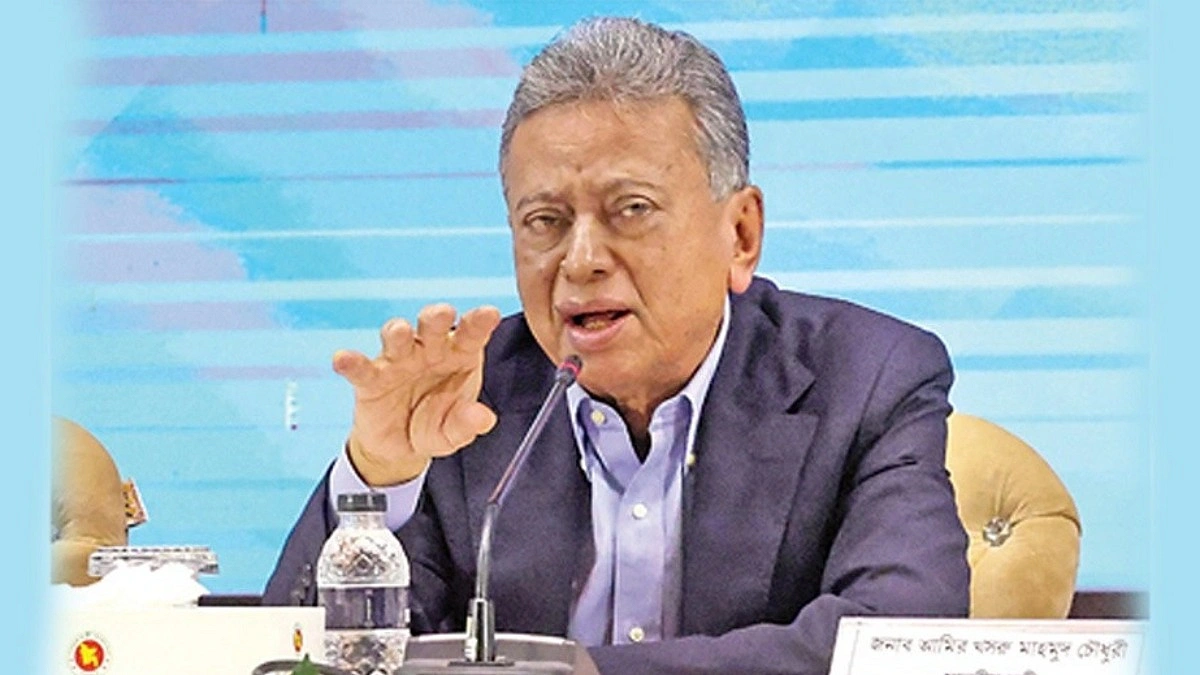
Photo: Agamir Somoy
Finance Minister Amir Khosru Mahmud Chowdhury is unwilling to view this year’s budget merely as a document for revenue collection and expenditure allocation.
He said that it is essentially an effort to change the economic philosophy - a blueprint for building an investment-based economy. At the centre of state policy will be the general public, the productive sector, and long-term reforms. The core philosophy of this budget is the democratisation of the economy.
Khosru made these remarks at a post-budget press conference on Friday. He highlighted the fragile reality of the country’s economy. He also explained the government’s strategy to tackle the crisis. Khosru answered various questions ranging from inflation control to the lack of confidence in the banking sector, salary increases for government employees, employment, and energy security.
Minister of Power and Energy Iqbal Hassan Mahmood, who was present at the conference, said that in the past, the energy sector was pushed into a trap of excessive import dependency.
Meanwhile, National Board of Revenue (NBR) Chairman Md Abdur Rahman Khan informed that no provision to legalise black money has been kept in the proposed budget. The Governor of the Bangladesh Bank stated that the crisis in Islami Bank would be resolved soon. There will be no problem for depositors to withdraw their money. However, he added that one-third of the deposits in the entire banking sector have been stolen.
Khosru said that it is not just a budget. Over the past few years, the economy of Bangladesh has faced multi-dimensional crises. Managing the economy is not easy given the global wars, supply chain disruptions, rising fuel prices, and weaknesses in the internal financial sector.
He noted that our resources are limited while demands are infinite; therefore, the most important question now is where spending will yield the greatest benefits. According to him, four factors have been prioritised for government expenditure: value for money, return on investment, job creation, and environmental sustainability.
Khosru said that the global economy has been in an abnormal state for three years. There was the Ukraine war, and now conflict persists in the Middle East. Consequently, the prices of fuel and food have risen in the international market. This will inevitably impact an import-dependent economy like Bangladesh.
According to him, weaknesses in the banking sector have also fuelled inflation. The looting in this sector has created a capital deficit. The cost of money has increased, and businesses are forced to operate with high-interest loans. Ultimately, a businessman adjusts his costs within the price of the product.
Khosru added that it takes a long time to start a business in Bangladesh. Various stages must be navigated, including company registration, approvals, and obtaining licenses. Time and money are wasted in these areas.
There are also inefficiencies and excessive costs in clearing goods from the ports. As a result, the overall cost of business increases. The government has undertaken reform programmes to eliminate these inefficiencies. He believes that if the cost of doing business can be reduced, it will have a positive impact on inflation.
Khosru said, “Market control is not possible through the police or mobile courts. Prices must be controlled through correct policy, efficient management, and long-term planning. If these reforms can be implemented, it will be possible to bring inflation under control.”
Responding to a question on whether corruption would decrease if government employees’ salaries were increased, Khosru mentioned that there is no scope to ignore reality. No new pay scale has been introduced for 11 years.
During this period, there has been inflation and the cost of living has risen. People’s needs have also grown. Khosru admitted that while there are multi-dimensional reasons for corruption, financial uncertainty is one element. He stated, “I am not saying that corruption will end just by increasing salaries. But if a minimum standard of living can be ensured for people, corruption will decrease to some extent.”
Employment
Khosru said that specific numbers were not mentioned in the budget. He remarked that saying five lakh jobs will be created without being able to ensure it in reality would not be a responsible statement. Employment is created through investment.
He stated that the government’s job is to create an environment where investment grows, industries expand, and entrepreneurs are encouraged to take risks. To this end, ICT, agriculture, health, small enterprises, skill development, and overseas employment have been identified as promising sectors.
Governor’s confession
Responding to a question at the press conference, the Governor of Bangladesh Bank Md Mostaqur Rahman said, “When we took charge, we saw that nearly one-third of the banking sector’s deposits had effectively been stolen.”
He added that the default loan rate is between 35 and 36 percent. He stated their first task was to prevent panic and keep the banking system functional. Their primary goal was to restore confidence so that people could go to the bank and withdraw money.
Regarding public panic over the banking sector, Mostaqur added that it is not right to put all banks in the same category. Some banks have liquidity crises, especially a few Islamic banks. He assured that necessary measures would be taken to ensure the security of people’s deposits.
Regarding the recovery of money laundered abroad, he mentioned the Stolen Asset Recovery Taskforce is at work. The success rate for recovering such assets globally is less than 2 percent and it takes seven to ten years. However, Mostaqur stated, “We will not give up our efforts. Those who have laundered money will be tracked down.”
Energy Security
Energy Minister Mahmood said that in the last decade and a half, domestic fuel exploration was not given sufficient importance. The country was pushed towards an excessive import-dependent system.
BAPEX was kept virtually inactive. Initiatives have now been taken to collect new rigs, increase domestic exploration, and search for gas in the sea. He added that despite the volatility in the international energy market due to the war in the Middle East, no major crisis occurred in Bangladesh.
Some complications arose with Qatar and Saudi Arabia, but supply was kept normal by collecting from alternative sources. He also informed that high-cost IPP contracts are now creating significant financial pressure. Many contracts were made in a way that makes it difficult to exit them easily. However, decisions will be made on these matters through legal review.
No opportunity to legalise black money
Regarding the opportunity to legalise black money, NBR Chairman Abdur said that no special provision has been kept in this budget to legitimise undisclosed money. However, he noted that in the past, many buyers and sellers displayed lower than actual transaction values during land and property registration.
This opportunity was created because the government-fixed “mouza rate” was much lower than the market value. Consequently, a portion of the actual money remained undeclared, effectively creating an opportunity to whiten black money.
Abdur added the government has now taken an initiative to bring the mouza rate closer to the actual market value.
