
Traders allege extortion, manipulation drive up commodity prices

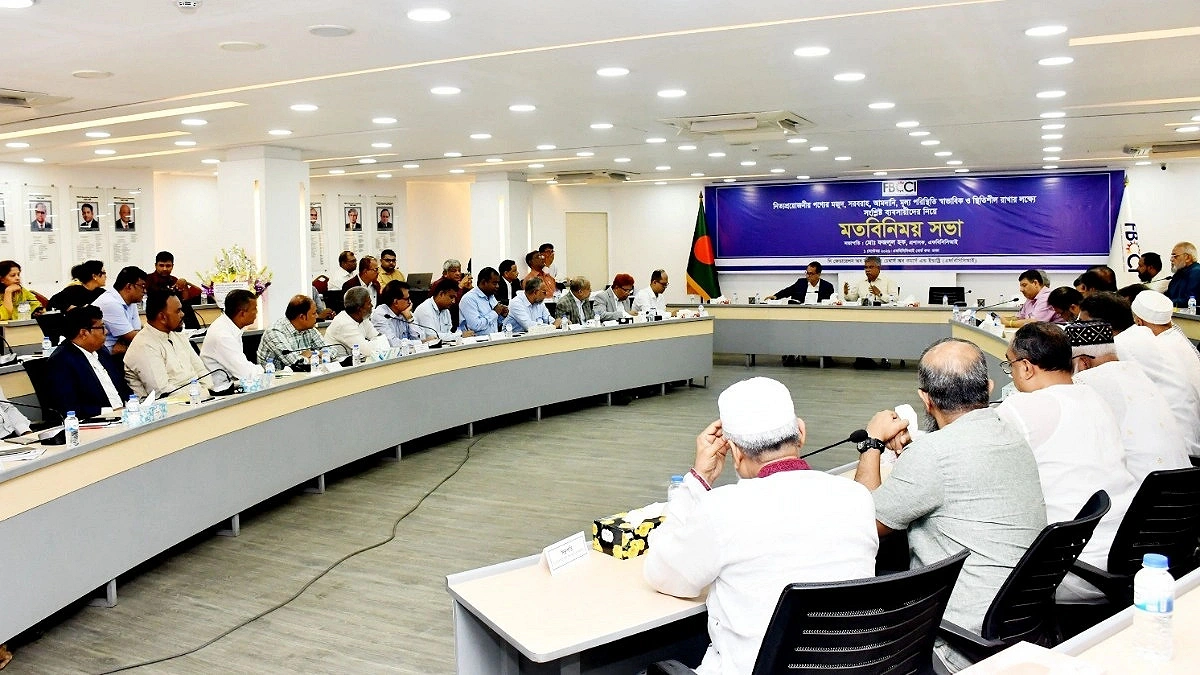
Collected photo.
Leaders from various market and trader associations in and around Dhaka have alleged that extortion on roads, the dominance of middlemen, and manipulation by dishonest syndicates are causing an abnormal surge in the prices of essential commodities.
At a view-exchange meeting held on Tuesday (September 1) at the FBCCI office in Motijheel, they said that ensuring effective and regular market monitoring could keep commodity prices stable during the upcoming Ramadan. Chaired by FBCCI Administrator Md. Fazlul Hoque, the meeting provided a platform for traders to highlight current crises in their respective sectors.
Abul Kalam Azad, Organizational Secretary of the Consumers Association of Bangladesh (CAB), said that due to extortion on transport routes and middleman interference in the supply chain, vegetables valued at Tk 30 per kilogram are reaching consumers at Tk 80 to Tk100.
Farid Uddin, President of the Shyambazar Agricultural Products Wholesalers Association, noted that market reputation is damaged by a few profiteers. He highlighted that despite no rice variety named "Miniket," corporate traders package Tk50 rice and sell it for Tk70. He added that middlemen extract up to 25% profit and alleged that police collect extortions at Shyambazar.
Addressing the issue of weak enforcement and regulation, Kazi Anisuzzaman, General Secretary of the Khilgaon (Taltola) City Corporation Super Market Owners Association, emphasized that increased surveillance would allow traders to do business comfortably.
Shawkat Hossain, a member of the Fakirapool Market General Traders Association, stated that every market has "controllers," and with every political transition, individuals affiliated with the ruling party take control of the markets.
Expressing similar concerns, Zakir Hossain, General Secretary of the Bangladesh Supermarket Owners Association, criticized the lack of monitoring, pointing out that prices jump from Tk50 to Tk 70 overnight due to an invisible syndicate directly affecting consumers' pockets.
Highlighting recent market trends, Bikash Chandra Saha, a member of the Pulse and Lentil Crushing Mill Owners Association, reported that prices of yellow split peas and chickpeas rose by Tk10 to Tk 15 per kg within 10 days, alleging market manipulation by some following cut in supply by City Group.
Jalal Uddin, President of the Bread and Biscuit Manufacturers Association, expressed his concern that rising raw material costs forced 20 factories to shut down in the last three months, leaving around 1,000 people unemployed. He warned that bread and biscuit prices could rise by 20% within the next four to five days.
Citing local-level extortion, Sohel Akhtar, Director of the Narayanganj Chamber of Commerce, said that a market in Narayanganj charges Tk 3,000 daily as vendor stall rent, an expense traders ultimately pass on to the consumers.
Golam Mawla, General Secretary of the Moulvibazar Traders Association, warned that operational crises have forced many businesses to close, consolidating market control into the hands of a few large companies. He cautioned that if closed factories are not reopened, shortages of edible oil and sugar will intensify.
Citing the global context, Taslim Shahriar, Senior Deputy General Manager of Meghna Group of Industries, said that despite the rise in sugar prices in the international market, the mill-gate price of the sweetner in the country currently remains stable.
Following the statements from the traders, FBCCI Administrator Md. Fazlul Hoque assured that instead of superficial market monitoring, effective measures would be taken to implement the traders' recommendations, and specific proposals would be submitted to the government to manage product demand during the upcoming Ramadan. He added that after holding discussions with relevant ministries and departments in October to control market conditions, another meeting with the traders would be convened.
At the event, Abu Saleh Mohammad Imran, Trade Consultant (Joint Controller) of the Ministry of Commerce, urged the media not to create unnecessary panic over commodity prices. He emphasized that decisions must be made taking into account the interests of both producers and consumers. Furthermore, he outlined plans to forecast market trends in advance by analyzing supply and demand data through artificial intelligence (AI) and modern technology.
